The first task or group concerns the semiotics of speech-alone talk. One of these would be about unveiling the hidden history of a word. This topic is addressed in chapters 2 and 12.
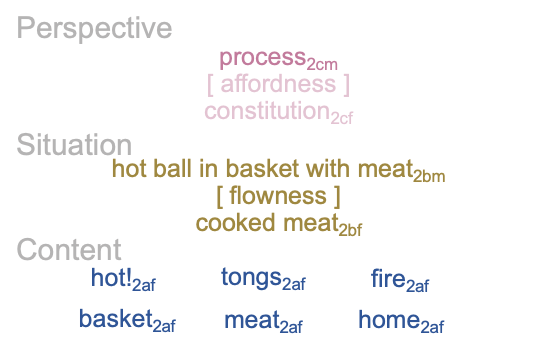
0089 Situations may encompass several contents, one for each thing2a. Recall, the normal context3a for each thing is structure3a and the potential1a is ‘disposition’1a. Key to the process2cm is the fact that raw meat2af needs to be cooked.
0090 Let me suppose the following.
A team slaughters one sheep and the family of each team member gets a cut. The archaeologist may build a model optimizing the slaughter of a sheep in terms of the number of families that get a cut of meat and organs. Surely, another team will tan the hide. Another team will process the bones for use as tools. Each team member has family and friends. Plus, each team member must make sure that the down-the-line processors get a cut.
This is why the situation-level forms entangles the perspective-level matter of “process2cm“. Humans depend on humans that know how to handle things. Even with an inconspicuous social hierarchy, social networks are active. Teams are crucial. Every child must compete to join one or more teams. The teams are specialized, not the individuals in the team.
0091 If some teams are more successful in obtaining calories than other teams, when why should a team cooperate with sharing their success with other teams?
That question could not be explicitly abstracted when Catal Hoyuk started. It could be explicitly stated before Catal Hoyuk ended.
The answer is that each team member shares success with family and friends.
0093 This question and answer is outside of the scope of Hodder’s conceptual apparatus. A sociological version of “entanglement” is simply not sufficient to ideate the noumenon that is responsible for the phenomena of an archaeological excavation, especially for a site such as Catal Hoyuk, which begins in one Lebenswelt and ends in another.
0094 Hodder reaches for something that he cannot quite grasp. In a subsection of S2C2, titled “reflective and non-reflective relationships with things”, the author discusses the distance between practical, everyday experience (such as cooking with hot little noumena) and abstract reflective thought (such as what occurs after the cook drops a hot clay ball and it rolls towards the pillar supported by the skull of the cook’s father, which reminds her of her brother, who has a sick child and cannot – by taboo – participate in today’s sheep slaughter, even though he is a member of the team).
0095 Forget the qualifier “abstract”. The qualifier should be “socially constructive”. The wayward ball may have been the ancestor’s way of reminding the cook to socially construct her brother’s condition into the process of dividing the cooked meat. There are always more mouths to feed than any slab of meat can accommodate. Happily, today’s hunk of meat is large. She puts an extra ball into the fire.
She knows that she is a little clumsy with the tongs.
0096 She is both cooking and engaging in reflective thought.
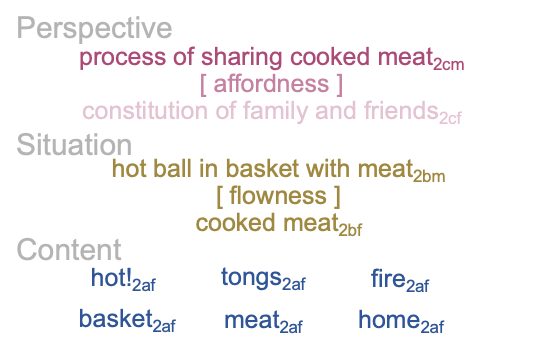
Here is a diagram.
0097 Note how the biological sounding term, “affordance”, is the contiguity between process2cm as matter and consitution2cf as form.
My example has already given away the fact that the perspective-level form2cf will entangle matter2am that brings the story back to the content-level. The cook’s family and friends are already constituted from prior affordances. Yet, the rolling of the dropped hot clay ball serves as a reminder. Think about your father, whose skull holds up this house.
0178 Chapter four (C4) is titled, “Things Depend on Humans”.
This chapter follows the break-out section on Catal Hoyuk.
0179 Over time, things fall apart. The author provides examples from England, where stone walls, marking the boundaries of fields, are inherently unstable. He describes the use of internal buttresses to stabilize walls in level III to I of Catal Hoyuk, as well as the Chalcolithic west mound (dating 6000 to 5500BC).
0180 To me, internal buttressing of walls may require explicit abstraction.
The smelting of copper probably entails specific recipes (serving as explicit abstractions).
The cylinder seals found at the site definitely indicate explicit abstraction.
0181 Nothing says, “Things depend on humans.”, like ownership.
That is what cylinder seals are all about. They are used to seal lists of goods as well as other documentation associated with ownership and transfer of ownership.
0182 Cylinder seals are things that depend on humans.
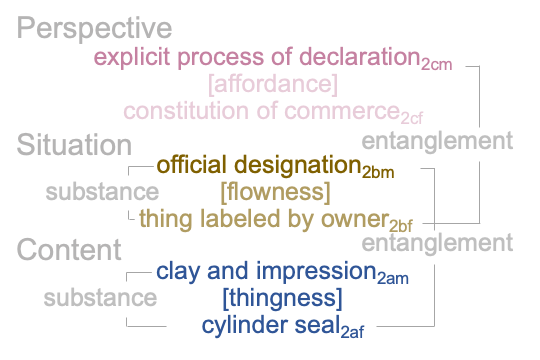
There are two confoundings in the following virtual nested form in the category of secondness.
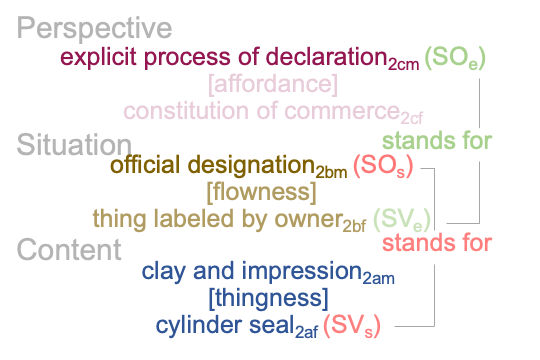
0183 In the first confounding, clay and a specific impression2am [thingness] a cylinder seal2af and the cylinder seal2af [entangles] the matter of an official designation2bm. Each element demands an explicit abstraction. What is the image on the seal? What does it designate?
In the second confounding, the official designation2bm [flowness] the embodiment of a thing that is labeled (with a sealed stamp) by its owner2bf and that label2bf [entangles] the matter of an explicit process of declaration2cm, that is, a process by which ownership is explicitly asserted.
0184 That is not all.
I already mentioned that sign-relations are built into the three-level interscope (points 150-156).
I explicitly detailed the specifying sign-relation.
0185 The two confoundings for cylinder seals correspond to the specifying (subscript “s”) and exemplar (subscript “e”) sign-relations. Here is a picture the sign-vehicles (SV) and sign-objects SO).
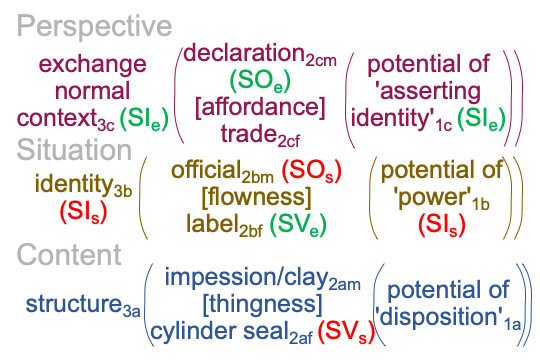
0186 Finally, all the elements of the specifying and exemplar sign-relations are labeled in the following three-level interscope.
0187 In the Lebenswelt that we evolved in, the elements of two sign-relations cannot be labeled with the gestural words of hand- or hand-speech talk. Instead, the sign-relations are simply performed. These sign-relations are adaptations into a niche composed of the potential of triadic relations. This biological proposal is set forth in Razie Mah’s e-book, The Human Niche (2018).
0188 In our current Lebenswelt,elements of the two sign-relations can be labeled with speech-alone words. The production of the seal (from thingness to flowness, so to speak) touches base with labor specialization. Not just anyone can fashion a cylinder seal for use. The embodiment of the label on a thing (from flowness to affordness, so to speak) touches base with social specialization.
0189 To me, the author – not even consciously – transits from a world where families build their own homes in a marvelously productive location (C2 and C3) to a world where social and labor specializations create things that depend on their… um… continued interventions to prevent the created things from falling apart (C4 and C5).
What was once an intrinsic manifestation of the three-level interscope of thingness, flowness and affordness shifts to extrinsically arranged specialties organized to maintain cultural traditions.
The intuitively obvious transitions into entrapment.
0191 The disciplines that deal with these topics include behavioral archaeology (S3C4) and material science (S2 and S3, C4).
0192 For example, these sciences try to figure out how the people of Catal Hoyuk dealt with refuse. These experts see attempts at refuse organization throughout the Levant in the PPNB. House floors are swept clean. Middens outside the settlement are established. This occurs without signs of social or labor specialization, long before the Ubaid of southern Mesopotamia appears on the scene.
0193 Behavioral ecology (S4C4) studies the domestication of plants and animals. Plant domestication is well underway before the sea-level rise. Cereals, lentils, fruit trees, and tubers respond to selective use and care by humans, consistent with Darwinian analysis. Humans offer a novel niche to plants and animals, because a relation with humans is an actuality that is independent of each adapting species. Plants and animals, in turn, offer niches for cultural adaptations.
One hand washes another, even in the biological realm.
0194 Mutuality is not exclusive to humans and plants and animals. For example, certain predatory fish will allow small grazing fish (otherwise an easy meal) to nibble parasites off their exteriors. It is a win-win situation. The predator gets rid of parasites. The grazing fish gets a meal and does not serve as a meal.
Of course, humans take “mutuality” to a whole new scale.
0195 Humans give food to the animals. Every type of animal is different. The humans read the signs that the animals offer.
A vast literature in behavioral and evolutionary ecology can be used to understand the phenomena of domestication. To me, these phenomena are observable and measurable facets of human adaptations to specifying and exemplar signs, which dwell within the three-level interscope that associates to Mariusz Tabaczek’s inquiry into classical and contemporary hylomorphism (points 0004 to 0012).
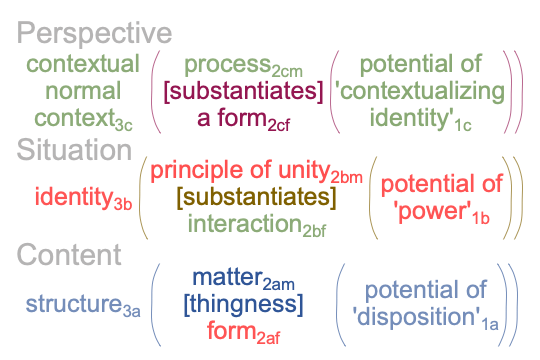
0196 In the following diagram, the specifying sign is rendered in light red and the exemplar sign is rendered in light green.
0197 In the specifying sign, a content-level form2af (SVs) stands for situation-level principle of unity2bm (SOs) in regards to identity3b operating on the potential of ‘power’1b (SIs).
In the exemplar sign, a situation-level embodiment2bf (SVe) stands for a perspective-level process2cm (SOe) in regards to a perspective-level normal context3c operating on the potential of ‘contextualizing identity’1b (SIe).
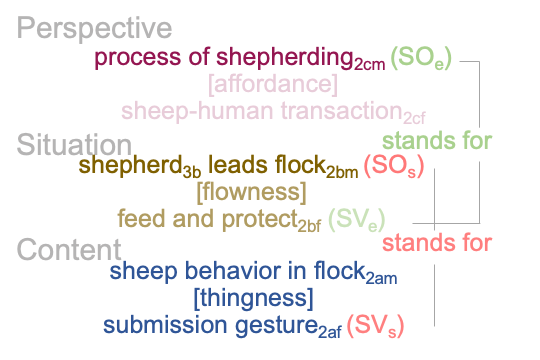
0198 For example, sheep perform a submission gesture, making it easy for humans to figure out how to become a leader of sheep. The sheep recognize their shepherd. Sheep are disposed to submit. The human whose identity3b is the shepherd2bm has the power1b to lead the flock2b on the basis of the way that he is able to read submission gestures2af.
0199 Animal domestication involves s human becoming pack leader and taking responsibility1c for feeding and protecting his flock2bf.
0200 In the specifying sign, the sheep’s submission2af (SVs) stands for the flock2bm (SOs) in regards to the shepherd3b operating on the potential of ‘human power’1b (SIs).
In the exemplar sign, the form of the feeding and protecting of the flock2bf (SVe) stands for a specialized way of living2cf (SOe) in regards to the normal context of animal domestication3c operating on the potential of ‘human responsibility’1c (SIe).
0201 On top of that, the process of serving as a shepherd2cm [substantiates by way of affordance] a human-sheep transaction2cf enacts the suggestion, “Give fodder to the animals.” (Genesis 1:30).
0202 The biblical reference is not an accident.
Domestication of animals implies that our kind adapts to the potential of ‘responsibility’1c.
0203 Does that connection appear in the vast scientific literature of human behavioral ecology?
Maybe, the connection may be winnowed from references to immediate and delayed return systems (S6C4).
Or, the connection pertains to the conclusion (S7C4) that things can be unruly, even when they depend on humans.
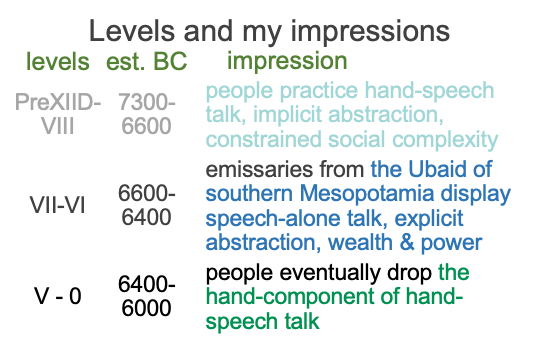
0220 The highest rate of sea-level rise occurs around 6800 B.C. That rise serves as a nominal starting pointfor the appearance of a speech-alone talking culture, on the cusp of experiencing trends towards unconstrained labor and social specialization.
By 6600 B.C., emissaries from the Ubaid may have contacted central Anatolia.
0221 Here is the timeline.
0222 By the time contact is made, Catal Hoyuk is 700 years old. Why would these settled, traditional folk adopt cooking with clay pots? Why would they be using cylinder seals a few hundred years later? These adoptions come from outside the community.
0223 The hypothesis of the first singularity provides a reason for why the Ubaid would be sending emissaries to distant settlements, such as Catal Hoyuk. They are traveling to preach the good news of a society, with wealth and power, willing to trade and eager to exchange ambassadors.
Plus, these emissaries practice speech-alone talk.
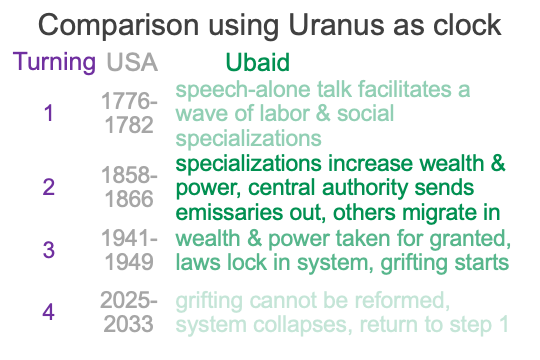
0224 Perhaps, I can measure time with the orbit of the first outer planet, whose unseen presence serves as a metaphor for a four-generation spiral of coming together, establishing permanence, falling down and surviving crisis. Uranus has a periodicity of 84 years. This period comes very close to the timeframe for the theory of the fourth turning.
Each orbit of Uranus corresponds to four human generations.
0225 For the USA, I date the start of a first orbit to the passage of Uranus through the constellation of Gemini, from 1776 through 1782. The years correspond to the American Revolutionary War. The second passage through Gemini contains the War of Southern Rebellion and the War of Northern Aggression, known today as “the Civil War”. The third passage covers the USA’s involvement in the Second Battle Among the Enlightenment Gods: The Hot War Among Fraternal Ideologies (1940-1945). The fourth passage begins… um… at the present moment.
0226 The USA may be a good analogy to the Ubaid of southern Mesopotamia because settlement by iron-bearing Europeans seems to expand into a power vacuum. The native Americans are stone age. The Europeans have greater wealth and power, due to their established labor and social specializations, as well as their tools and weaponry.
For the Ubaid, small cumulative advantages of explicit abstraction applied to everyday living may have had similar psychological impact on hand-speech talking cultures. The hand-speech talking people of Catal Hoyuk were taken by surprise by these speech-alone talking emissaries who seemed more advanced than themselves. The emissaries introduced clay pots for cooking. They offered recipes.
0227 Here is a list for the four passages of Uranus through Gemini for the USA and – what I imagine – the corresponding trends in the Ubaid.
0228 Emissaries from the second or third Ubaid passage may have made contact with Catal Hoyuk in their explorations. A parallel between the Ubaid and the USA may be drawn, at least in terms of metaphor and timing. It makes me wonder. How weird is that?
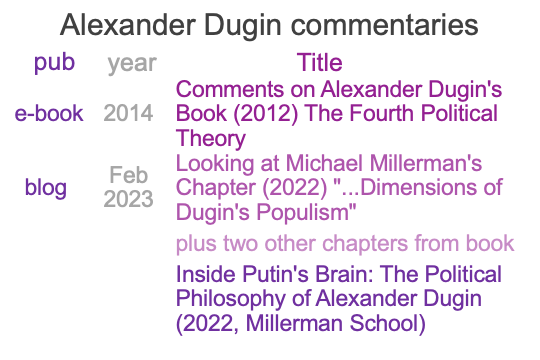
0229 Intimations of the adoption of speech-alone talk and the potentiation of civilization may be also found in contemporary Russian political theory, in particular, the writings of Alexander Dugin. Here are some of the commentaries by Razie Mah.
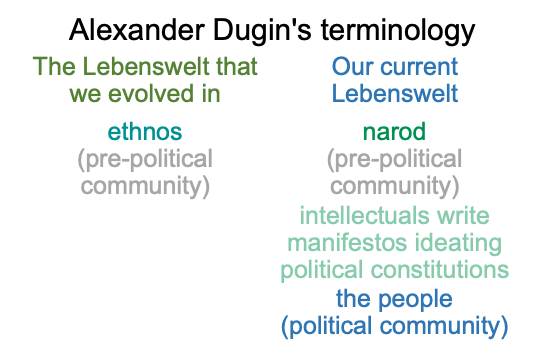
0230 Alexander Dugin’s terminology is telling. Today, we, the people are the focus of attention. This attention to the people stands in contrast to political theories about how to constitute a people. For the past century, three ideologies have gained sovereign power, these are capitalism (also called “mercantilism”), fascism and communism.
Each of these ideologies participated in propaganda and military wars of great intensity. Mercantilism draws the world into the First Battle Among the Enlightenment Gods: The Tragic War of the Naive Mercantilists (1914-1918). Fascism ignites the Second Battle Among the Enlightenment Gods: The Hot War Among Fraternal Ideologies (1939-1945). Communism and Capitalism dominate the Third Battle Among the Enlightenment Gods: The Cold War Among Materialist Ideologies (1945-1989).
0231 Dugin, writing after 1989, complains that these political theories failed to create a people worthy of the name. The intellectuals have failed. Capitalism, fascism and communism have been discredited.
The problem is that we cannot return to a pre-political community. He uses the Russian label, “narod”, to designate traditional culture, which is not really interested in power as a thing in itself. Rather, the narod is interested in well… having fun and pleasing the gods. For the Russian people, that means God, as well as the saints, as well as the priests and monks, as well as the old ladies who do not ignore what they witness.
0232 What is even more interesting, Dugin takes one more intuitive step. The narod, the pre-political traditional community in our current Lebenswelt, cannot return to its original condition. Just as a people cannot go back to their narods, a narod cannot go back the its ethnos, its pre-pre-political condition.
0233 Dugin’s surprising claim keys into the hypothesis of the first singularity. The narod belongs to our current Lebenswelt. The ethnos belongs to the Lebenswelt that we evolved in.
0234 The entanglements of the ethnos resolve into the thingness, the flowness and the affordness of adaptation into the niche of triadic relations, motivated by obligatory collaborative foraging and obligatory social-circle harmonizing.
The entanglements of the narod resolve into the thingness, the flowness and the the affordness that derives from the capacity of speech-alone talk to explicitly abstract each of the elements in the three-level category-based nested form, among other realities. These explicit abstractions create the entanglements… er… “entrapments” familiar to unconstrained social complexity.
Individuals in community are confounded, and who is not more prepared to diagnose the social illnesses and to propose clinical solutions (that will require sovereign power to enact) than political theorists? Who is more expert than an academically certified political theorist in proclaiming what a people should be?
0235 So what am I saying?
Chapters two through five (C2 though C5) subtly transport the reader from the Lebenswelt that we evolved in to our current Lebenswelt.
So do the levels of excavation at the remarkable archaeological site of Catal Hoyuk.
0261 In the e-work, The First Singularity and Its Fairy Tale Trace (2012), Razie Mah proposes that the late Neolithic is subject to two trends. The first is material and associates to the domestication of plants and animals. The second is semiotic and associates to a transition from hand-speech to speech-alone talk, initiated by the Ubaid of southern Mesopotamia.
To date (2026), archaeologists have focused only on the first trend. They are not even aware of the latter trend, even as a possibility.
0262 Why is this the case?
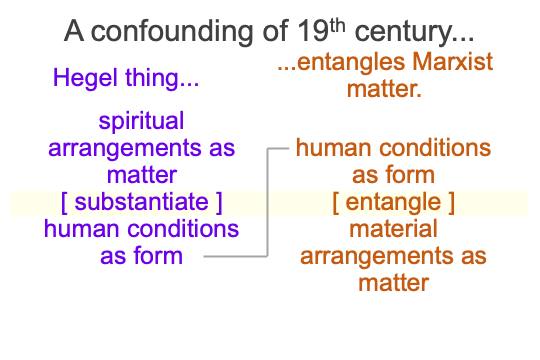
0263 As previously mentioned, Hegel’s thing entangles Marxist matter and the confounding resolves into a thesis and an antithesis for modern social science.
Here is a diagram of the confounding.
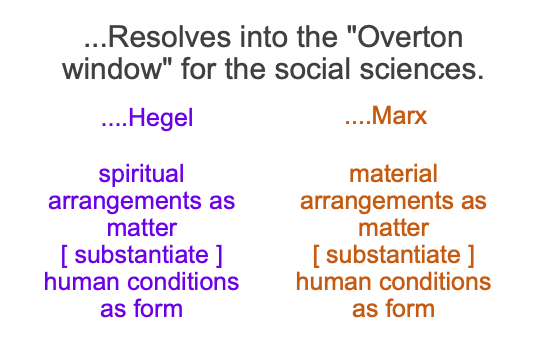
0264 The resolution of this confounding turns into the two limits of an Overton window for the positivist social sciences during the entire twentieth century.
0265 The Hegelian thing addresses adaptations in the style of social constructions. The emphasis is on symbolism. For example, a display of a recovered skull is labeled, “symbolic”, by many social scientists.
The Marxist thing addresses adaptations in the style of sensible construction. The emphasis is on dependencies, human-thing, thing-thing, thing-human and human-human.
0266 As far as I can see, Hodder’s work runs between these two end-posts.
0267 Are human conditions substantiated by way of spiritual or material arrangements?
Hegel says spiritual. Marx says material.
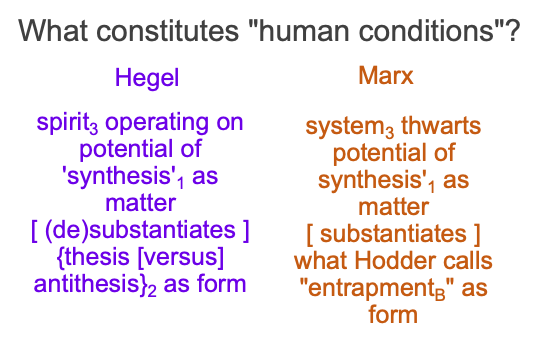
0268 Hegel’s and Marx’s things are reifications of fully triadic category-based nested forms. The normal context3 and potential1 are set as matter2m. The actuality2 serves as form2f. Since the category-based nested form for each thing is different, the human conditions2f are distinct, yet… may I say?… bound to one another.
0269 The spirit3 operating on the potential of ‘synthesis’1 as matter [(thwarts) the continuation of] the dyad of thesis in perpetual conflict with antithesis2 as form.
The system3 operating on the potential of ‘(thwarting) synthesis’1 as matter [maintains] entrapment in the condition where thesis and antithesis are never allowed to end2 as form.
0270 If Hegel’s and Marx’s things constitute one’s perception of what the noumenon must be, then that perception will influence what one observes and measures.
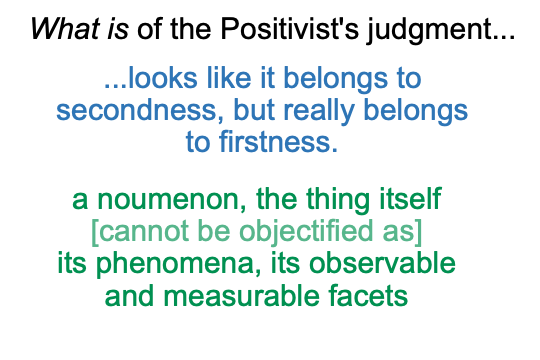
0271 The Positivist’s judgment is foundational for science, as discussed in Razie Mah’s four part e-book, Biosemiotics as Noumenon. The Positivist’s judgment contains three elements: what is,what ought to be and relation.
0272 Here is a picture of what is for the Positivist’s judgment.
0273 I now ask, “What happens when the Overton window anchored by Hegel’s thing and Marx’s thing characterizes what the noumenon must be?“
0274 Obviously, the researcher will look for particular types of phenomena.
For example, in an archaeological excavation, if material artifacts do not change over time, then the anthropologist will build models based on a system3 that excludes the potential of ‘synthesis’1.
If the anthropologist excavates phenomena that change over time, then models will reflect changes in outlook3, attitude3 and so forth.
0275 Consequently, I suspect that Hodder’s book attempts to portray a noumenon, with the goal of influencing which phenomena become salient during archaeological excavations.
0001 The full title of the book before me is Sumerian Mythology, Ancient Civilizations, and the Epic Search For Humanity’s Origins. That is a great title. This publication is the 13th in a sequence of 37 books downloaded into the Amazon product line between the end of July, 2025, and the start of January, 2026. This literary output is staggering.
0002 Plus, it raises a question in my mind.
How does one identify an artificial intelligence (AI) produced article or book?
0003 Every sentence is well constructed. The text is highly segmented.
Are these clues?
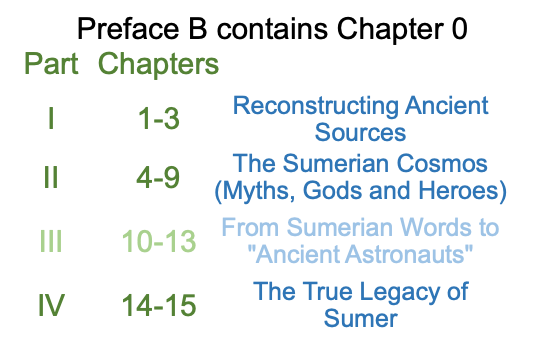
0004 For example, the preface divides into A (5 subsections) and B (1 subsection). Each subsection contains two paragraphs. The preface also includes additional material, C, informing the reader what to expect, why this is essential reading, and how this qualifies for understanding.
Of course, this is standard textbook formatting.
However, the two clues, well-constructed sentences and high segmentation, still apply to the question at hand.
0005 Here are some other clue.
Flat statements contain no wordplay. The entire book consists of (1) direct statements and (2) a negative followed by an affirmative. No, I don’t mean to be negative, it is obviously better to be positive.
Fractal repetitions appear within the book’s organization. For example, the preface’s B subsection constitutes (what may be called) “Chapter 0”, which recapitulates the topics of the subsequent 15 chapters.
0006 Here is a picture of the list of chapters.
0007 Even though the text itself does not state that it is AI generated, one may raise the question and ponder the clues. These clues do not prove an answer, one way or another. But, they do raise another question.
If the work at hand is AI generated, then what does that imply?
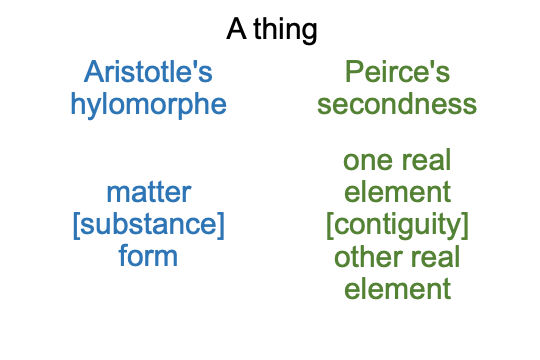
0008 The postmodern scholastic will start with Aristotle’s hylomorphe, which is an exemplar of Peirce’s category of secondness. These concepts may be derived from Razie Mah’s e-books A Primer on the Category-Based Nested Form and A Primer on Sensible and Social Construction.
The book that I have before me is a thing. A thing is composed of two contiguous real elements. For Aristotle, the real elements are matter and form. The contiguity is placed in brackets for clear nomenclature.
0009 Here is a diagram.
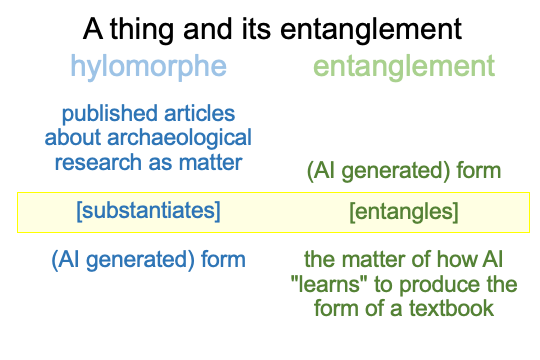
0010 My question as to whether the book is AI generated and what that implies is called “an entanglement”. The following diagram is sort of confusing (something that an AI would avoid), because two expressions are linked in that they have the same form.
0011 In the hylomorphe, describing the book before me, the phrase, “AI generated”, is put into parenthesis because the question remains open. The form is a book.
In the second (upside down, so to speak) thing, the (AI generated) form entangles another matter. That “other matter” is a question about how the AI learns what it is going to say. Obviously, the answer will include the originating matter. One may wonder, “What else?”
A thing and its entanglement consists in two matters (one originating and one entangled) and one form. The technical name for this pair is “confounding”.
0012 With the above confounding in mind, I may consider Chapter 1.
Here is a list of the learning objectives.
0013 This list suggests that the search for humanity’s origins, involving the Sumerian civilization and its mythology, arises in response to the precarious and fertile landscape between the Tigris and Euphrates Rivers. Annual floods from both rivers deliver silt. They can also deliver floods and destruction.
Excavations at locations in southern Mesopotamia find strata associated to floods during the Ubaid, Uruk, and Sumerian Dynastic archaeological periods.
0014 The irrigation systems control the rivers and redirect their water into productive agricultural uses. These systems require large scale labor under central (yet local) authority.
0015 To me, these conclusions are precisely what an AI program would deliver, after processing the literature (web-pages) cited at the end of the chapter. But, these are my suspicions. I have no proof.
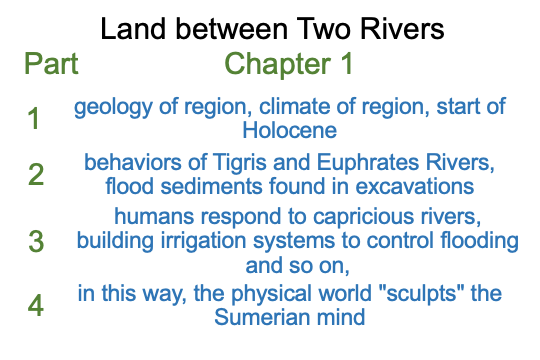
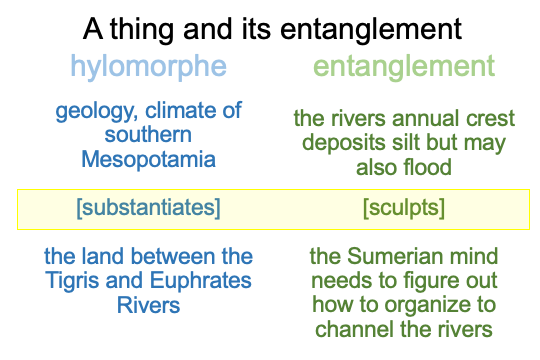
0016 However, I can construct a confounding. There is one form, the land between the Tigris and Euphrates Rivers. These rivers are subject to annual crests that deposit silt and may cause catastrophic flooding. The originating matter is the geology and climate of southern Mesopotamia during the Ubaid, Uruk and Early Sumerian Dynastic archaeological periods. The entangled matter is the mind of the Sumerian people, who celebrate the mythology that this book addresses.
0017 Here is a picture of the confounding.
0018 The confounding leaves this reader with a hypothesis. Sumerian mythology is an ideological component of an organizational imperative. The Sumerians must figure out how to organize to channel the rivers in order to irrigate their fields and to avoid catastrophic flooding.
In the process, the organizational imperative captures the Sumerian imagination.
What other conceptual apparatus congeals when Neptune is in Aries and then blobs out in the same zodiac sign, one orbit of Neptune later?
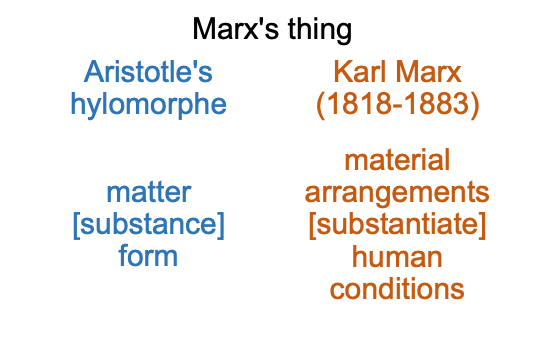
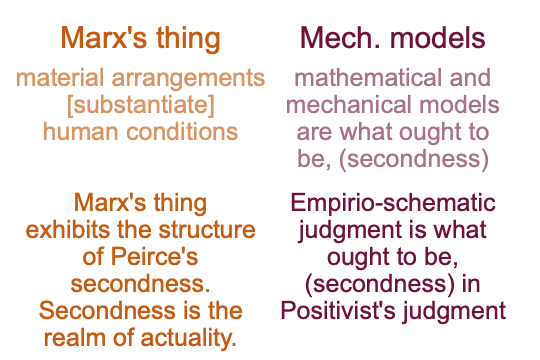
0140 Here is a picture of Marx’s thing.
0141 Marx’s thing is not a mathematical or mechanical model. It is a variation of Aristotle’s hylomorphe, which is an exemplar of Peirce’s category of secondness. Secondness is the realm of actuality. The realm of actuality is subject to the logics of contradiction and non-contradiction. The realm of actuality is what science is all about.
Remember that the mechanical philosophers are writing in Europe around 1600s, near a peak of Neptune’s cycle that passes through Aries in 1533-1548 and then in 1697-1706. This Neptunian cycle concerns literalism. Literal references [substantiate] spoken words. I call this hylomorphe, “Martin Luther’s thing”.
0142 A sea change starts with the Reformation (1533-1548) proclaiming that literal interpretation of the Bible (translated into the person’s vernacular) is to be preferred to the Catholic’s literal, allegorical, moral and anagogical approaches.
The sea change overflows the dikes by the time Neptune enters Aries again. Pierre Bayle (1647-1706) publishes Dictionnaire Historique et Critique (1697) with copious and often secret messaging footnotes. John Harris (1667-1719) publishes Lexicon Technicum, the first with all the accoutrements of a modern encyclopedia. The modern dictionary is a tribute to Luther’s thing. If literalism is real, then aren’t dictionaries necessary?
What is more literal than a dictionary?
At the height of this sea change, mechanical philosophers (around 1600) design the empirio-schematic judgment. This judgment is a triadic relation. A literalist disciplinary language (relation, thirdness) brings mathematical and mechanical models (what ought to be, secondness) into relation with observations and measurements of phenomena (what is, firstness). Dictionaries and encyclopedia are demanded by disciplinary languages.
0143 Baruch Spinoza (1632-1677) is the precursor to what comes together during the next Neptune in Aries (1697-1706). If literalism is real, if literal references [substantiate] our spoken words, then we can be rational in ways that people have never really been rational before. Gottfried Leibniz (1646-1716) proposes a systematic rationalism, which rises to the formulation of the Positivist’s judgment, which contains the empirio-schematic judgment as what ought to be.
0144 What is the Positivist’s judgment?
A positivist intellect (relation, thirdness) brings the empirio-schematic judgment (what ought to be, secondness) into relation with phenomena (what is, firstness).
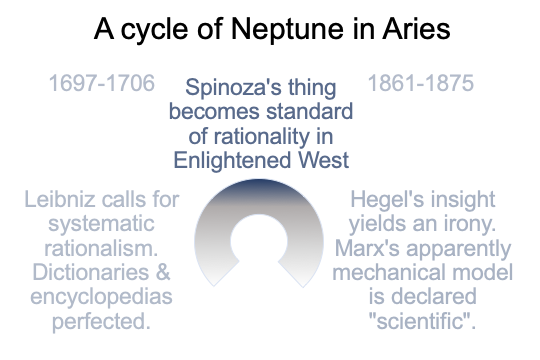
When Neptune is in Aries between 1697 and 1706, the relationship between faith and reason is a topic of intense interest. Scientific reasonas a manifestation of literalism (as opposed to religious reasoning) arises from the sea of uncertainty and sets the stage for further developments. The western Enlightenment is going to be the high-point of the coming cycle (1697 to 1861). I call this Neptune-in-Aries cycle, “Spinoza’s thing”.
0145 Here is a picture.
0146 Both Immanuel Kant (1724-1804) and Georg Wilhelm Friedrich Hegel (1770-1831) write between the emergence and submergence. In a way, they represent how Spinoza’s thing, actualized by Leibniz during Neptune’s passage through Aries, reaches its peak as well as its point of manifesting the contradictions that will lead to its submergence.
In the descent, Karl Marx (1818-1883) proposes a dyadic structure that substitutes for a mathematical and mechanical model. In other words, Marx claims that his dyadic model is scientific. At the start of the next passage of Neptune through Aries, the Paris Commune proclaims Marx’s thing as the scientific model that must be taken literally by their international movement. This international movement captures the imagination… er… “empirical interest”… of the burgeoning social sciences.
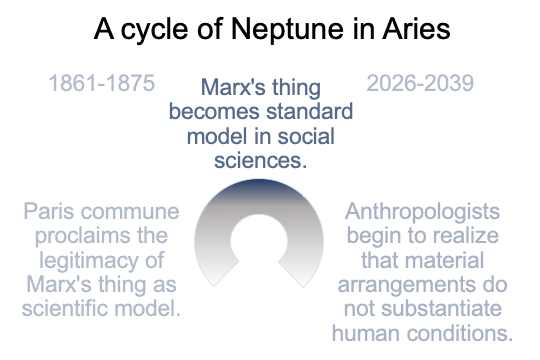
0147 Here is a picture of the next cycle for Neptune in Aries, which comes to its submergence at the current moment (1861-2026).
0147 For this cycle, one may ask, “Is Marx’s thing really a scientific model? Or is Marx somehow gaming the Positivist’s and the empirio-schematic judgment?”
0148 The answer begins with the question, “What is a judgment?”
A judgment contains three elements, relation,what ought to be, and what is. When each element is assigned a unique Peircean category, then the judgment becomes actionable. Actionable judgments unfold into category-based nested forms on the basis of the categorical assignments.
0149 What are the Positivist’s and empirio-schematic judgments?
The Positivist’s judgment consists of a positivist intellect (relation, thirdness) bringing an empirio-schematic judgment (what ought to be, secondness) into relation with the dyad, {a noumenon [cannot be fully objectified as] its phenomena} (what is, firstness).
The empirio-schematic judgment, in turn, consists of a disciplinary language (relation, thirdness) bringing a mathematical or mechanical model (what ought to be, secondness) into relation with observations and measurements of phenomena (what is, firstness).
0150 Here is the trick.
Marx’s thing has the structure of Peirce’s secondness. Secondness consists of two contiguous real elements. The real elements are material arrangements and human conditions. Secondness is the realm of actuality.
Mathematical and mechanical models belong to what ought to be in the empirio-schematic judgment. And, what ought to be is assigned to the category of secondness. Observations and measurements belong to the category of firstness. Disciplinary language belongs to the category of thirdness. These assignments place mathematical and mechanical models into the realm of actuality.
Also, the empirio-schematic judgment belongs to what ought to be and is assigned to the category of secondness in the Positivist’s judgment.
0151 So, why would a dyad that belongs to secondness not effortlessly glide into a slot that is twice imbued with that category?
0152 Who is so fixated on the natural sciences as to notice that Marx’s thing is not exactly a mathematical or mechanical model?
Only natural scientists would notice. Those that do are shunned by social scientists.
0153 Meanwhile, social scientists bend over forward in order to apply rigorous statistical criteria and analysis to their materials and methods sections, as if statistical manipulations are equivalent to mechanics and mathematics.
Precisely how does an inquirer demonstrate that the Marxist thing (as a scientific model) does not work because there is a flaw in its mathematical or mechanical formulations?
Indeed, phenomena are observed and measured selectively in order to support the appearance of mathematical or mechanical certainty characteristic of the physical sciences.
0154 Even more disheartening, statistical models constructed on selective observations and measurements of phenomena are crucial for the publications that administrators count, as if each publication is a data point that goes into a model of “academic productivity”.
0155 No wonder young professional archaeologists are exhausted.
0249 Chapters 11, 12 and 13 are devoted to debunking an agenda, called “the ancient astronaut theory”, proposed by various hucksters starting in the 1950s. This theory is multifaceted, since there is more than one proponent. Basak’s book says that the theory sweeps into public popularity because of the uncertainty following the second battle among the Enlightenment gods, the hot war among fraternal ideologies (1938-1945 AD) and leading into the third battle among the Enlightenment gods, the cold war among materialist ideologies (1945-1989).
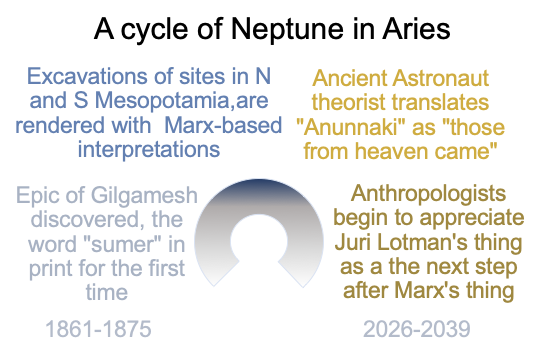
0250 Against this interpretation, which explains this social phenomenon in terms of a model where material arrangements after the Second World War and the start of the Cold War [substantiate] conditions ripe for scam-ideas about ancient civilizations, I place a Lotmanist suggestion that the social popularity of the ancient astronaut theories is accounted for by the inadequacies of Marxist-interpretations of archaeological research into the Neolithic period.
0251 Here is a picture of the framework of the latest cycle of Neptune in Aries.
Highly successful excavations by Western archaeologists offer the promise of coming to terms with the rise of ancient civilizations, based on Marxists formulations.
The Marxist thing does not quite do the job, so alternate theories are proposed by hucksters anticipating an explanatory breakthrough. Basak’s exercise in debunking the very entertaining alternatives only replays the Marxist thing. Basak relies on the Marxist thing to debunk the alternatives that arose from the lack of explanatory power of the model that material arrangements [substantiate] human conditions.
Now, anthropologists are starting to realize that all those people who entertained the now-debunked “ancient astronaut theory” were not as stupid as the Marxist thing presumes.
0251 Once again, Razie Mah’s four part blog, Looking at Melinda A. Zeder’s Article (2025) “Unpacking the Neolithic”, offers insights. The results of anthropological research into the so-called “Neolithic” does not… indeed, cannot… account for another trend hidden within the data. That trend is towards unconstrained social complexity. Basak’s AI program (my speculation, of course) trains only on results and discussions produced by researchers interested in looking for the material arrangements that substantiate neolithic conditions. They cannot account for a change in semiotic practices. They cannot account for what Razie Mah’s hypothesis of the first singularity suggests.
0252 Therefore, why not postulate ancient astronauts?
Surely, ancient monumental constructions, such as pyramids, stone circles, and tracks of figures that can only be seen from the sky indicate ways that civilizing humans communicate with these alien beings.
0253 If this is not a cry for a semiotic accounting for the emergence of unconstrained social complexity, I don’t know what is.
0254 Chapter 14 offers a standard summary of the achievements of ancient Sumeria.
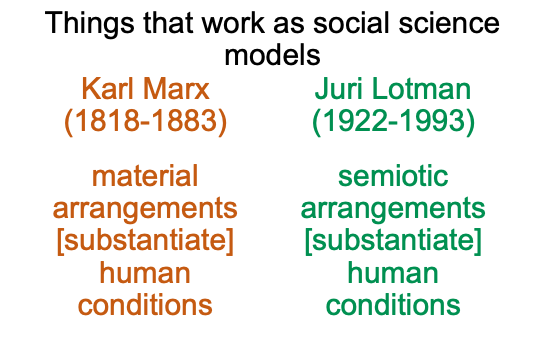
0255 Chapter 15 returns to the topic of the Sumerian creation myths. Once again, the text re-iterates established points. On one hand, the Marxist thing can provide an explanation that cannot be challenged because… well… it is supposedly just like a mathematical or mechanical natural science model. On the other hand, the Marxist thing cannot account for the emergence of unconstrained social complexity in southern Mesopotamia.
Lotman’s thing can.
0256 Here is a picture.
0257 Although this pair of options may appear stunningly simplistic, the ancient astronaut theory shows that stunningly simplistic can work. It can offer an off-ramp to the current academic highway of a publication-based arms race, where young professional archaeologists struggle to pass through the substance called “tenure” only to realize that they have merely passed from antithesis to thesis (see points 0124-0128).
0258 Beck et al.’s manifesto, “Changing the Landscape of Archaeological Publishing” (Current Anthropology 67(1) (2026), https://doi.org/10.1086/739789), is well worth contemplating as a marker for the end of one Neptune in Aries spiral and the beginning of another.
0001 The book before me is published by Fidelity Press. The subtitle is “The Rise, Fall and Return of American Identity”. The author is editor of Culture Wars Magazine. And, everyone knows what “culture wars” means.
For students who are pursuing Semiotics and History, please have a copy of this book at hand. Look at the title and read the table of contents. The instructions in this examination should be clear.
Dr. E. Michael Jones, the author, reads and comments on literature from a Catholic point of view. His works are iconic, in so far as he is orthodox. “Ortho” means “right”. What about “dox”? Here, I mix terminology. Orthodox love icons. You know, those paintings that adorn the churches with names like “Saint Basil’s”.
0002 Of course, for the semiotics of Charles S. Peirce, an icon is one of three types of natural signs. An icon is a triadic sign-relation whose sign-object is based on the qualities of similarity, imagery, pantomime, likeness and so on. In other words, an icon offers a sign-vehicle that allows me to visualize its sign-object.
0003 But what about the icon rendered in E. Michael Jones’s text?
What about the icon on the wall of St. Basil’s?
Razie Mah’s blog appearing in January 2025, Looking at Boris Uspenskij’s Article (2016) “Semiotics and History”, contains a hypothesis about Russian icons.
0004 Boris Uspenskij (1937-present) is a Soviet era expert on Slavic literature who, along with Juri Lotman (1922-1993), proposes that semiotic arrangements substantiate the human condition. He does so in the 1990s, after the Soviet political system lost all credibility. The Soviet system enshrined Marx’s slogan: Material arrangements substantiate the human condition. How well did that thing work?
0005 Boris Uspenskij’s journey into semiotics begins in the 1950s, when the Soviet empire is intimidating and everyone senses that Marx’s slogan applies. After all, it sounds so scientific.
Uspenskij wants to offer a materialist explanation for the power of Russian iconography. Russian icons are portraits and scenes painted on the foreground with a background of thinly hammered gold foil. Uspenskij figured that icons are meant to be viewed by candlelight. The flickering light of candles produce the aesthetic effect associated with Russian icons.
0006 Of course, this is a materialist explanation for Russian iconography, fully congruent with the central slogan of the Marxist thing: material arrangements [substantiate] human conditions.
However, from the Korean War until the fall of the Berlin Wall, Uspenskij (along with Lotman) reach the conclusion that Marxism does not have the vocabulary to explain Slavic literature. Instead, they figure out the aesthetic effects of Slavic art by using the vocabularies of semiology and structuralism.
“Figuring out” means “bricolage”. They practice what they figure out. The vocabularies of semiology and structuralism hammer out a model. Then, when the form of the work of art is viewed in the flickering light of that model, an aesthetic effect is reproduced as matter. The work of art entangles the contemporary language of the positivist mind.
0007 In the flickering illumination of a semiological and structuralist model, the work of art begins to speak to the viewer.
The Tartu-Moscow School of Semiotics is discussed in Razie Mah’s blogs, spanning from December 2025 to May 2026. These blogs initialize an online course titled “Semiotics and History”. See Razie Mah’s blogs for October 3-6, 2025 for an introduction.
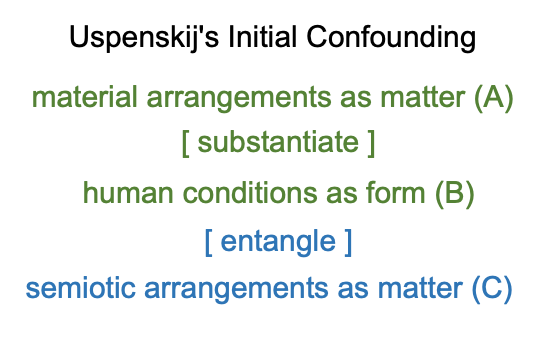
0008 This is confounding.
“Confounding” is a technical term, labeling a single form (B) that originates from one matter (A), yet entangles another matter (C)
A historical literary text (or a work of art, such as a Russian icon, A&B) becomes a form (from the perspective of a semiological and structuralist model, B alone) that entangles a voice (matter within the viewer, speaking to the viewer, in a contemporary vocabulary of meaning, presence and message, C).
0009 A as matter [substantiates] B as form. {A[&]B} constitutes a thing.
B as form [entangles] C as matter. {A[&]B[entangles]C} is a confounding.
0010 The question that I pose is this.
Does Dr. E. Michael Jones construct a similar cognitive apparatus in the USSA, during the years preceding the collapse of its big government (il)liberal and neoconservative Marxist ideations?
0011 I know what you are thinking.
USSA?
United Sycophantic States of America?
I love acronyms.
But, what the hell is a “sycophant”?
Okay, the author has another word that begins with “S”.
0027 The Tartu-Moscow School of Semiotics grows within the repression of the USSR then blossoms with the fall of the Soviet empire. Boris Uspenskij and Juri Lotman participate in that end-of-an-era flourishing. That is the end of the story. What about the start?
Uspenskij and Lotman begin their careers in Slavic studies by proposing atheist materialist explanations for the nature of Russian (and Slavic) literature. Uspenskij’s model of the candle-illuminated Russian icon is an example. However, the vocabulary of atheist materialism proves inadequate, so they supplant their explanations with semiology and structuralism.
0028 This fits the pattern of a confounding.
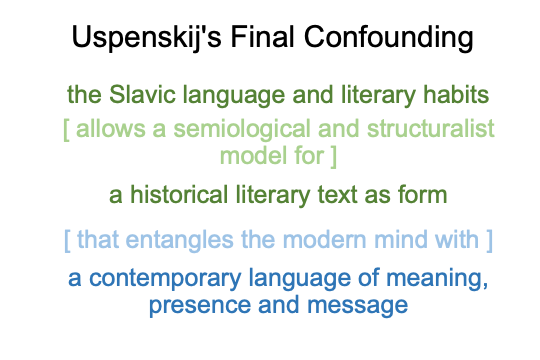
0029 By the time the USSR ends (along with the incentives for atheist material explanations), their confounding is refined into the following script for inquiry into aesthetics.
0029 This is not the same as the original confounding.
Instead, the above figure matches Uspenskij’s original insight arguing that Russian icons should be regarded in candlelight.
B: The form is a literary historical text (which is like the Russian icon).
A: The originating matter is the Slavic language and literary genres (which is like the material for the substance of the flame of a semiological and structuralist model).
C: The entangled matter is a contemporary (and, yes, academically inclined) language of meaning, presence and message.
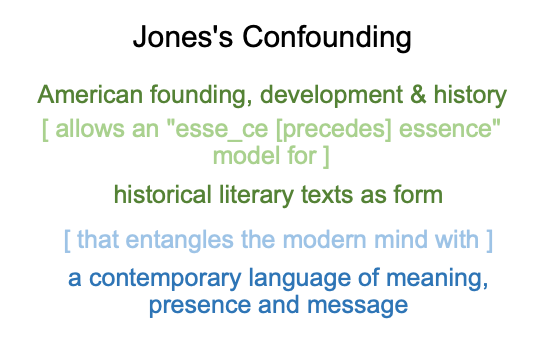
0030 Independently, E. Michael Jones learns to practice these steps in the USSA, using a model that is not associated with semiology or structuralism.
0031 To me, the parallel is striking.
The Tartu-Moscow School of Semiotics develops a practice that coheres to the categorical structure of a confounding. They do so in order to plumb the beauty and insights of Slavic arts and literature. Yet, no one in that school explicitly articulates that structure.
Similarly, E. Michael Jones develops a practice that coheres to the categorical structure of a confounding. He does so in order to plumb the charisma of the American identity, as expressed historically in its arts and literature. Yet, he does not explicitly articulate the structure of the confounding.
0032 I wonder, “What is the esse_ce that calls forth the essence of the title of this book?”