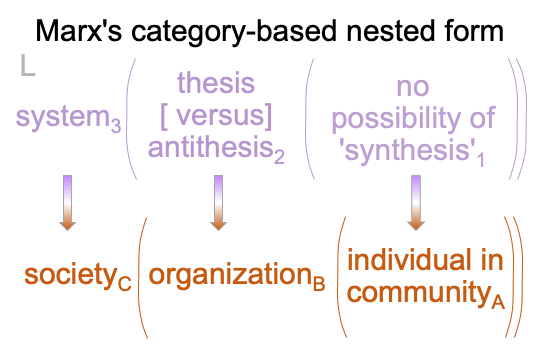
0128 The lower category-based nested form (L) describes a civilizational stasis that Marx instantly recognized.
If Hegel’s spirit3 operates on the possibility of ‘synthesis’1, then a civilization-exploiting elite3 will try to ensure that there is no possible resolution1 to the social conflict2 that their party benefits from.
0129 An elite party infiltrates institutions in societyC. Then, elite institutionsC promulgate a thesis that calls for individuals in communityA to join organizationsB that are under management by the elitesC. Individuals resisting material and instrumental exploitation in an organizational setting produce the antithesis, which unfortunately, gets co-opted by the elite.
0130 So, a thesis is promulgated by elites and its antithesis is co-opted by elites. The result is that the spirit3 cannot constellate a synthesis1. The system3 continues as long as there is no potential for a ‘synthesis’ that collapses the promulgated thesis and its co-opted antithesis.
Perhaps, the best way to thwart the spirit3 is to obsessively focus on material arrangements.
Imagine someone so twisted as to propose that material arrangements are … um… spiritual arrangements.
Imagine the education required forth that.
0131 To me, the downside of Hegel’s nested form (that is, the Marxist nested form) overlays a three-tier nested form, where the societyC tier brings the organizationB tier into relation with the potential of ‘the individual in communityA tier‘.
Hmmm, maybe I am off target in that impression.
The condition of the individual looks bleak, to say the least.
0132 The upper and lower (U and L) category-based nested forms can reify into things. Clearly, Hegel’s and Marx’s things are different, because each focuses on one or the other version of two entangled category-based nested forms.
0133 I derive Hegel’s and Marx’s things from their category-based nested forms for two reasons.
First, the discussion shows that not all confoundings resolve into interscopes. There are many ways for a confounding to resolve. For this reason, confoundings can present opportunities and dangers.
Second, Hodder’s argument is bound between these two things.
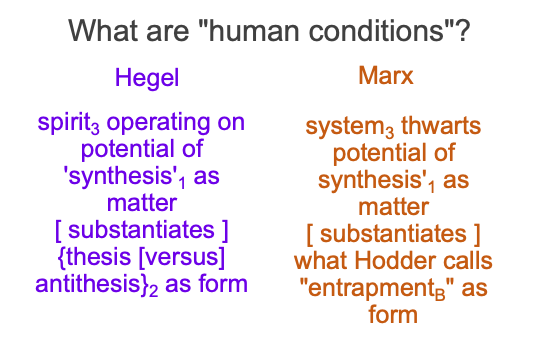
0134 In other words, Hegel’s and Marx’s things2c constitute the Overton window2a for Hodder’s discussion of entanglement as a principle of unity2bm.
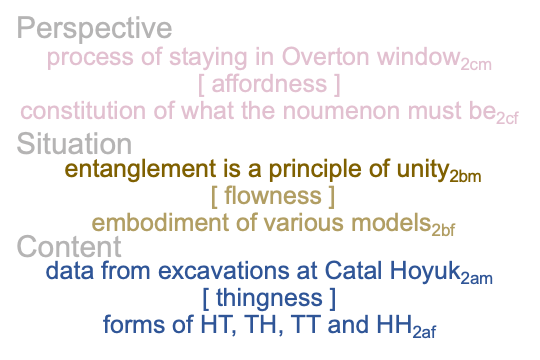
0135 Of course, my digression into the phenomenology of Hodder’s early chapters, may seem a little shocking, especially the part about the author’s cognitive processing2cm staying within the bounds of an Overton window framed by Hegel and Marx.
0136 To me, the text tells the tale.
For example, the title of chapter 2 (C2), “Humans Depend on Things”, reflects Hegel’s thing, because humans provide the spiritual3 (or cognitive3) synthesis1 that substantiates processes (theses) in the face of difficulties (anti-theses)2.
The titles of chapter three (C3), “Things Depend on Other Things”, and four (C4), “Things Depend on Humans”, reflects Marx’s point of view, because the interdependence of established things and the vulnerability of established things draw people into organizationB.
The title of chapter five (C5) “Humans Depend on Humans” completes the transit from Hegel to Marx by suggesting that a systemC that thwarts the potential of ‘escaping from a sociological entanglement’A transforms entanglementB into entrapmentB.
0137 Read on, because the path from Hegel to Marx overlays a much more significant, semiotic, turn.