01/1/26

Looking at Melinda A. Zeder’s Article (2025) “Unpacking the Neolithic” (Part 3 of 4)

0031 The story does not end here.

This is what the article under examination is all about.

0032 The formal cause for Braidwood’s actuality2 involves the normal context of novel interglacial ecologies3.  The neolithic archaeological period flowers at the end of the previous ice age.  New ecologies allow humans to figure out how to live in one location and engage in domestication.  The substance of [location & domestication] defines the essence of the neolithic human condition2f.

The final cause might be labeled ‘settling down’.  Complementary seasonality1 (different ecologies assessible at one location) and insurance1 (through domestication) support efficient causes that cohere to the final cause of ‘settling down’1.  

0033 Indeed, complementary seasonality and domestication may be reified into the contiguity between the real elements for Braidwood’s material arrangements2m and neolithic human conditions2f.

As soon as this is done, then the normal context3 of interglacial ecology3 is destabilized.  An interglacial ecology3 does not contextualize the final cause that arises from the potential to ‘settle down’1.

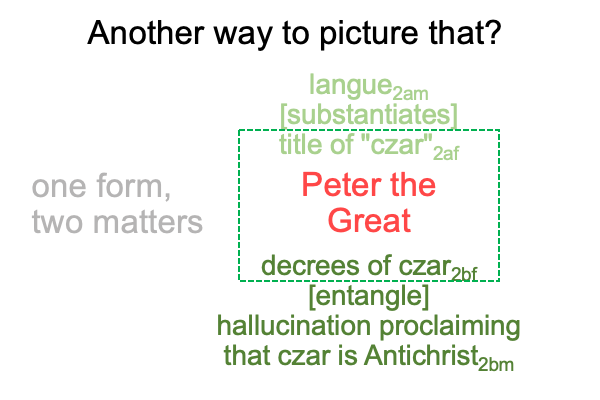
0034 Here is a picture.

0035 Although, the author’s history of “neolithic” (A) does not articulate the resulting confounding, the storyline suggests the following.

0036 The matter of a bauplan, a fairly well conceptualized unfolding pattern (such as embryo development) seen over and over in evolutionary biology, is now entangled with the form of the neolithic condition.

This is the agenda hidden within the article under examination.  The idea of bauplan is introduced in the third section (C), but the idea colors the presentation of current information about neolithic emergences throughout the world (B).

Or does it?

0037 Of course it does, because the author’s interest shifts from the efficient causalities that rely on the potentials1underlying sedentism2, that is, complementary seasonality1 (at one location) and insurance1 (in the style of domestication), to final causalities such as ‘settling down’.  Why would a species that is used to traveling settle down?  Well, certain locations offer the proper affordances.

However, these locations cannot be recognized and the affordances cannot be cultivated if there is no… how to say it?.. unfolding of ‘something’ within the species (humans) that is settling down.  Can location somehow consolidate human social circles?  Can plants and animals apply to the potential of settlement1?

These are very good questions.

0038 The evolutionary biologist who retains an interglacial ecology3 as the normal context for the neolithic condition2fcannot explain the development of ‘something’1 implicit to the archaeological data (B).

0039 What is the bauplan?

The bauplan3 situates the interglacial3 in so far as the emphasis shifts from efficient causes, where ecological and environmental features of the interglacial1 potentiate material arrangements2am, to final causes, where the substances of enhancing complementary seasonality (say, by building sheds to store food) and actualizing domestication (say, by doing what the animals and plants want them to do) makes2 the neolithic… um… “revolve”.

0040 Or, maybe, I should say, “Spiral.”

“Spiral” portrays the character of final causality, every bauplan unfolds according to the intentions built into the formal design.  Efficient causes do not have to be coordinated.  They only need to influence one another, as if trying to achieve the same ends, for the bauplan to spiral into actuality.

0041 The author frames her proposal that the normal context3 is (some sort of) bauplan3 with the term, “middle way”.  The middle way covers the span from the start of a spiral to its terminus.  The spiral starts in our current interglacial with a change in stone tools2m, along with all sorts of other arrangments2m, working to actualize the potential of ‘settling down’1.

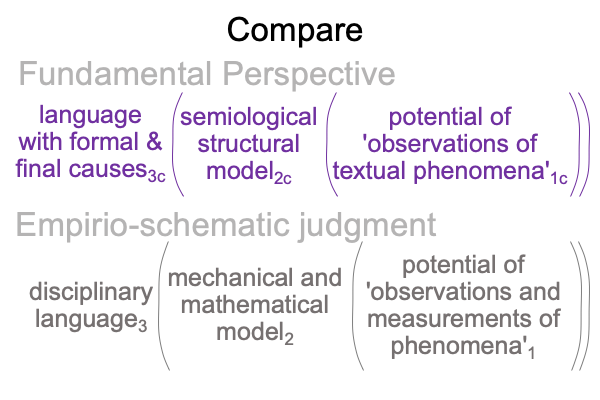
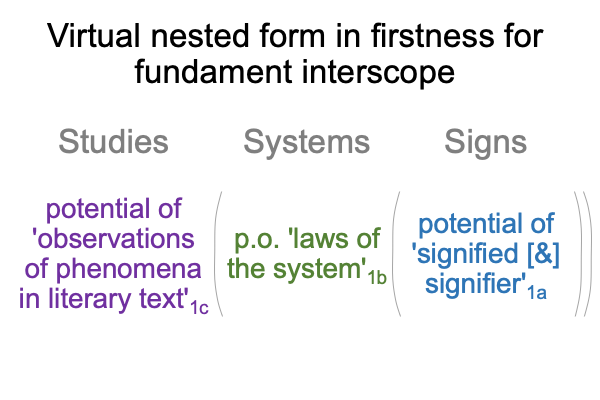
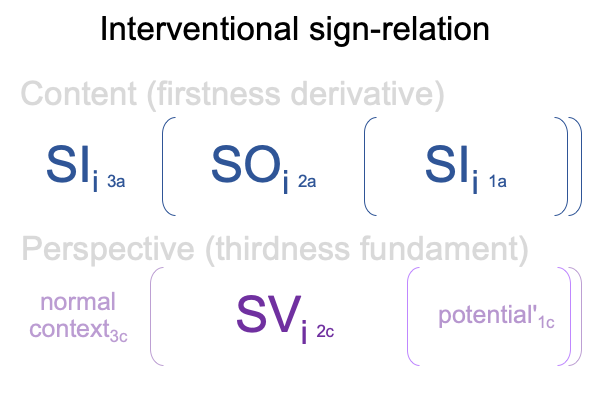
0042 The following diagram depicts the author’s paradigm as a category-based nested form.

0043 The normal context of a spiraling middle way3 (characteristic of a bauplan3) brings the dyadic actuality, {arrangements based on final causes2m [complementary seasonality and insurance] neolithic human conditions2f}, into relation with the potential of ‘a convergence of final causes, such as settling down’1.

At least, that is what I (C).

0044 The sections summarizing recent research on the Neolithic (B) walk the reader towards two conclusions.

0045 First, each region follows a different trajectory, due to efficient causalities pertinent to that ecology and environment.  Nevertheless, all regions fall within the expectations of the author’s middle way3.  The potentials inherent in efficient causalities are reified into a substance2 that stands between the matter of the settler’s arrangements2m and the form of the neolithic human condition2f.  The potentials inherent in final causalities1 undergird a bauplan3.

Efficient causalities vary.  Final causes are held in common.

0046 Second, I may ask, “How does the educated expert investigate the neolithic bauplan3 and its potentials1?”

0047 Well, a top-down reduction of matter and substance (what a Latin-speaking scholastic would call, “esse“, or being substantiating) does not assist, because… well… the mechanical philosophers rejected final causation back in the 1600s.

A bottom-up theoretical construction of substance and form completely misses the normal context3 and potentials1, which harken back to evolutionary biology.

0048 The author admits the impossibility of reductionist and social constructionist approaches by singling out Uchiyama’s NEOMAP cultural landscape framework as exemplar.  The project synthesizes data from the so-called “inland seas” of China, Japan, Korea and Eastern Russia with the intent of identifying convergent (efficient causal) factors.

Oops.

It’s the final causes that give rise to behavioral arrangements as matter that are convergent.

0049 Now, I could stop here and return to my cocktail, but there is a third conclusion.

Really, it is an observation about the second movement (B).

An irreversible transition towards unconstrained social complexity occurs within each region that the author discusses.

0050 The clue is found in a figure that accompanies each region (southwest Asia, China, Japan, Eastern North America, Mesoamerica and the Pacific Northwest of North America).  The horizontal axis is time.  The vertical axis divides according to Braidwood’s complex of material arrangements.

The spiral (inherent to any bauplan3) is indicated by the thickness of a horizontal line, which widens until a point of… shall I say?… no return.  There is a line for each material arrangement.  When the width of the dotted line reaches its maximum, an irreversible transition has taken place.

0051 Here is a picture of what I am saying.

0052 Irreversible transition?

The author emphasizes the concept that the early neolithic is reversible, tentative, and subject to dynamic change, especially in response to climate.  In other words, the early neolithic (when the dotted lines are narrow on the pertinent figures) slowly constellates according to an emerging bauplan3.  The fact that the final causes for all regions are the same makes possible the trend toward the thickest line for each of Childe’s and Braidwood’s material arrangements.

0053 Here is another observation.

In each region, the various horizontal lines do not become thickest at the same time for all material arrangements.  In most regions, maximum thickness is achieved for some arrangements in a first wave, then for all arrangements in a second wave.

0054 Here is a picture of my estimates.

0055 Do I give myself away in the titles of the above figures?

The second and terminal wave marks the start of a new Lebenswelt. This living world fosters unconstrained social complexity.

The first and prophetic wave marks the end of the Lebenswelt that we evolved in.  The living world exhibits constrained social complexity, but not for long.

01/1/26

Looking at Melinda A. Zeder’s Article (2025) “Unpacking the Neolithic” (Part 4 of 4)

0056 Okay, I will continue drinking my cocktail in the following exposition.

I regard the last two figures, along with the figures that appear in the article under examination.

0057 There is something in B that suggests two bauplans3.  Early Neolithic Bauplan 1 marks the terminus of the Lebenswelt that we evolved in.  Late Neolithic Bauplan 2 denotes the start of our current Lebenswelt.

0058 Bauplan 1 looks like this.

The early Neolithic bauplan3 does not permit untrammeled social and labor specializations.  Rather, all social circles2m (family (5), friends (5), teams (15), bands (50), and community (150)) are optimized2f in the pursuit of the final cause of ‘settling down’1.  It is the same way that different organs and organ systems are optimized for ‘settling down’ into an individual.

Details of optimization will be specific to each location (because efficient causes differ), yet produce something ‘general’, that manifests in excavation sites as varied as Catal Hoyuk and Tepe Gobekli.  Domestication includes the local geography, plants and animals.  Domestication may even include settlements more than a day’s walk away.  Domestication may include the heavens.

0059 Once rendered in this manner, the slow, seemingly reversible, spiral into the neolithic thing2 gets depicted as thin dotted horizontal lines along the axes of arrangements versus time.

0060 The late Neolithic bauplan3 permits individual social and labor specializations.  Something significant has changed.  The key final cause of ‘settling down’ remains relevant.  However, another key final cause cannot be ignored.  The optimization of the early Neolithic somehow breaks down and the late Neolithic initiates a search for order1 that continues to this day.

0061 Here is a picture of what Bauplan 2 might look like.

0062 It is as if an individual, having been formed by a bauplan 1 gestation, gets born.

What a rude awakening.

0063 What about the timeline?

If I replace the increasing boldness of the horizontal dotted lines with a slowly rising bauplan 1 slope, and if I depict the most bold horizontal dotted lines as a bauplan 2 phase transition, then I get the following graph.

0064 What does this imply?

Obviously, bauplan 1 ends in a twist, that is, bauplan 2.

I noted this slogan at the start of my examination.

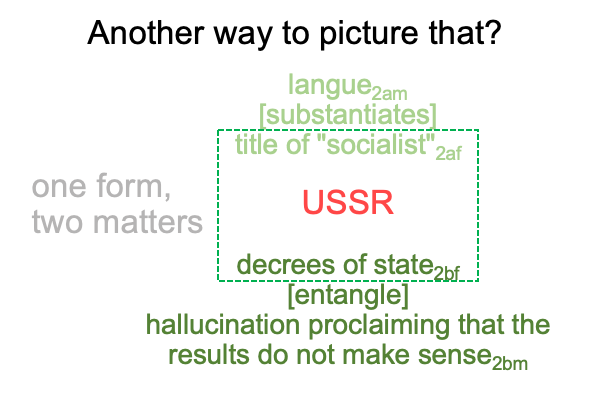
0065 Less obviously, the Neolithic revolution is not in the actuality of {material arrangements [substantiating] the neolithic condition}2

“The Neolithic Revolution” involves a transition from the Lebenswelt that we evolved in to our current Lebenswelt.

0066 Fortunately, for the author, the American Marxist academic candle is about to exhaust itself, just as the Soviet Marxist illumination did decades ago.

Yes, the crisis begins.

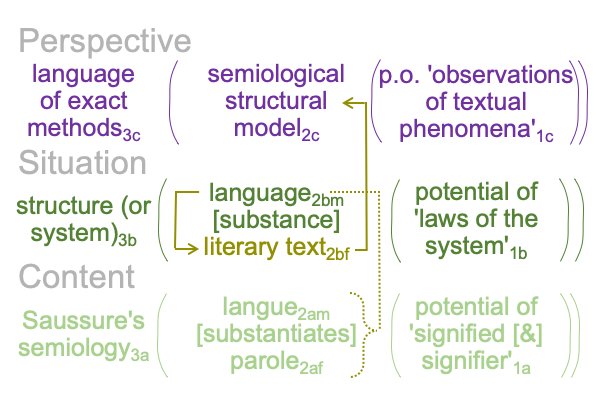
0067 The impending change of cognitive grounds will be at least as great as the following transition from Karl Marx (1818-1883) to Juri Lotman (1922-1993).  This transition goes sigmoidal in 1989.

0068 The following hylomorphic transition is derived in Razie Mah’s blog for December 2025, titled Looking at Igor Pilshchikov and Mikhail Trunin’s Article (2016) “The Tartu-Moscow School of Semiotics”.  

0069 Marx’s actuality2 is supposed to arise from the potential of scientific models1, even though the actuality2 served as doctrine, rather than a mechanical or mathematical formulation.  Remember, Marx’s actuality2 conforms to the structure of Peirce’s secondness.  Secondness is the realm of actuality.  How easy is it to confuse this actuality with the realness of a mechanical or mathematical model?  Yet, they are not the same.

0070 Lotman’s actuality2 arises from the potential of the semiosphere1, the universe of sign-relations.  Semiotic arrangements are not the same as material arrangements.  They are not even close.

0071 So, what am I saying?

The author senses that ‘something’ is coming and she figures out that it must concern a bauplan.

After all, bauplan is a term that is familiar to evolutionary biologists.

0072 Happily, the semiotician, Razie Mah, has already explored human evolution from the point of view of Peirce’s categories.  The human bauplan is an adaptation to the niche (or the potential) of triadic relations.   Plus, human evolution comes with a twist.

Here is a list of works by Razie Mah that pertain to Bauplan 1 and Bauplan 2.

0073 Surely, this is a lot to unpack.  But, that is precisely what Melinda Zeder’s article calls for.

My thanks to the author for publishing this thought piece.

Happy New Year.