0390 Here is a picture of the resulting two-level interscope.
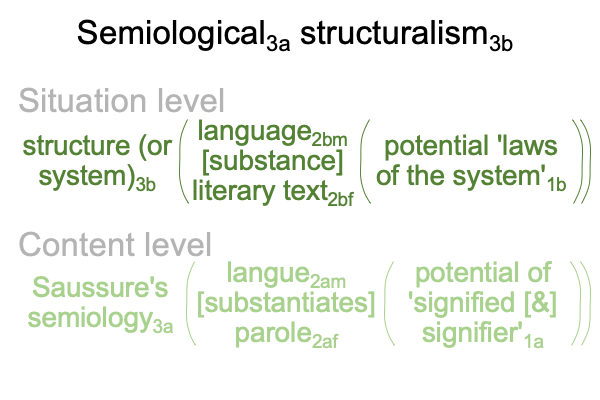
0391 The article begins with a pithy introduction. Boris Anreevich Uspenskij (1937-present) is a linguist and semiotician from Moscow, one of the leading figures in the Tartu School of Semiotics, and a protege of Juri Lotman. He is one of the founders of the above nested form, which I label “semiological3a structuralism3b“. But, he has never encountered the diagrammatic formulations portrayed above.
0392 Each row constitutes a category-based nested form where:
Actuality2 emerges from potential1.
Actuality2 situates potential1.
Normal context3 contextualizes actuality2.
Normal context3 brings actuality2 into relation with potential1.
The subscripts, “1, 2, 3”, correspond to Peirce’s categories directly. The subscripts “a, b, c” correspond to the levels of content, situation and perspective. The three levels constitute a category-based nested form composed of category-based nested forms. The relational structure is called an “interscope”. The above interscope has only two levels, typical for sensible construction.
0393 All this is discussed in A Primer on the Category-Based Nested Form and A Primer on Sensible and Social Construction, by Razie Mah, available at smashwords and other e-book venues.
0394 The two-level interscope associates to sensible construction.
So, I ask, “Where in these interviews does the idea of sensible (as opposed to social) construction manifest?”
0395 On page 408, in a question on deixis and language, Uspenskij notes that both parapsychological relations (between mother and infant) and imitation (an innate tendency) play roles in language acquisition. Mother-infant interactions exhibit the character of signifier (the gestures, facial expressions and sounds) as well as signified (perhaps expressed as a theory of mind). It is as if each signifier poses the challenge, “Guess what I am thinking.”
However, not only are mother and infant good at guessing, and psychologically supported by their mutual reinforcement, they display an actuality2a, {langue as matter [substantiates] parole as form}2a, that manifests systemic laws. Each mother tongue is a structure3b operating on the potential of ‘lawful correspondences’1b. Years later, when the child goes to school and learns to write, the content-level actuality2a will be situated by a similar appearing dyad, {language as matter [substantiates] literary text as form}2b.
0396 Of course, Uspenskij does not say this directly.
I only suggest that what he does say comports with semiological3a structuralism3b as portrayed in the Peirce-inspired diagram above.
0397 On page 409, the discussion turns to one of Uspenskij’s unanticipated discoveries: the first Russian grammar book written in Russian. At the time, there are Russian grammar books in German, French and other languages. This is the first written in Russian.
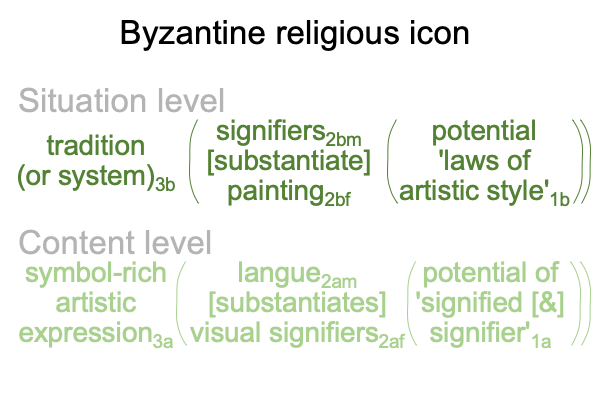
Uspenskij tells the story of how his interest in iconic Byzantine painting led to the unexpected treasure. He originally wanted to appreciate the actuality of Russian iconic painting2b within a formalized artistic system3b, with its own laws1b and its own way of communicating2a.
0398 Indeed, his original inquiry follows the contours of semiological2a structuralism2b.
0399 Of course, the associations may not be as straightforward as that.
0400 But it is a good starting point.
On the content level, the normal context of symbol-rich artistic expression3a brings the dyadic actuality of {human ideation2am [substantiates] visual signifiers2af}2a into relation with the potential of ‘a signified (the saint) and a signifier (the icon of the saint)’1a.
On the situation level, the normal context of the Orthodox tradition3b brings the dyadic actuality of {the icon of the saint (which is also the signifier1a)2bm [substantiating] a painting as an artistic production2bf}2b into relation with the potential ‘laws of the artistic style of the sacred icon’1b.
0401 The young Uspenskij formulates a hypothesis.
Byzantine religious icons are meant to be viewed in flickering candlelight.
The rich-unreflective clothes, the serious face staring back at the viewer, and the gold inlay of the background catching the import of every flicker of the flames belong to the laws of the artistic style1b. The candlelight assists in drawing the viewer into the visual elements2bm… the visual matter2bm… until suddenly… what?
402 The saint in the figure speaks to me.
How weird is that?
403 Eighty years after Uspenskij proposes that Russian icons are designed to be viewed in flickering candlelight, Razie Mah reviews two books in September and October 2025: Looking at Steven Mithen’s Book (2024) The Language Puzzleand Looking at Julian Jaynes’s Book (1976) The Origin of Consciousness in the Breakdown of the Bicameral Mind. These reviews are combined in the e-book, Synaesthesia and the Bicameral Mind in Human Evolution (by Razie Mah, available at smashwords and other e-book venues). This e-book justifies Uspenskij’s hypothesis as a characteristic of human practices long before the start of civilization.
404 Here is a picture.
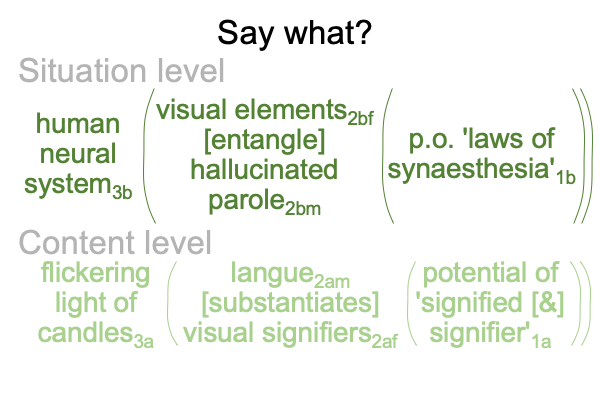
0405 In this case, the structuralist system2b is a neural adaptation3b that facilitates the addition of vocal utterances to hand-talk word-gestures under less than ideal visual conditions, such as before a campfire at night. As it turns out, this neural adaptation3b also engages a previously established adaptation called the interventional sign-relation (not pictured). If Julian Jaynes is correct, then this system undergirds what he calls “the bicameral mind”.