0108 In section five, the author moves towards an integrated conceptual framework of evolutionary biology and anthropology.
So far, this examination conjures a vision of two applications of that framework.
0109 One reflects the Lebenswelt that we evolved in and niche construction.
Here is a picture of the domestication of cows2b as an adaptation. Human sociality2a constitutes the actuality independent of the adapting species2a.
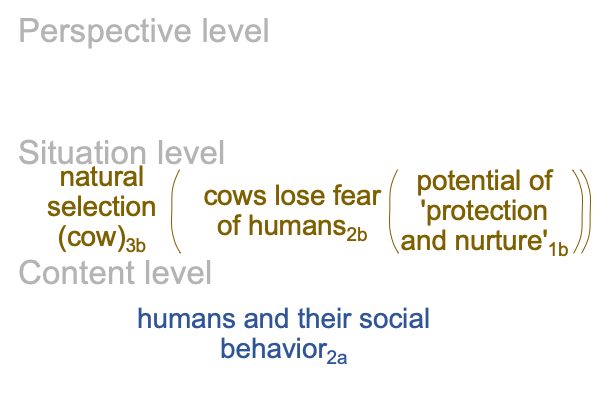
Here is a diagram of the entanglement of humans2b as an adaptation. Niche construction1b produces increasingly domesticated cows2a that yield more milk for the herding ethnos. Adult lactose-tolerance is one of the adaptations2b.
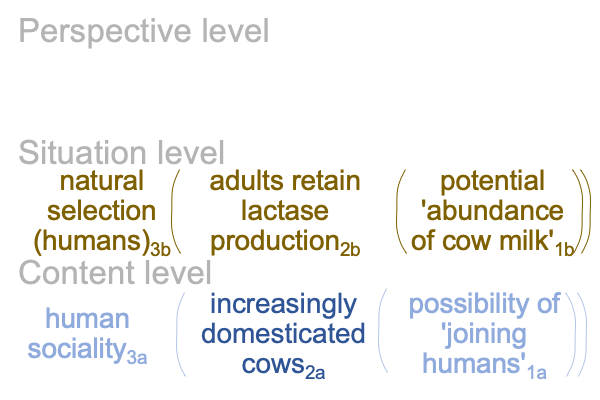
0110 Two goes with our current Lebenswelt and seems to manifest as a standard adaptation.

The academic community3b compares to natural selection3b.
0111 But, in regards to the domestication and entanglement example, are the academics like cows or like humans?
Perhaps that is not a fair question. But, an anthropologist may admit that the kenosis that the ethnographer learnsmight be comparable to an adult regaining the childhood ability to drink milk.
0112 If that is the case, then the dyad, {ethnographer [records] cognitive map}2b, touches base with adaptation2b.
The possibility of ‘subject cognitive spaces’1b reflects niche1b.
The dyad, {persons as matter [substantiate] narod as form}2a, mirrors the actuality independent of the adapting species2a.
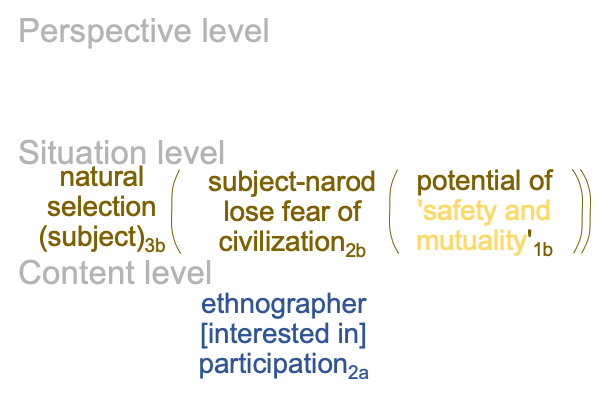
0113 But, the subject community is not merely the community that is the subject of anthropological inquiry. It is a community that assumes that these novel humans offer the potential of ‘what’?… ‘protection and nurture’?.. or at least… ‘something other than predation’. Maybe, the labels of ‘safety’ and ‘mutuality’ will do.
With that assumption, the subject community adapts by losing fear of the civilized humans that send an ethnographer to participate in their world.
0114 Here is a picture.
0115 Of course, nothing like the above argument appears in section five.
Instead, the author says that anthropologists (“we”) need to develop a framework of feedback loops that include behavioral, cognitive, material and ecological components, that addresses key issues of human evolution from at least the mid-Pleistocene (maybe 2Myr) to the present.
Surely, evolution-informed anthropologists should be interested in showing how kinship systems, economic, religious and political affiliations, and institutions construct and influence social and perceptual processes through… um… interpellation.
Niche construction is key because humans… and their hominin ancestors… somehow… alter the actuality independent of the adapting species… through social and perceptual processes.
Yes, it may be messy, but an integrated anthropology will be worth the effort.
0116 The last claim that the author wants to make is that ethnographers are like humans and their subject narods are like cows.
Ha!