02/6/26

Looking at Kalevi Kull and Ekaterina Velmezova’s Book (2025) “Sphere of Understanding” (Part 1 of 3)

SaH 0001 The full title of the book before me is Sphere of Understanding: Tartu Dialogues with Semioticians.  The book is volume 23 of the series, Semiotics, Communication and Cognition, edited by Paul Cobley and Kalevi Kull, published in 2025, by Walter de Gruyter GmbH, Berlin/Boston.  

Kalevi Kull is a biologist who joined the Department of Semiotics at the University of Tartu in 1997.  Ekaterina Velmezova is a linguist and historian who graduated from Moscow State University.  Each, in their own way, represents the two poles of the Tartu-Moscow School of Semiotics.

0002 The question is: Does this book mark the end of the first ascent or the beginning of the second ascent for the Tartu Moscow School of Semiotics.

0003 After the introductory chapter, extolling the virtues of dialogue, the authors offer a brief history of semiotics in Estonia.  The arrival of Juri Lotman, a scholar of Slavic literature, initiates a transnational collaboration within the old USSR.  The summer school at Tartu University proves seductive.  Here is a place where scholars in Slavic literature are free to play.

0004 So, one aspect of the sphere that the authors desire to understand is a historical conception, sired from the intellectual loins of Juri Lotman, that has taken a life of its own.  The only question is: Who is she?

0005 Kalevi Kull wrestles with emergence in biological systems.  What about this semiotically inclined child of history?

0006 Ekaterina Velmezova performs translation into English, as well as, I imagine, editing in Russian.  After all, these are times when Estonians may want to hedge their bets.

0007 Who knows?

Can the Tartu-Moscow School of Semiotics be born again?

The interviews provide clues.  They are gems framed in their historical moments.

0008 So how do I, a crypto semiotician, respond?

0009 First, I look at back issues of the journal that Juri Lotman founded, Sign System Studies, and find a special issue in 2017 bearing the title: Semiotics and History.

Second, I review several of the articles, plus one from 2016, in order to produce my contribution to the book’s dialogue.

Third, I package the results into an online independent mini-course, the first in a series titled, “Semiotics and History”, by Razie Mah, starting in December, 2025.

0010 The editors of the journal, Sign System Studies, have permission to scrape the blogs of this mini-course for a special on-line issue, as well as permission translate the blogs into other languages.  After all, time is cruel.  If the blog goes off-line, then the editors will retain a response that addresses what the authors seek.

0011 What do the authors seek?

0012 First, they seek a “sphere”.  Shall I add… “of influence”?  Or, shall I be satisfied with “of understanding”.

The interviewers ask semioticians questions.  After the year, 2008, these queries include how the semiotician came into contact or awareness of the (first ascent of) the Tartu-Moscow School of Semiotics (1960s-1980s).  The authors want to appreciate the school’s sphere of influence.

0013 Second, they seek understanding.

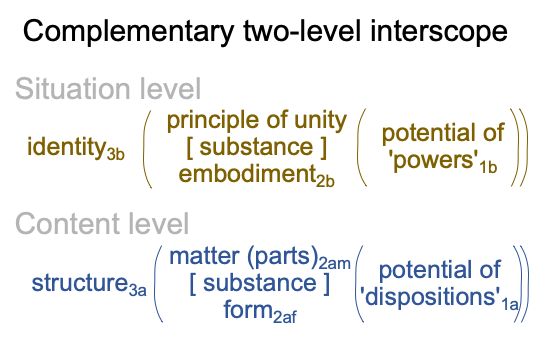
Here is where the discrepancy between Saussure and Peirce comes in.  Today, practitioners of both traditions are called, “semioticians”.   But, Saussure called his path of inquiry, “semiology”.  And structuralism?  Structuralism virtually situates semiology.  Structuralism is semiology as matter substantiating aesthetics as form.

0014 So, what am I doing?

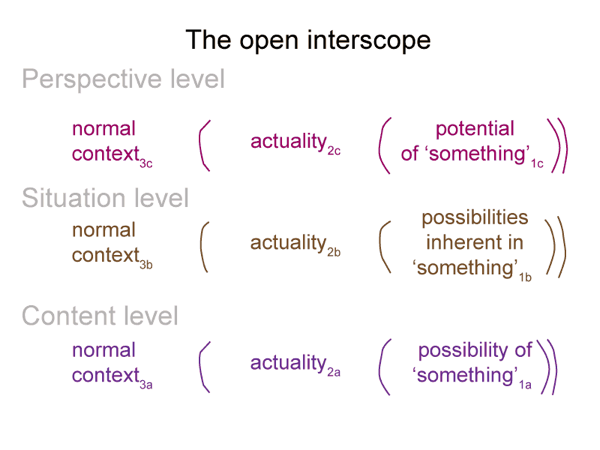
I follow the path of Peirce, into the labyrinth of triadic relations, and attempt to identify the normal contexts (thirdness) and potentials (firstness) of the actualities (secondness) of semiology and structuralism.

0015 What do I find?

I find that “she” is Slavic civilization, herself.

0016 My examination of articles in the 2017 special issue of Sign System Studies, titled “Semiotics and History”, pays tribute to the authors’ search, embodied in the title, and provides a way to understand the Tartu-Moscow School’s sphere of influence, for both the first iteration in the old USSR and its second iteration in the upcoming Eurasian convergence.

02/5/26

Looking at Kalevi Kull and Ekaterina Velmezova’s Book (2025) “Sphere of Understanding” (Part 2 of 3)

SaH 0017 The authors quest for a sphere of understanding.  They seek the egg, so to speak, impregnated by Juri Lotman’s genius.  In the interviews in chapter 2.1, Lotman is spent, although still alive.  He is old.  The interviewer is a youth, a personification of the metaphysical love-child born after Slavic civilization reveals herself to Lotman’s circumspection.

0018 The miracle of Lotman’s arrival in Estonia is, weirdly, recounted in the last interview (2.14) with psychologist and cultural theorist, Jaan Valsiner.  As it turns out, Valsiner’s step-father was instrumental in getting Juri Lotman to Estonia after the Second World War.

0019 Jaan Valsiner demonstrates that the Tartu-Moscow’s sphere of influence is diffuse.  His testimony is seconded by Paul Cobley (2.13), Terrence Deacon (2.12), Jesper Hoffmeyer (2.11) and Stuart Kauffman (2.10).

0020 The sphere becomes less diffuse in interviews with Roland Posner (2.9), Gunther Kress (2.8) and Wilfred Noth (2.7).

Notably, Noth conducts a discourse on the crucial potential of truth, as opposed to the potential of will.  Indeed, the contrast between truth and will turns out to be integral to my examination of a 2017 article on Russian identity.

0021 Finally, the sphere becomes tangible with interviews with American anthropologist, Myrdene Anderson (2.6), who researched indigenous people in Sweden, Italian semiotician Paolo Fabbri (2.5), who railed against the wooly thinking that passes for “models” in contemporary humanities, and the Italian know-it-all Umberto Eco, who noted the importance of iconicity in semiotic humanity.

What?

“Semiotic humanity”?

What about semiology?

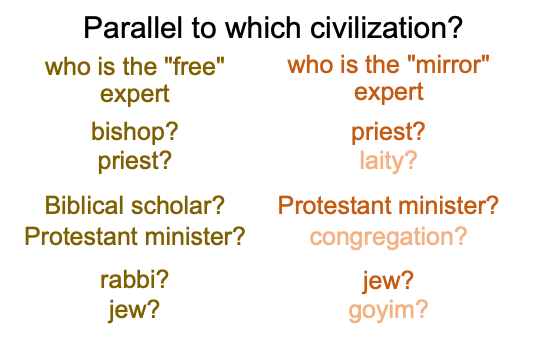
0022 Contemporary academic discourse is currently conducted with expert-coined spoken words, but these utterancescannot picture or point to their referents.  Academics swim in a pool of differences… er… two arbitrarily related pools of differences.  No one can tell where he or she flotates.

Flotates?

This is what happens when spoken words are placeholders in two arbitrarily related systems of differences.

0023 Finally, the interviews engage a still-living member of the original Tartu-Moscow School of Semiotics, Boris Uspenskij (2.2).  This interview gets a full examination in the course on Semiotics and History.  Uspenskij stands within the sphere that the authors aspire to understand.

0024 So, what does Razie Mah’s contribution under the banner of Semiotics and History offer?

0025 For the diffuse sphere, these examinations will present a historical narrative of ideas in the style of diagrams of purely relational structures.  In short, Peirce-inspired diagrams offer a new way to narrate intellectual history.

0026 For the almost tangible sphere, these examinations practice a method of association, followed by a discussion of the implications.  The articles provide material to fill in the empty slots of relational structures.  When associations are made, implications become apparent.

0027 For the sphere itself, one unexpected insight is that, as the first ascendant of the Tartu-Moscow School of Semiotics struggles to fulfill the political mandate of the USSR (to make all fields of inquiry “scientific”), the researchers excavate the recently-buried remains of the civilization that is their subject of inquiry.

Imagine a scientific investigation of Russian language, history and literature, as a archaeological excavation into the being of Slavic civilization.

0028 Is that the same “she” that… um… you know… captured the attention of Juri Lotman?

How confounding.

0029 The next blog offers an introduction to Semiotics and History: The Tartu-Moscow School of Semiotics.

02/3/26

A Course on Semiotics and History: A List of Online Contributions

SaH0001 Razie Mah offers three foundational courses that cover human evolution.

These are:

The Human Niche

(also see the four accompanying commentaries as well as the three-part Comments on Michael Tomasello’s Arc of Inquiry (1999-2019))

An Archaeology of the Fall

(also see the three part Instructor’s Guide, as well as The First Singularity and Its Fairy Tale Trace and Original Sin and Original Death: Romans 5:12-19)

How To Define the Word “Religion”

(also see the ten primers, starting with A Primer on the Category-Based Nested Form and A Primer on Sensible and Social Construction)

These courses are on sale by various electronic booksellers.

The texts are designed to be read and discussed in a seminar setting.

0002 For inquirers. educators and students would who like to try their hands at Razie Mah’s approach, Semiotics and History offers a path.  This is one course consisting of many strands.  Like a fiber in a rope, each strand strengthens the entire conceptual apparatus.  With few execptions, each course completely appears in the blog.  Some strands will have an electronic e-book component.  So, don’t be afraid to make a purchase.  You will find that the costs of Mah’s electronic works are reasonable.

In the following list, the date corresponds to the cover page of each strand.  A strand typically covers a month.

0003 The following list extends into the future, because more strands will be added over time.

Feb 6,5, 2026

Looking at Kalevi Kull and Ekaterina Velmezova’s Book (2025) “Sphere of Understanding” (Part 1 and 2 of 3)

Feb 4, 2026

Semiotics and History: The Tartu-Moscow School of Semiotics (Part 3 of 3)

May 30. 2026

Semiotics and History: Baroque Scholasticism

May 7, 2026

Semiotics and History: Baroque Scholasticism and Early Modernism

June 30, 2026

Semiotics and History: Early Modernism

July 31, 2026 Semiotics and History: Gnosticism in Modern America