SaH0047 The following essay, originally written in 2016, comments on a book by a Lutheran Pastor about heretical influences in contemporary American society. The author is Peter Burfeind. The title of the work is Gnostic America: A Reading of Contemporary American Culture according to Christianity’s Oldest Heresy (Pax Domini Press, 2014). Please have this book at hand for the full story.
These comments are not a close reading. They situate Burfeind’s text with category-based models. These models were proposed and developed in How to Define the Word “Religion”, plus Primers 1 through 10. They were refined in the Course on Implicit and Explicit Abstraction. They portray relational and logical structures.
Also, my discussion presumes the first singularity. Gnosticism was cultivated in an early ancient civilization. As such, I expect its origin myth to be a fairy tale about the first singularity. The first singularity is discussed in the Crystallizations of the Fall series plus An Archaeology of the Fall, available at www.smashwords.com and other e-book venues.
In short, these comments apply a suite of postmodern scholastic hypotheses to Burfeind’s excellent text. They are different from, yet complementary to, Burfeind’s passionate argument.
SaH0048 This exposition constitutes a strand in the Razie Mah’s online course: Semiotics and History.
The various strands are listed in Razie Mah’s blog for February 3, 2026
‘Words that belong together’ are denoted by single quotes or italics.
0001 Peter Burfeind wrote Gnostic America: A Reading of Contemporary American Culture according to Christianity’s Oldest Heresy (Pax Domini Press, 2014).
This book is composed of four parts. The first part covers the fundamentals of Gnosticism as a Christian heresy. The second and third parts explore cultural manifestations. The fourth part applies these fundamentals and explorations to contemporary American Neo-Evangelical Christian churches.
0002 Burfeind argues that two Gnostic movements contend for sovereign power, progressives and Neo-Evangelical Christians.
To me, big government (il)liberals (BG(il)Ls) beat these Christians to the punch. The federal government has established a religion. It is not Christian. BG(il)Ls run Gnostic bureaucracies where authorities deny that they are religious at all. BG(il)Ls are the self-anointed angels (or more accurately, daemons) of a New Age dawning in America.
Christians who self-describe themselves as “spiritual, but not religious” accommodate BGL’s increasing sovereign power and aggression.
0003 Burfeind is not alone in this awareness. Over 60 years ago, Eric Voegelin expressed similar ideas in his short but significant book, The New Science of Politics.
This raises a question. What is the meaning, the presence and the message underlying the word “Gnosticism”?
With this question in mind, I turn my attention to Burfeind’s text.
Students should read chapter 1 of Burfeind’s text before proceeding.
0004 From Burfeind’s introduction, I know that Gnosticism is a very old heresy.
How old?
From chapter 1, I suspect that Gnosticism predated Christianity. Indeed, the death and the resurrection of Jesusrebuked Gnostic intuition. Why would Jesus retain the evil material shell of His body?
Jesus highlights all the ways that the Mosaic tradition offended Gnostic sensibilities. Both Christians and Jews are enamored of the material world. Gnostics, not so much.
0005 The Judeo-Christians believe in one God. So do the Gnostics. But, the one God of the Judeo-Christians is not the same as the Gnostic Source. The Source is a Monad, a complex singularity capable of putting everything into perspective. The Monad is the source of meaning.
0006 The Monad plays a key role in the Gnostic origin myth. The myth begins with the Source, beyond spoken language and in eternal time. From the Monad, male and female pairs emanated, each according to its aeon. The totality of theaeons is called the “pleroma”.
For the last era, our own, the female of the pair acted without her male consort. He was missing in action, so to speak. Sophia became pregnant with Yaltabaoth, half lion and half snake. She thought to herself, “This is not me.” So she took action, ripping the monster from her womb and hiding him in a cloud.
0007 Born yet aborted, living in a fog, Yaltabaoth decided to build his own world. He decided to create. What else was this demiurge supposed to do? He constructed his own world, which is our universe. He assigned archons (powers and governors) to rule his cosmos.
He was proud of his accomplishments.
Here I make an admission, there is more than one way to spell Yaltabaoth. That exercise is left to the reader.
Okay, back to the story.
0008 What else does this builder god do?
He manufactures our physical bodies. He steals a spark from the Monad (a soul) and pulls it into his world. As the soul descends, Yaltabaoth adds matter. At birth, each person is a spark wrapped in a mortal cloak. The spark is not material. The body is material. The two will war with one another.
0009 Therefore, Sophia pities us and offers this myth. The Self has a mission: Return to the Source. Sophia offers secret knowledge, gnosis, opening a path out of Yaltabaoth’s apparently all-encompassing cloud.
In fact, this myth, which joins cosmic and personal origins, contains a secret. It describes a location where you can find your Self.
0010 Clearly, this origin myth provides meaning. This meaning coincides with the model of social construction in Razie Mah’s How to Define the Word “Religion”. This model is further detailed in A Primer on the Category-Based Nested Form and A Primer on Sensible and Social Construction.
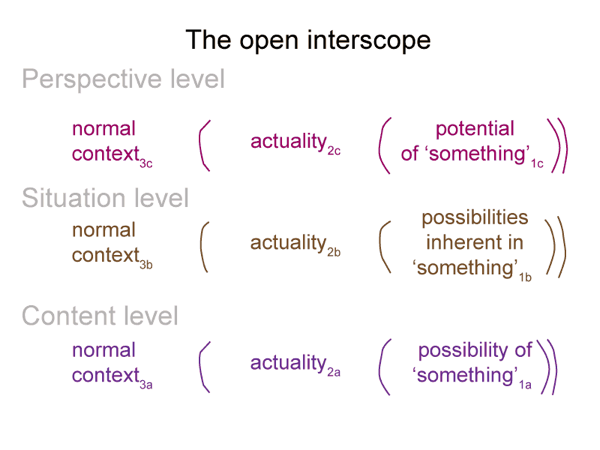
0011 The model is an interscope, a nested form of category-based nested forms. The interscope offers nine slots. Features in the above myth associate with different slots.
Here is the open interscope, before any associations.
0012 My intent is to associate elements of the Gnostic origin myth with slots in the interscope of social construction.
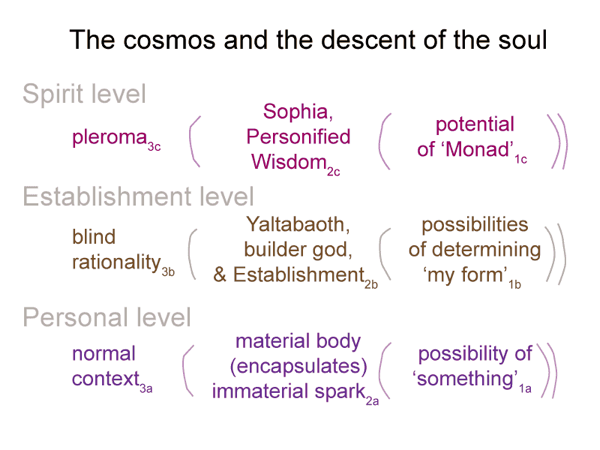
0013 My first association concerns the Monad. The Source has the potential to put the situation into perspective, so it goes into slot 1c. The pleroma automatically becomes the normal context of the perspective level (slot 3c). The pleroma3c brings the possibilities inherent in the Monad1c into relation with the actuality of Sophia2c.
0014 So what is the secret about Sophia?
Sophia is Personified Wisdom. It is not much of a secret. After all, philosophy is rooted in love (philos) and Wisdom (sophia).
0015 If Sophia2c is the mother of the builder god, Yaltabaoth, then I should put the builder god into slot 2b. Yaltabaoth2b situates our universe within the normal context of blind rationality (slot 3b).
Or should I say, “mindless rationality”?
The builder god lives in a cloud, isolated, without awareness of even his own mother. Sure, he snatches sparks from the Monad. He does this blindly. Who knows what spark goes into what body? Yaltabaoth operates in a fog. His archons are like bureaucrats, always following their rulebooks. His social norms? They constitute the Establishment.
The Establishment is the social arm of Yaltabaoth’s evil material world of blind chance and mindless necessity. For teenage Gnostics, that includes all parents. For big-government Gnostics, this includes everything associated with the American Founding.
0016 So, why does the builder god need a spark from the Source in order to animate the human body?
Yaltabaoth is so clueless. He does not realize that the spark comes from the Monad. It is just another thing at his disposal. Obviously, there is no better way to animate humans. He snatches an unwitting soul from its contemplation of Sophia and uses it to bring breath to a breathless body. Inspire. Hold it. Expire. I can feel it.
0017 Here, let me put my associations into the open interscope.
0465 A type 1 Gnostic, who has been indoctrinated to be your Self, has an ego that says, “I am inadequate.” Otherwise, why would I need a Self-help book, or a drink, or a hit? Why would Sophia call to me?
Sophia says, “Escape. Return to the Monad.”
0466 A type 2 Gnostic, who may be so far into the conflict that the Self has won, projects her fallen ego onto others. She demeans others as puppets of a rigid, doctrinaire, paranoid, traditional, Yaltabaoth-worshipping superego.
The ego of the Self-anointed is no longer responsible for the Self. The Self may use her body for whatever purposes suits her proclivities.
0467 What do I mean by “her”?
I am “she” when my Self is my normal context. My Self is an image of Sophia.
If everything is determined by culture, why can’t I declare my own culture?
My Self-wish transforms into a program for development.
My ego is like my ex-. My superego is like his paranoid delusions. My idreal is like a golden ring, serving as a gilded cage.
0468 A type 2 Gnostic sees others as marionettes of Yaltabaoth and the Establishment. She stands beyond freedom and responsibility. She serves another master. She works for an institution. She supports a cause. She stands righteous among the Self-anointed.
She knows about Freud. She adores Jung. She is a Marxist. She is a big government liberal, demanding sovereign power. Does that make her il-liberal? Not in a world where “liberal” means “anything goes”.
Sovereign power constellates Personified Wisdom.
The type 2 Gnostic strives to grasp sovereign power. She will master social evil. Her Self-wish is to control the builder gods and the Establishment, forcing them to work for her organizational objectives. Her Self-wish is to regulate and educate the pathetic ego-driven masses.
She is a post-religious social activist.
0469 A type 2 Gnostic will contextualize himself as a member of a New Age, the next emanation of the pleroma.
0470 What do I mean by “him”?
Is “he” the missing ingredient?
By “him”, I suppose, I mean Sophia-Self gives birth to… or rather, gives abortion to… the next Yaltabaoth. She will put him into a cloud. He will create the next age, even if he is a she, whatever that means.
0471 The next age comes in like a lion, then out like a snake.
Or, should it be, in like an ego, then out like a Self?
0472 Gnosticism is a religion of secret knowledge.
The Gnostic origin myth, itself, opens like lockbox, when the key is fashioned in truth.
0478 Ah, then, here we have it: What is truth?
On one hand, the words of the Gnostic are never to be taken literally. They are symbols evoking fantasies that inform the Self. The Self reads word-gestures. The Self relies on touch.
Sophia interpellates the Self through desire.
On the other hand, the possibilities inherent in the truth support the perspective-level actuality of the Holy Spirit.
The Father virtually situates the Son[redeeming] me.
0478 I can put my hands together, with this conclusion:
The origin stories of Gnosticism and the Bible both point to a transition from the Lebenswelt that we evolved in to our current Lebenswelt.
The Gnostic origin story mythically re-creates a repetition disorder characteristic of unconstrained social complexity.
The Biblical origin story mythically portrays the transition as an actual historic event, serving as a fountainhead for disaster after disaster.
0480 Aren’t both these origin myths about Original Sin?
SaH0045 This strand of Semiotics and History considers the rise of capitalism in early modernism in terms of changes of political theology.
Oh, I meant to say “mercantilism”.
Okay, how about a label for whatever Shakespeare’s Merchant of Venice and income taxes in twenty-first century Americahave in common?
Also, I should have also said, “political economy”, instead of “political theology”.
Be that as it may, please enjoy the following commentary on Eric Santner’s challenging book.
This strand starts with of Looking at Daniel Novotny’s Article (2016) Izquierdo and Universals (and appears in Razie Mah’s blog in May 7-1, 2026, for orientation, see Razie Mah’s blog for May 7, 2026).
As well as Looking atEric Santner’s Book (2016) The Weight of All Flesh (appearing in Razie Mah’s Blog in June, 2026, go to month and scroll down).
SaH0046 For a full list of strands in the course on Semiotics and History, see Razie Mah’s blog for February 3, 2026.
0001 The following 2017 essay comments on a recent book by a Professor of Literature about the subject matter of the political economy. Eric Santner tries to figure out its immaterial measure.
Why do I say immaterial measure?
Consider the complete title: The Weight of All Flesh: On the Subject Matter of Political Economy.
Weight is a measure of something material. However, weight itself is not material.
Similarly, matter ought to be material. But, subject matter is not.
Also, the economy processes materials. Politics does not.
Will literalism do under these circumstances?
Once the flesh has weight, then it is no longer simply what it is.
Once matter is taken to be a subject, then it is no longer merely what it is.
Once the economy is taken to be political, then it is no longer only what it is.
0002 To me, the category-based nested form applies.
The actualities of flesh, matter and economics exist by themselves. But, humans evolved to consider more than what is at hand. We are designed to put actuality into a nested form.
So, these actualities exist, for us, in the normal contexts of weight, subject and politics. These are not the only normal contexts. They are the contexts raised by the author.
The contextualization of actuality raises another question.
What potentiates the weight of flesh, subject matter and political economy?
You may already know the answer. I do not. Consequently, I turn to this text to see what I may discover. This will be a fairly close reading, so have Santner’s book at hand.
‘Words that belong together’ are denoted by single quotes or italics.
0003 Eric Santner wrote The Weight of All Flesh: On the Subject-Matter of Political Economy (Oxford University Press, 2016). The main body of the book consists in a preface and two lectures. The two lectures constitute chapters 1 and 2. These chapters are broken into parts.
Santner’s presentations are works of art, composing the 2014 Tanner Lectures on Human Values at the University of California, Berkeley.
0004 The front piece is an introduction by Kevis Goodman. The end piece is a suite of comments by Bonnie Honig, Peter E. Gordon and Hent de Vries, followed by a reply by Eric Santner.
The responses are very challenging. How does one reply to something that sounds like free association?
Unfortunately, the front and end pieces will not be covered in these comments. However, the end piece may be used as an exercise in the methodology that composes these comments.
0005 Why is this interesting?
My interest is obvious once one looks at How To Define the Word “Religion” plus the first ten associated primers.
The tenth primer ends before the majesty of sovereign power. Primers 8, 9 and 10 tell of the difficulty of seeing beyond these mountains. Anyone who argues about politics can stir up an avalanche.
What does Primer 8 tell me?
Infrasovereign religions grasp for sovereign power in order to impose their organizational objectives on those outside their organization.
What about Primer 9?
Socrates had to drink hemlock. Why did he have to do that?
Primer 10?
Rene Girard proposes that a scapegoat mechanism is apparent in all civilizations. Plus, the mechanism comes into play when power structures try to preserve themselves.
Overall, politics and religion map a dangerous landscape. Eric Santner walks where angels fear to tread.
0006 Primers 8, 9 and 10 explore the presence underlying the word “religion”.
Institutions occupy the content level of the society tier. They contextualize the organization tier. These institutions harbor organizational objects, objectsorganization, that call the individual into organization. These objectsorg are virtually situated by sovereign acts, laws and decrees.
0007 Eric Santner reads literature. He observes art. He sees that something changed in the West over the past few centuries.
What is this something?
It is completely missed by the current social and political sciences. However, it appears in Western paintings, poems, novels, plays, and other artistic works. This is the stuff that Eric Santner studies.
0008 Subject matter. What is it?
“Matter” is stuff. “Subject” is something that ends up objectified.
Okay, now what?
Does subject matter signal the objectification of matter?
Or does subject matter signify the objectification of something that matters?
0009 At the end of the Latin Age and the beginning of the Age of Ideas, around the 1600s AD, the subject matter of political theology was the king’s two bodies. One body was mortal. The other was sublime.
The object of the king’s glorious body supplemented the subject of the king’s mortal body. Santner labels the process spectral (glorious body) materiality (mortal body).
0010 To me, the glorious body is the normal context for the actuality of the king’s mortal body.
The nested form looks like this:
Sublime body3( mortal body2( potential of kingly being1))
0011 Does this express the character of the subject matter?
The mortal body is matter. The sublime body is the normal context that objectifies the mortal body. Thus, the king’s mortal body becomes a subject for political theology. The something that underlies the mortal body, giving its flesh weight, is the quality of being king.
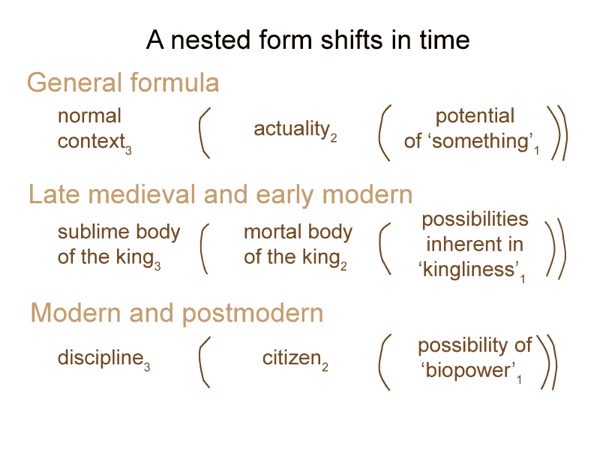
0012 Moving to the present day, the matter of political theory falls to the people, rather than the king. The subject gets dispersed from one king to many citizens. The glorious body translates into what Michel Foucault calls “discipline”. The qualities that weight the mortal body of the king turn into “biopower”.
To me, modern political theory translates into the following nested form:
Discipline3( citizen2( possibilities inherent in biopower1))
0013 The two nested forms are shown below:
Normal context3 and possibility1 surcharge actuality2.
0014 The mortal body of the king is more than it otherwise would be in any other context. Its actuality possesses a surplus of immanence because it now has potential.
Similarly, one citizen may heroically rise above others as an expression of the biopower released by discipline. Other citizens are weighed and measured in the exercise of biopower.
0015 The pressure cooker of the royal person expanded to the business of the citizen. Medieval and early modern political theology gave way to modern political economy.
0016 Take a look at a painting. Jacques Louis David painted the extraordinary Death of Marat, during the French Revolution.
Compare this image to a wax effigy of a dead medieval king, or some other memorial, placed on the throne during official mourning.
0017 Jean-Paul Marat, the citizen, dies in his tub. David paints the death scene.
The king’s mortal body is buried. An icon of his sublime body is placed on the throne.
Clearly, David paints the equivalent to the sublime body of the citizen, Marat.
0018 One could say that this represents a loss of enchantment. After all, Marat, the revolutionary, hardly behaved royally.
This lack of royalty aligns with the emptiness above Marat, the corpse. The upper half of David’s painting is empty. If Marat had been royalty, the upper register would be full of angels and saints welcoming the glorious king.
What happened to the angels and saints?
0019 Heck, not even Marat’s fellow citizens are in the upper frame, registering the emotions of shock, grief, and, perhaps, relief. Critics have called the nondescript space above the dead Marat oppressive, abstract and unmotivated, characteristic of a representational deadlock.
0020 Perhaps, the cunning and ambitious artist was saying, “Do not let this be you.”, while painting, “This fellow was a citizen hero.”
Santner does not tell why Marat got knifed in his enclosed bathtub, filled with medicinal waters. Marat was a radical agitator. He named his newspaper, “The People’s Friend”. He was murdered by a woman who had come to him, claiming news from one of the districts of France.
During her trial, she testified that she killed one man in order to save one hundred thousand. She was found guilty. Her head was chopped off with a guillotine.
0021 Jacques-Louis David was charged with organizing Marat’s funeral. Surely, Marat was a martyr for the Revolution. Yet, despite the acclamation, no other figure appears in the painting.
0022 Why?
The reason is simple.
No sane person (whether angel, saint or fellow citizen) wanted to be associated with this crazy person, who was typical of the Jacobins, the party that celebrated the Cult of Reason and the Cult of the Supreme Being.
0023 David’s painting is both a warning and a paean.
0024 To Santner, the empty upper register of the painting associates to the impossibility of transcendence in the modern age. Business is busy-ness.
In the preceding section, Santner dwells on the word “doxologies”.
0548 There are two doxologies flowing upwards in the following figure.
This pair of doxologies is glory and money.
One is societal. The other is organizational.
0548 Santner coins the word, paradoxology, for exploring this double flow.
The subject matter of the political economy is a paradoxology.
0549 There are two movements flowing downwards in the preceding figure.
The pair of condensates are busy-ness and identity / purpose.
One is societal. The other is organizational.
One is enforced through sovereign laws and decrees. The other is inculcated through broadcast advertising.
0550 Santner recounts a debate about how to interpret Kafka’s writings.
Walter Benjamin and Gershom Scholem expressed different views of the theological tracks of Kafka’s stories.
0551 Scholem argued that Kafka’s work shines like a revelation. But, it’s a tricky revealing. It does not lead the reader to God, but to some originating nothingness.
0552 Benjamin countered that Kafka’s work has a message: The gate to justice is study. But the question is: What to study? The Torah has been brushed over by modern inquiry. Students have lost the Holy Writ.
0553 Scholem replied: No, those who study have not lost the Scriptures. They have lost the ability to decipher them.
0554 Does this conversation fit into the previous figure?
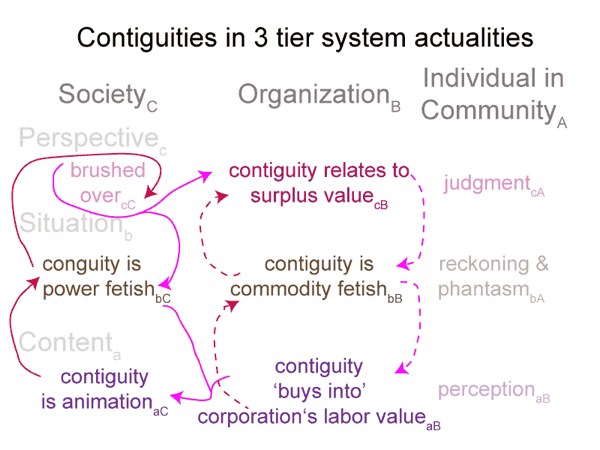
A suprasovereign religion was brushed over by the time that Marx projected the transcendent (a political theology) onto the immanent (the machinations of the organization tier).
0555 Santner concludes with Walter Benjamin’s tripartite image of capitalism.
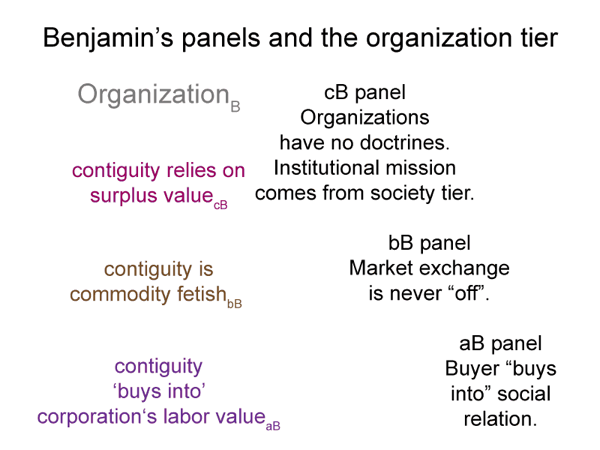
In one panel, capitalism is a purely cultic religion. It has no doctrine. It has no dogma. Adam Smith’s theories of the self-regulation of markets are exemplar. What is the invisible hand? It is dogma? Or is a way to describe events that cannot be reduced to cause and effect?
In the next panel, capitalism is always “on”. It never takes a holiday. Santner associates this to the doxologies of everyday life. Work is always waiting. Duties are never completed.
In the final panel, capitalism creates guilt, not atonement. In other words, it creates more debt, more burdens and more work.
Does the sovereignty of debt become sovereign debt?
Not necessarily, but it happens often enough. After all, who pays for the political entrepreneurs? Who pays for the busy-ness of citizensMarat?
0556 Does each of Benjamin’s panels describe a level of the organization tier as understood from the communist perspective?
How curious.
0557 Certainly, capitalism is a religion worthy of contempt.
Too bad it is a projection of Marxist ideology.
Walter Benjamin’s career as literary critic expanded the cognitive space opened by the Marxist religion.
This is the nature of religions.
0558 Marxist ideology projects a plausible theology onto something in the organization tier that everyone encounters.
0559 Marx selected one of the best encounters.
In every purchase, I, the buyer, encounter a corporation that I do not belong to.
Is this alienating, or what?
0560 My money goes up from the product (content) through the price (situation) and becomes surplus value(perspective).
A quality of the product comes down, from the brand name (perspective) through the abstract material guaranteed by the brand name (situation) to the aspects of my identity congruent with this abstract material (content).
0561 Following this pattern, I only purchase bread from The Staff of Life Bakery.
It is my paradoxology.
My devotion increases the glory of the bakery. The bakery provides me with a mission, “Eat the bread of life.”
My money keeps the bakery in business. The brand name makes my mouth water.
0562 When Adam Smith attempted to describe this process, he saw an invisible hand, guaranteeing high quality products for low price. There was no dogma. There were no doctrines. There was only rational self-interest.
0563 When Karl Marx passed judgment on this process, he reified the theological dogmas of mercantilism. Everywhere that Marx looked in the organization tier, he found religious expression.
If he were to start his own religion, then what better way than to project the theology of mercantilism onto the operations of the organization tier and then declare it evil?
Indeed, the organization tier becomes evil when viewed as an unholy ascent of money and a devilish descent of brand names.
0564 Thus, the paradoxology of Marxism becomes clear.
A doxology of communist powerrises through the society tier in response to a projected evil doxology, called “capitalism”, arising in the organization tier.
0565 The organizational objectives of Marxism become inevitable once its projections are assumed and never questioned.
0566 To me, this conclusion makes the works of Eric Santner and Giorgio Agamben fascinating to behold. Here is the subject matter of political economy.
SaH0001 Are there independent courses of study completely contained within Razie Mah’s blog?
Yes, besides the main courses that are announced at Razie Mah’s website, other online courses may be found.
Semiotics and History offers various courses. The courses are like threads. Each strand integrates with other strands, so the conceptual apparatus starts to work like a rope, giving the student a tool to climb through history.
Here is the reading list for this strand.
Looking at Daniel Novotny’s Book (2013) “Ens Rationis from Suarez to Caramuel” (points 0001-0265, appearing in May, 2026)
Looking at Daniel Novotny’s Essay (2017) “Izquierdo on Universals” points (0266-0365 appearing in June 2026)
The dates pass backwards because WordPress places latest post first, for each month.
So, click on the month, then scroll downwards
0002 Other notes.
Words and phrases that belong together may be placed in italics for easier reading.
Prerequisites include A Primer on the Category-Based Nested Form and A Primer on Sensible and Social Construction,by Razie Mah. These are available at smashwords and other e-book venues.
A list of other strands may be found on the Semiotics as History Post at Razie Mah’s website, dated April 1, 2026.
SaH0043 The Baroque scholastics of southern and central Europe live at the same time as the mechanical philosophers of northern and western Europe. The latter give rise to the Age of Fiction, with Cervantes publishing Don Quixote in the early 1600s. The former give rise to the Age of Ideas, with the birth of modern science.
Of course, it is not as neat as that.
Consequently, an examination of an article by Novotny serves as a capstone for Razie Mah’s online course on Baroque Scholasticism and as an introduction to an online course in Early Modernism.
Baroque Scholasticism consists of Looking atDaniel Novotny’s Book (2013) Ens Rationis from Suarez to Caramuel (and appears in Razie Mah’s blog in May, 2026).
The capstone for Baroque Scholasticism and the introduction to …and Early Modernism consists of Looking at Daniel Novotny’s Article (2017) Izquierdo on Universals
Baroque Scholasticism and Early Modernism consist of a review of Eric Santner’s Book (2016) The Weight of All Flesh.
SaH0044 Both are strands in the course: Semiotics and History.
In the Spring 2017 issue of the American Catholic Philosophical Quarterly (vol. 91(2) pages 227-249), Daniel Novotny examines Disputation 17 of the Baroque scholastic treatise, The Lighthouse of the Sciences (1659). The title of Novotny’s article is Sebastian Izquierdo on Universals: A Way Beyond Realism and Nominalism. These comments intend to demonstrate the postmodern relevance of this work using the category-based nested form.
The student should obtain the article from online.
0268 Oh, back to the starting questions.
Some things are similar to one another. Universals grow out of this impression. Various things can share in certain universals, to the exclusion of other things. In this very brief paper, Daniel Novotny reviews and summarizes the theory of universals proposed by the Spanish Baroque scholastic, Sebastian Izquierdo, SJ (1600-1681 AD).
Izquierdo’s life overlaps with the northern European authors who mark the dawn of the Age of Ideas, including Thomas Hobbes (1588-1679) and Rene Descartes (1596-1650). His life also overlaps with theorists marking the twilight of the Latin Age, including Francisco Suarexz (1548-1617) and John Poinsot (1589-1644). Our current age is born at this time. This is the moment to which we must return in order to come to terms with our era.
0269 Daniel Novotny is not unfamiliar with the Baroque philosophers. I commented on his full-length book, Ens Rationis: From Suarez to Caramuel, published in 2013. Novotny’s exposition is so clear that constructing (inevitably messy) category-based nested forms came easy.
My comments wove a story into his presentation, starting with the dichotomy of fact versus fiction and ending with an intimation of postmodern social construction. This narrative adds value by connecting Baroque scholasticism and our present, postmodern, world.
0270 As for the article under examination, Novotny begins with a caveat. Baroque philosophy and theology is a complex tapestry, filled with commentary and references. One can easily get lost in this forest of questions and answers. Typically, an entire text must be examined in order to configure an author’s opinion, if distinct from all others. Since such effort is very difficult and time consuming, Novotny limits this publication to a careful examination of Disputation 17 of Izquierdo’s major philosophical work, The Lighthouse of the Sciences.
Disputation 17 presents Izquierdo’s theory of universals.
0271 The table of contents for The Lighthouse of the Sciences is organized in a novel way, portending substantial differences from traditional doctrines and methods. In Disputation 17, Izquierdo considers three questions. To me, these questions sound postmodern.
Q1. What are universals?
Q2. Are some universals independent of the intellect?
Q3. If universals are intellect dependent, what is their nature?
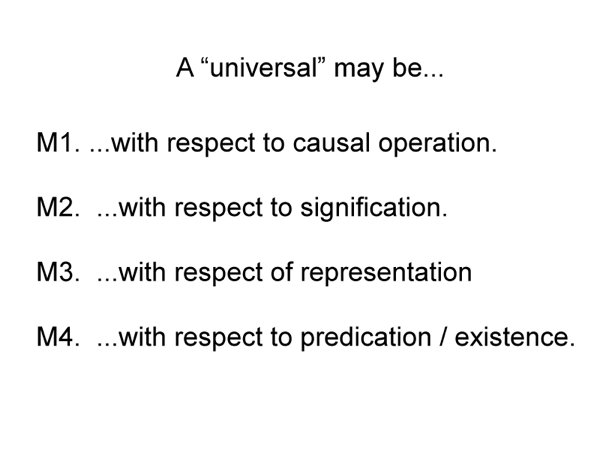
0272 To the first question, Izquierdo offers four meanings:
0273 Let me supply an example from Eric Santner’s (2016) book, The Weight of All Flesh.
0274 During late medieval and early modern times, political theologians proposed that the king had two bodies. One was mortal. The other was glorious.
When a king died, his mortal body was quickly buried. An effigy (representing the king’s glorious body) was manufactured and placed on the throne until the coronation of a new king. Then, the effigy was buried in a separate funeral.
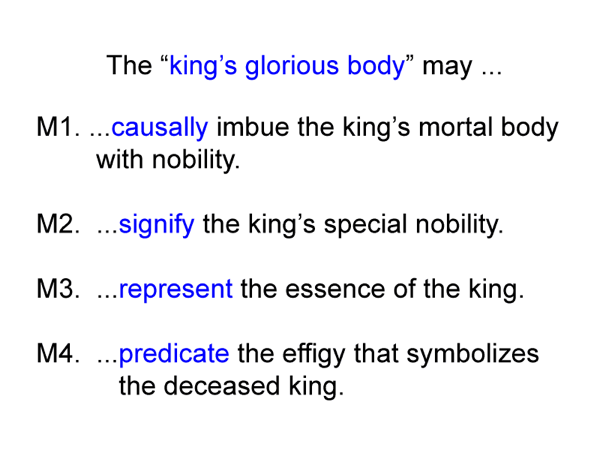
0275 The glorious body of the king is a universal with four meanings.
0276 The last meaning is particularly twisted. The universal, in its proper sense, cannot be a particular. Yet, here is a particular effigy that becomes a symbol of the king’s glorious body.
According to C. S. Peirce, a symbol is a sign based on tradition, convention, law, consensus and so on. Here, a political and theological consensus connects a sign-object (the king’s glorious body) to a sign-vehicle (an effigy of the deceased king).
0277 In Peirce’s semiotic terminology, the scholastic term “objective concept” portrays the union of a sign-vehicle and sign-object. The term “objective precision” reflects the operation of a sign-interpretant.
0278 In the terminology of the nested form, “objective concept” belongs to secondness, the realm of actuality. “Objective precision” belongs thirdness and firstness, the realms of normal context and possibility, respectively. An objective concept is a mind-dependent being. Objective precision is a formal act of the intellect.
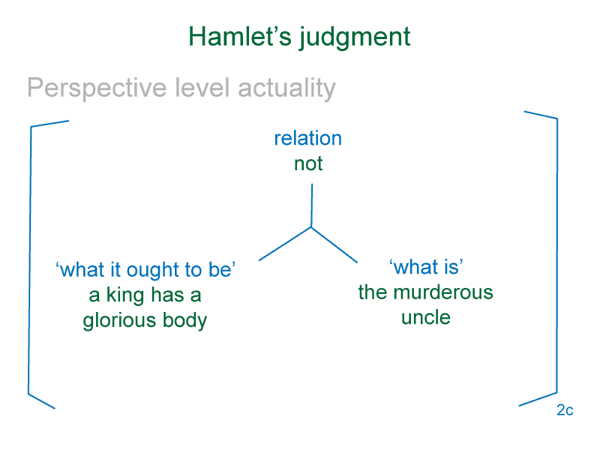
0279 For example, in Shakespeare’s Hamlet, a murderous uncle gains the throne and becomes king (objective concept). Unfortunately, the ghost of Hamlet’s father (the glorious body of the deceased king) appears, calling Hamlet to reject his uncle’s claims (through objective precision). Hamlet’s uncle has no nobility. Therefore, his uncle is not king (and does not have a glorious body, since the glorious body of Hamlet’s father haunts the world).
0280 This dramatic call to judgment may be depicted as a relation between what is and what ought to be. Indeed, I define the actuality of judgment as this triadic relation.
0350 Next, the fourth proposition (P4) comes up for consideration.
0351 What is the disposition of the universal to each of Aristotle’s definitions?
According to the working model, both definitions are in play in the primal triad. They are not independent. How can this be? This model supports further philosophical inquiry.
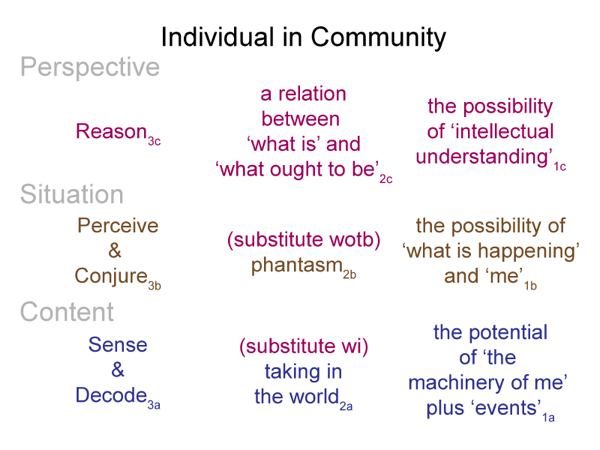
0352 Propositions P2 and P3 pertain to the interscope of the individual in community.
0353 P3 points to the fact that the normal context for judgment2c is reason3c.
0354 P2 suggests that what is and what ought to be may not be labeled. Instead, phantasmsandimpressions substitute for these intersubjective unities. The resulting judgment is called an intrinsic abstraction. This is the type of judgmentrendered in the Lebenswelt that we evolved in.
0355 The Christian sacrament of the Eucharist serves as an example.
What is appears as a piece of bread2a. What ought to be is the phantasm of the body of Christ2b. Thomas Aquinas discovered the relation, twelve hundred years after the commissioning of the Last Supper. Transubstantiation2c (as the universal, relation) brings the appearance of bread2a->2c (as the universal, what is) into relation with the body of Christ2b->2c (as the universal, what ought to be).
0356 What is emerges from the potency of the material and physical. What ought to be emerges from the potency of the formal and logical. What brings these into relation is a mystical operation emerging from the potency of human understanding.
0357 Of course, I will never hear the word “transubstantiation” on television in this era of big government (il)liberalism.
Instead, I will see a commercial for a Czech beer, starting with the image of an amber bottle, glistening with condensate. Music starts. The word “you” appears as a hand grasps the bottle. “Can”, another hand pops the cap. “Be”, one hand lifts the bottle. “The King”, the hand pours the beer. “Of Bohemia”, the cascading brew fills an image of a throne.
The music swells as the honey-colored throne morphs into a glistening glass of beer.
The voice-over intones, “You can be the King of Bohemia.”
0358 Has the glorious body of the king transubstantiated into a commodity, a regal libation?
0359 I raise my glass to Ceske Budejovice in the Czech Republic, the home of the University of South Bohemia.
0360 Daniel Novotny lists the consequences of Baroque Scholastic Sebastian Izquierdo’s Disputation 17 in The Lighthouse of the Sciences. He concludes with an impression: Izquierdo is close to modern empiricism.
0361 Izquierdo rejects the extra-mental features of universals and avoids the projection of universals into the realm of the mundane. He avoids nominalism by insisting on objective concepts.
0362 Novotny suggests that Izquierdo’s rejection of Aristotle’s act-potency distinction draws him into the same errors that plague contemporary metaphysics and philosophy of mathematics. The middle way between nominalism and Platonism must be grounded in the metaphysical structure of reality. But, Izquierdo cannot lock onto that relational structure.
0363 Charles S. Peirce gave me a gift.
0364 His three categories point to the ground that Izquierdo intimated. Izquierdo’s third way may have failed, but with the category-based nested form, I can look across the turbulent seas of the Age of Ideas and say, “I see what you mean.”
0365 The Lighthouse of the Sciences still beacons.
SandH0366 This concludes this strand on Baroque Scholasticism in the rope of Semiotics and History.