0009 Words refer to things.
When one talks about literal interpretations of a text, things are typically sensible.
This is where Walton’s terms, reference and affirmation apply. Reference points out the presence the thing. If there is no presence, then reference is not relevant. Affirmation indicates the form of the thing. If the thing is present, then it should have a form.
Aristotle comes to mind. Literal interpretations of a text make sense when it comes to things. Things contain two contiguous real elements, matter and form.
0010 Things belong to Peirce’s category of secondness, the realm of actuality. Peirce proposes three categories: thirdness, secondness and firstness. The name represents the number of elements in the category. Thirdness includes an element that brings the other two categories into relation. Secondness consists of two contiguous real elements. For proper notation, I place the contiguity in brackets in the following figure. Firstness contains one monadic element.
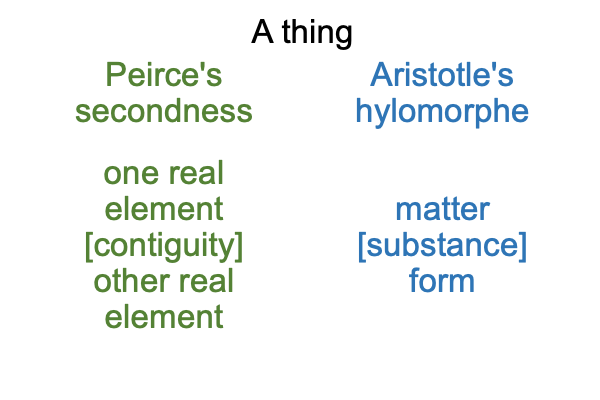
0011 Aristotle’s hylomorphe is an exemplar of Peirce’s category of secondness.
Plus, the contiguity between matter and form may be labeled with the much abused term, “substance”.
0012 How does this apply to a literal interpretation of the Bible?
Consider the following application.
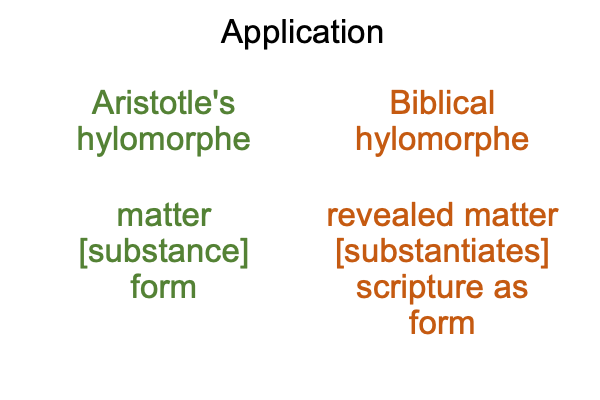
0013 Now, if a literal interpretation regards the text as a thing, then matter must be presupposed, because the text is present. For the Bible, matter is revealed. Matter may include being (in Latin, ens, being itself). Beings are relational. So, revealed matter may be called “being substantiating”. In Latin, this corresponds to the term, “esse”. Esse_ce is the matter (or being) of what goes into a literal interpretation. In other words, the text portrays something real that substantiates form.
If the text is a thing, then it must take a form. For a literal interpretation of the Bible, scripture is a form that literally portrays forms. This is the essence of the literal interpretation of scripture.
0014 Here is a diagram.
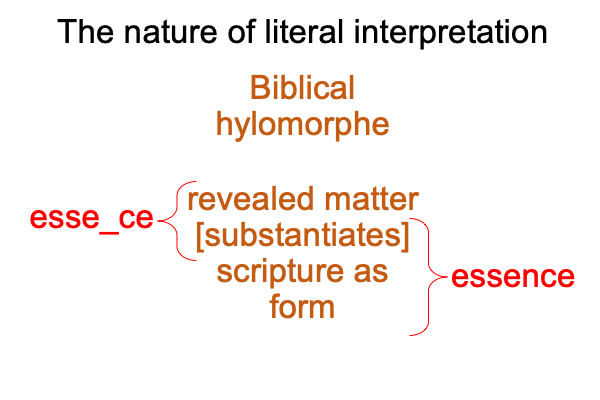
In Walton’s terminology, “reference” corresponds to esse_ce (that is, matter or being substantiating).
“Affirmation” corresponds to essence, (that is, substantiated form).
0015 Literalism assumes that the esse_ce and the essence of what the Biblical text says is as real as the presence and the form of the Biblical text itself.