0016 Now, if I know a person and that person tells me something, then what that person tells me is a real as the person that I know.
This may seem to be an odd way to consider how literalism works.
Literalism presumes that what the Bible says is as reliable as the person writing the text.
According to the Old Testament, that person is Moses.
But, for the past two centuries, an academic movement called higher criticism strives to ascertain who wrote the Old Testament, by analyzing writing styles within the text itself. Each writing style indicates a different person.
0017 Perhaps, there is an additional complication.
I suppose that I need to figure how the person that I know (the author) makes what the person says (the biblical text) real.
One answer is that the person that I know serves as a mediator that turns the matter of something into the form of an… um… text.
The triadic structure of mediation comes to mind.
A triadic relation is a relation that employs all three of Peirce’s categories.
0018 Here is a picture.
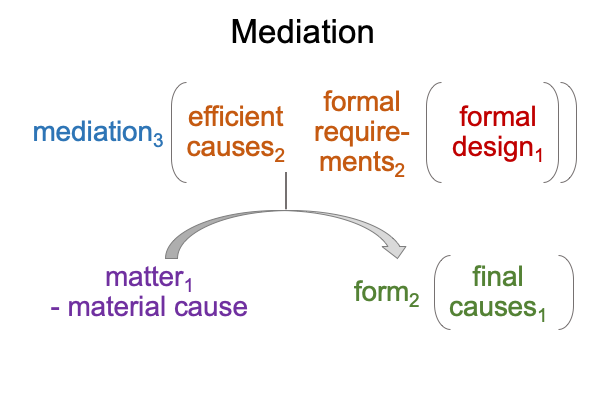
0019 The mediation3 itself belongs to thirdness. Thirdness contains three elements, one from each category. The subscript indicates the category. Thirdness is the realm of triadic relations, including mediations, signs, judgments and category-based nested forms.
Peirce’s concept of precission is on display in the structure of mediation3. Precission underscores the fact that each higher level emerges from the adjacent lower level.
Thirdness prescinds from secondness.
Note how there are two real elements that support the mediation3.
The first is efficient causality2. Efficient causes2 are at work in turning matter1 into form2.
The second is called “formal requirements2“. Every design1 has formal requirements1.
For example, a text (as form2) has a formal requirement of an author saying something1 (as matter). If the author says nothing, then the text is blank. So, a text2 (as form) implies that someone3 (the mediator) is saying something1 (as matter) according to the author’s design1.
Design1 belongs to the realm of possibility, so the author’s design1 can somehow manifest God’s design1. For example, a warning of an impending event could also be God’s way of telling future generations that the author is prophetic,because the warning turns out to be applicable to an event far into the future.
0020 The form2 belongs to secondness. Secondness is the realm of actuality. Secondness prescinds from firstness. In this case, the form2 prescinds from intention1. Like formal design1, final causes1 belong to firstness, the realm of potential.
0021 Finally, matter1 belongs to firstness. And that is quizzical, because in Aristotle’s hylomorphe, matter belongs to secondness.
0022 Okay, mediation3 portrays that matter1 becomes form2 in a triadic relation.
Aristotle’s hylomorphe says that {matter2 [substantiates] form2} in a dyadic relation.
How am I to understand these two configurations?
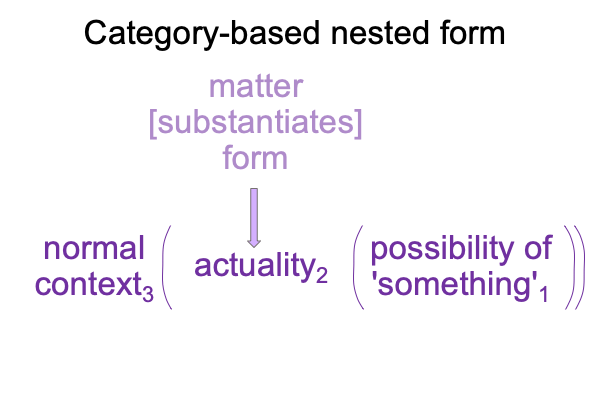
0023 Oh, the term, “understanding”, calls to mind the category-based nested form.
We encounter things as actualities2.
We can understand the thing that we encountered2 by placing it2 in a normal context3 and potential1.
0024 Here is a picture.
0025 For further reading, consult A Primer on the Category-Based Nested Form and A Primer on Sensible and Social Construction, by Razie Mah, available at smashwords and other book venues.
If I put the above figure into words, I say, “A normal context3 brings an actuality2 into relation with the possibility of ‘something’1.”
0026 For a literal interpretation of the text, the text tells us things, corresponding to Aristotle’s hylomorphes. A thing is present because of matter. A thing is what it is because of form.