0027 I know what you are thinking.
What about John H. Walton’s book?
Is it about literalism?
0028 If so, from the introduction, I gather that matter has something to do with what makes Genesis 1-11 present. Or maybe, what does Genesis 1-11 make present?
I label Genesis 1-2.3, “the Creation Story”. I label Genesis 2.4-11, “the Primeval History”. Some authors differ on this nomenclature.
0029 Okay, Walton wants to narrow these explorations to Genesis 1-4, the Creation Story and the Story of the Fall.
0030 The form is the scriptural text itself. In particular, the form is written in Hebrew, using particular words. The form is substantiated by the cultural circumstances of authors living in ancient Near East civilizations.
Indeed, the canonized form reflects the circumstances of redactors living some time after the return to Jerusalem after the exile to Babylon.
0031 Here, I am getting ahead of myself.
Why?
Literalism presumes that what the Bible says is as reliable as the person writing the text.
Walton asserts that what Genesis 1-4 says is as reliable as the redactors who composed the text.
0032 In order to understand this, we must look at the Creation Story and the Story of the Fall as a thing2 that enters a category-based nested form.
Plus, this nested form corresponds to a redaction3 as the mediation3.
0033 Here is the general picture.
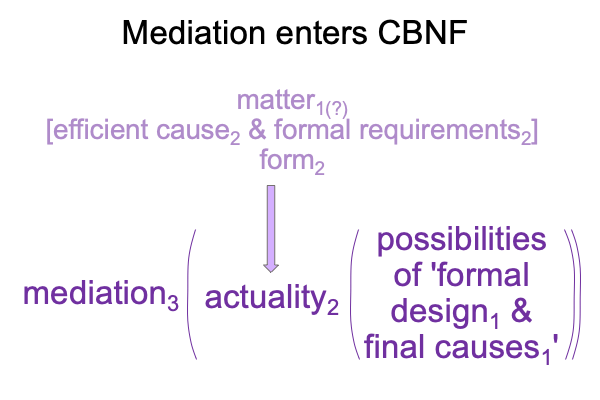
This figure expresses a mediation as if it is a category-based nested form.
Mediation3 becomes the normal context3. The formal design1 and final attributes1 go into potential1. Matter1(?)substantiates form2. The substance contains efficient causes2 and formal requirements2.
0034 Now, the redactor3 operates in the name of Moses. So, it is my understanding that the mediation3 involves divine inspiration3 and the formal design1 concerns what the redactors are constructing1 (with God’s permission) and um… their intentions1 (again, with God in the picture1).
The normal context3 and potential1 are on display in the introduction in a section titled, “Synopsis of the Message of Genesis 1-3”.
0035 A mediator3 compiles Genesis. That mediator is the redactor3. The redactor3 operates on a design1 and with intentions1.
0036 In the Creation Story, one intention is to show that God’s acts of creation bring order, where order grounds a stable and properly working world. God’s design is for humans (His image bearers) to work alongside God as partners for bringing order. God is sovereign, and His royal presence in His cosmion… er, temple… establishes a patronage relation with humans.
0037 In the Story of the Fall, the intention is to describe people’s inability to create meaning. Genesis 2.4-4 portrays several attempts to establish order, like naming the animals, obtaining a side-splitting helper, going naked and not being ashamed, as well as obeying the command not to eat from that poisonous tree. I don’t know whether these activities are designed to establish order. To me, they sound like things to do in the royal gardens of a deity who will let one get away with anything but one thing.
0038 After doing that one thing, the humans get evicted from the royal gardens and have to figure out how to achieve order on their own. Civilization follows.
Well, in Genesis 4-11 civilization does not offer an improvement. A reader can argue that the revelation (matter) is designed to show how the usual ways for seeking order do not work. Only a covenant with God will save the people of Israel.
0039 I hope that I report the author’s text correctly, because I know that literalism presumes that what my text says is as reliable as the person writing the text.
I call this, “authorial authority”.
0040 If I look at the above figure, I conclude that my own authorial authority may be questionable when it comes to laying out the mediation3 (by the “redactor” or “compiler”), the formal design1 (to orient the people returning after the exile) and the final causes1 or intentions (to communicate about the nature of order in the ancient Near East cultural milieu… er… river).