0078 Yes, the business about the Tartu-Moscow School of Semiotics, at least its first manifestation (1960s-1980s), is off the rails.
No, I am still on the track of Walton’s methodology in chapter two.
0079 Here is an application to the interpretation of the Creation Story (Genesis 1-2.3) and the Primeval History(Genesis 2.4-11).
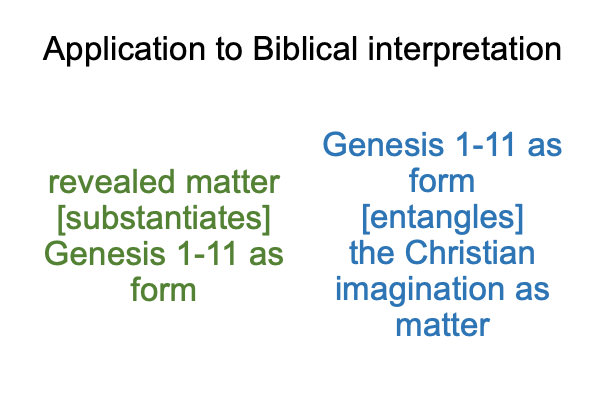
0080 In the scientific modern age, the Christian imagination is informed by science. Since the positivist intellect rules out metaphysics (especially, when “metaphysics” means “religious presuppositions”), many aspects of the Christian imagination are already… how shall I phrase it?… “disallowed”.
After all, science is invented only after the plain-speaking traditions of the Reformation are hijacked by the speak-plainly exhortations of the mechanical philosophers. Disciplinary languages are constructed in such a fashion that the meaning, presence and message of each technical term is obvious to all. Technical terms are rigorously defined.
0081 This is absolutely the case for the disciplinary languages of mathematics, physics and chemistry and its derivatives, including astronomy, geology, biochemistry, and so on.
This is a little less absolute for the disciplinary languages of biology and its derivatives. After all, what do the words, “adaptation” and “niche”, really mean?
This is no longer absolute for the disciplinary sciences related to humans, but pretending to be scientific, ranging from economics to health sciences.
Finally, this is downright wooly when variations of Aristotle’s hylomorphe are taken to be models.
0082 Now, where was I?
Oh yes, the modern Christian imagination is informed by science.
This can be pictured as a confounding, as follows.
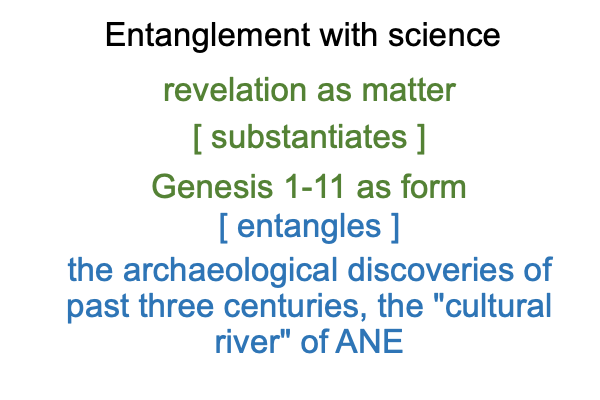
0083 Of course, confoundings are dangerous.
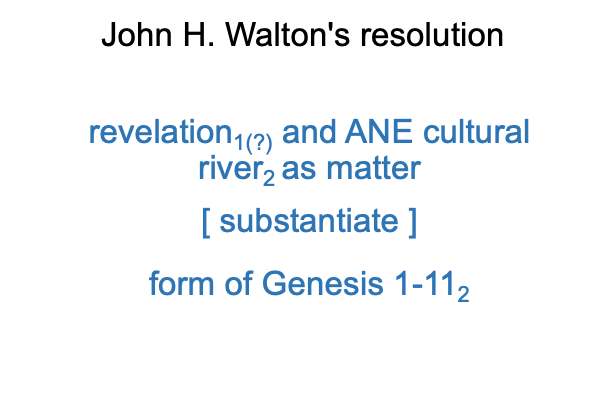
John H. Walton resolves the danger in the following fashion.
0084 Hmmm.
On page 36, it seems that the author explicitly rejects this resolution. He does not suggest that the literature of the ancient Near East (ANE) carries authority or that it stands next to Scripture. Instead, he insists that the literature of the ANE provides a reliable window into how people thought in the ancient world. Therefore, it um… provides information… that is… um… essential to the process of interpretation.