0412 Let me go through some of the items that Santner examined in the course of his discussion.
Jean-Paul Marat, the one who died in a bathtub, may have thought that he was an angel, but his assassin Charlotte Corday, thought he was a devil (Preface 0.2).
In Shakespeare’s The Merchant of Venice, Portia, in the guise of the lawyer Balthazar, serves as an angel, praising the laws of the city (Lecture 1.2).
In Kafka’s stories, various bureaucrats act as messengers, but have no truth, hence, no message to tell (Lecture 1.4).
0413 Professor Bonnie Honig adds Herman Melville’s Captain Ahab to the list. Ahab is a devil who wants to deliver a message to the leviathan that stumped him (First Comments).
Moby Dick portrays the dangers of mercantilism as brilliantly as The Merchant of Venice.
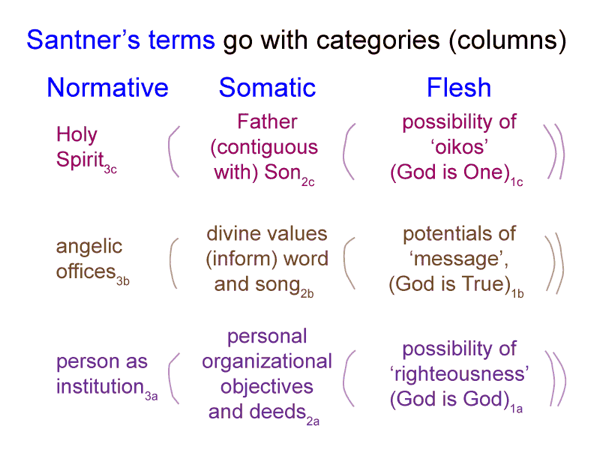
0414 In addition, Santner’s key terms, normative, somatic and flesh, correspond to the columns of the angelic model.
The flesh corresponds to possibility. The somatic emerges from and situates the flesh. The normative brings the somaticinto relation with the possibilities inherent in the flesh.
0415 The sovereign office compares to the angelic office.
The one who occupies the office is more than he otherwise would be. The king would be just another person. The angel would be nothing. Or worse, the angel would retain its office while proclaiming a false message. Similarly, the mortal body of the ignoble prince grows corrupt.
0416 Erik Peterson concludes his 1935 book with this: Knowledge of God culminates in praise of God. Theology builds into doxology.
0417 For Santner, doxology takes on a life of its own.
Theologically informed acclamations may be transubstantiated into political glorification.
0418 How is this so?
The sovereign offices occupy the same slot as the angelic offices.
Theological acclamations always carry political undertones.
A political slogan may sound identical to a theological message.
0419 Both angels and sovereigns proclaim.
Angels proclaim the actions, laws and decrees of God.
In the late medieval and early modern periods, the king, or rather, his ministers, proclaimed sovereign actions, laws and decrees in the name of God.
In modernism, the same bureaucrats proclaim in the name of the People.
Or maybe, they do so in the name of institutions that stand in for the People.
It’s hard to see what is upstairs.
Do administrators stand for anything, other than their appointed duties?
0420 Both angel and king situate the subject, the regular folk.
Agamben argues that traditional acclamations of the king’s legitimacy (or kingliness) weighted the occupant of the sovereign office.
The weight of the king’s flesh is somatic (soma is “body”).
Nobility supplements the king’s mortal body.
0421 The king’s glorious body congeals vibrant doxological matter.
The noble flesh of the king appears to embody an angelic message: This mortal being serves a royal destiny.
0422 Similarly, the truth of God congeals vibrant doxological matter.
But, what is the weight of an angel’s flesh?
Word and song accompanies the angelic office. An angel embodies word and song.
0423 These words and songs are witnessed by the folk.
0424 So is the mortal body of the king.
0425 Is the supplement of liturgy necessary?
The king has a mortal body. Why does he need a glorious one?
Does a political theology of sovereignty require a theological oikos-onomy of glory?
0426 If so, then the supplement is foundational. It is the libidinal oikos-onomic base that shapes the political bond.
0427 This logic seems both circular and foundational.
In Christianity’s divine Oikos, doxologies appear to be a mode of God’s own Self-glorification.
0428 One problem is that God does not have a Self, but that does not matter for this argument. The angels are singing about something up there.
Does it matter whether the words and songs are about God’s Self (not Christian doctrine, since God is a Household) or the contiguity between the Father and the Son (which is not a Self, but a connection that may be symbolized by a name)?
0429 I suppose this technical aside sounds neurotic, consistent with a picture of circular logic.
Yes, this is the stuff of obsessions.
Why else would Santner give these lectures?
Why else would anyone consider them?