0182 I now turn to science and the Gnostic origin myth.
The associations are clear. The contiguity between superego and ego(idreal) is not scientific causality. Superego [causes] ego2a is an artifact of the elite version of the Gnostic origin myth.
This content-level actuality is a symptom of the exclusion of the superego by the Sophia-promoted Self. Expertise in state-funded cultural studies and on American television expresses the meaning underlying the word “religion”.
This expertise is a social construction, labeling itself “social science”.
The experts have secret knowledge that they verify through surveys and dramatic examples.
0183 This raises a question: Where does actual science enter into the picture?
If science has anything to do with this madness, then where would it fit?
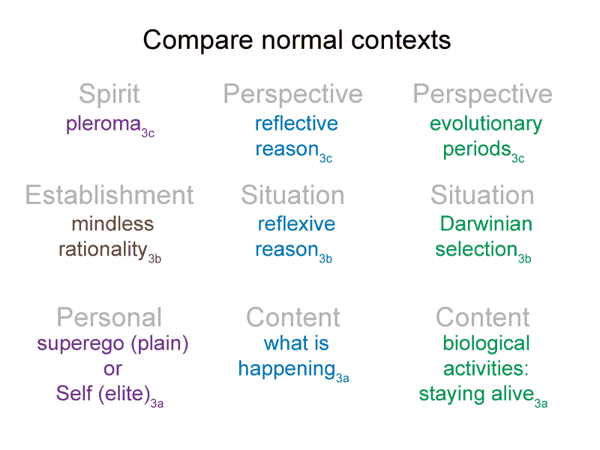
0184 I begin my discussion of this topic with a comparison of the elements of thirdness among three models: (1) the Gnostic origin myth, (2) Suarez’s interscope on mind-dependent being and (3) the current (8816 U0’) biological sciences.
The normal contexts for the biological sciences are not final. I simply choose topics that seem to correspond to the other two.
0185 What is my first impression?
In the Gnostic myth, mindless rationality3b characterizes any particular aeon3c and virtually defines the superego3a. Ironically, mindless rationality3b is not aware that its horizons are limited to its particular age3c.
Similarly, reflexive reason3b typically does not evoke reflective reason3c. Reflexive reason3b should solve any situation. Reflective reason3c may adjust one’s take on ‘what is happening’3a after reflexive reason3b runs into problems.
Similarly, Darwinian selection3b reinforces stasis during an evolutionary period3c. The same drama of staying alive3ais played over and over for millions of years. When Darwinian selection3b alters, then this stability3c disappears and new tactics for survival3a appear.
0186 The comparison makes me wonder: What is the pleroma3c? Is it emanations of male and female pairs representing aeons of mindless reason3b? Or is the pleroma3c the wheel drawing the elite Self3a into the turning of an age? Does the actuality of Sophia2c denote the one becoming the other?
In other words, does the pleroma come into play when the mindless rationality of the current aeon fails?
It must be, since reflective reason comes into play when reflexive reason becomes confounded. In the same way, an evolutionary period ends when Darwinian selection significantly changes.
0187 Is the Gnostic origin myth a fairy tale about something catastrophic in the nature of the other two topics?
Did some event in our past both destroy the reflexive reason characteristic of the Lebenswelt that we evolved in and, at the same time, significantly change the reproductive success of humans?
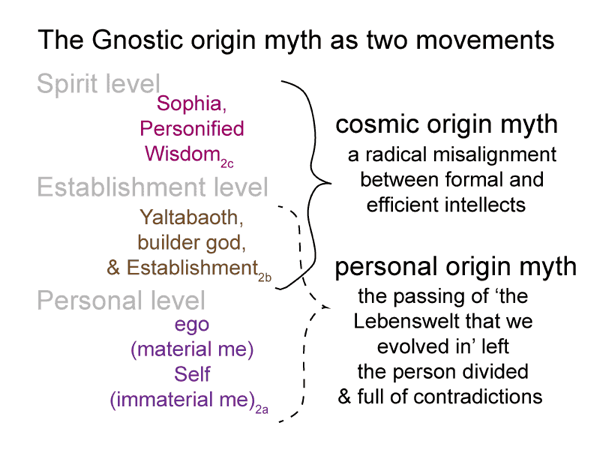
0188 On top of that, did this catastrophic alteration in the human Lebenswelt produce the division of the person into material and immaterial aspects, the ego and the Self?
Whoa. What a nightmare.
0189 Consider the person.
The superego3a is the normal context in which the ego2a takes responsibility for the Self2a. When the Self3a becomes the normal context, the person becomes a husk of social conditioning (superego) causing material concerns (ego & idreal).
A distortion of the person along the axis of material and immaterial opens the door to both permutations.
The superego3a and the Self3a are normal contexts that belong to our current Lebenswelt.
I doubt whether they belong to the Lebenswelt that we (humans) evolved in.
0190 Consider our cosmos.
The eternal cycles of the pleroma became immanent.
The unfolding of the aeons came down to Earth at some point in human prehistory. It came down as a huge mistake by Sophia. It describes the cloud where Yaltabaoth resides. Yaltabaoth begins as a lion and ends as a snake.
The Gnostic origin myth captures a radical separation between reflective and reflexive reason as a loss of the Lebenswelt3a that we evolved in.
0191 The Gnostic fairy tale contains two origin myths. Each addresses a catastrophic division within our world and our person.
0192 The next question that arises is this:
Can anthropology propose a prehistoric event that accounts for these coordinated fairy tales?