0257 I now turn to the treatment of Gnosticism as a suite of infrasovereign religions.
Gnosticism infiltrates institutions, turning them into infrasovereign religions.
Unfortunately, the organizational objectives within any infiltrated institution cannot be taken at face value.
How should I appreciate Gnostic organizational objectives when nothing is what it seems to be?
How do I unlock secrets held within the myth?
0258 Is it fair to compare the Gnostic origin myth to models concerning the presence underlying the word “religion”?
I hope so, because that is what I intend to do.
Two relevant interscopes appear in How To Define the Word “Religion”.
One interscope models the society tierC. The society tierC is composed of the three levels of institutiona, sovereignband suprasovereignc religion.
The other interscope models the three tiers of societyC, organizationB and individual in community (IiC)A. Each tier is an interscope containing three levels. I call this model the three-tier system.
0259 The following sections detail this comparison.
I start by comparing the Gnostic myth to a model of the society tier.
0260 The society tierC is modeled as an interscope. The three nested forms look like this:
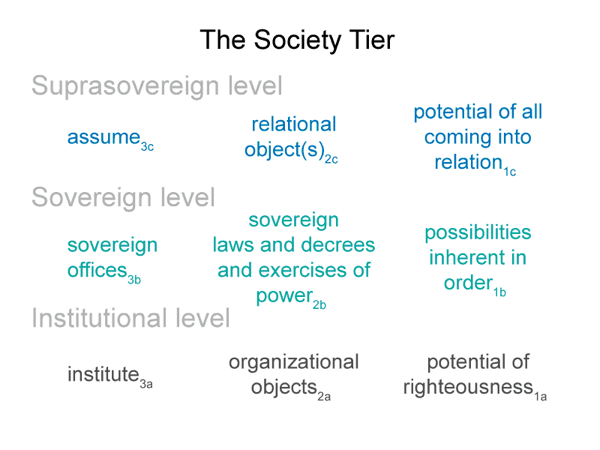
0261 The word “power” is equivocal. Sovereign offices carry sovereign power. Institutions carry disciplinary power. Power is witnessed in its exercise.
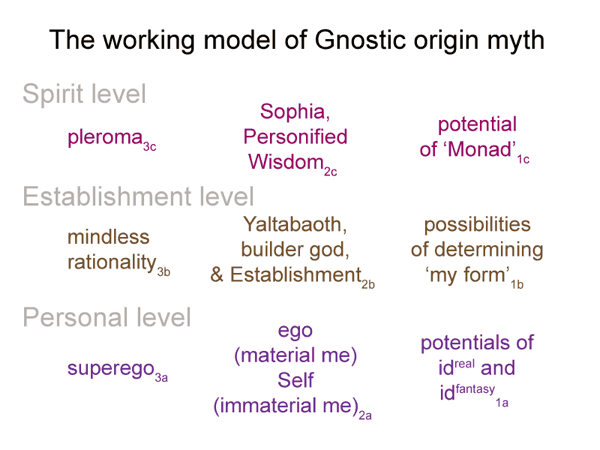
0262 The working model of the Gnostic origin myth looks like this:
0263 Let me juxtapose each virtual nested form according to category, starting with firstness.
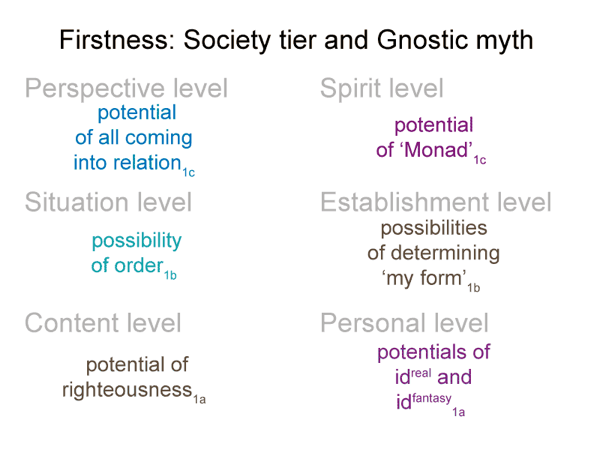
The comparison is remarkable.
0264 Idreal and idfantasy may be viewed as two different qualities of righteousness.
Idreal relies on the righteousness of Yaltabaoth and the Establishment. Yaltabaoth and the Establishment provide accounts for everything one might encounter. The ego is confident in its pursuits involving material concerns.
0265 Both idreal and idfantasy are virtually situated by possibilities of determining my form.
This matches the possibility of order.
0266 Idfantasy-fed experiences of the Self, then, may interfere with the possibility of Yaltabaoth and the Establishment maintaining order. Idreal-fed accountings by the ego reinforce the possibility of order. The association re-iterates the concept of the Self as subversive.
0267 Idreal feeds into determinations of my form that contribute to order.
Surely, that sounds like Freud’s depiction of the desires underlying the ego. The reality principle1a terminates in order. Idreal does not proceed to the perspective level because order manifests continuity with the perspective level. Order takes the big picture for granted.
0268 Idfantasy feeds into determinations of my form that will be put into perspective by potentials within the Monad. The Monad acts to reify possibilities within idfantasy.
0269 In a previous example, I experienced a fantasy. I felt that there ought to be a world where friends never lie to one another.
The Monad responded by saying, “Yes, I am that world.”
To me, the Monad corresponds to Utopia. “Utopia” is a word that literally translates into no where.
So, when I go off to find my Self. I will be going no where. Plus, in order to get there, I will have to get around Yaltabaoth and the Establishment.
0270 Here is a juxtaposition of the virtual nested forms in the category of secondness.
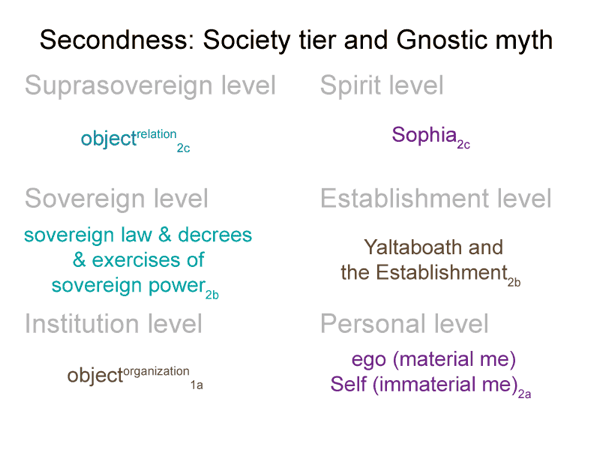
0271 Here, the organizational objective2a directly matches the ego and the Self2a.
If the organizational objective is development, then there are two types of development. Yaltabaoth and the Establishment develop my ego. Sophia develops my Self. One exercises the authority of the sovereign. The other exercises no authority whatsoever. Instead, it judges the sovereign as inadequate in regards to the potential of Utopia.
0272 For example, the establishment accepts the drama where one friend lies to another and says, “Deal with it.”
Sophia finds all that terrible. From the point of view of Utopia, almost everything that Yaltabaoth and the Establishment do is unacceptable. The Self may encounter constant rage. The Self may yearn to fly, like a bird, over the Establishment level to Sophia.
0273 The ego engages a world manufactured by the builder gods. The ego obeys the laws and decrees of the sovereign. The ego adapts to exercises of sovereign power. The ego deals with rules.
The Self says, “This is not right for me.”
0274 The Self, therefore, makes no effort of obey or defy sovereign laws and decrees. It does not seek to organize resistance. It does not say, “I will do what I am told to do.” It does not seek to build a better world. Instead, it seeks to fly.
Fly away.
This is the organizational objective2a of type 1 Gnosticism.
0275 The Self constructs wings of secret knowledge. These wings are magical. They can lift the Self towards the immaterial Sophia through manipulations of the material realm.
Like Utopia, Sophia is a destination. She is Personified Wisdom, despite her apparently foolish role in giving birth to the current Yaltabaoth and Establishment. She represents the object that will bring the Self into relation with It-Self.
Be your Self. Find your Self.
0276 Once I make it to Sophia, ecstatic union ensues.
Now, I may discard my wings.
Why?
No one can assume that I am here. If you come to my door, Personified Wisdom will answer.
0277 Here is the comparison in the category of thirdness:
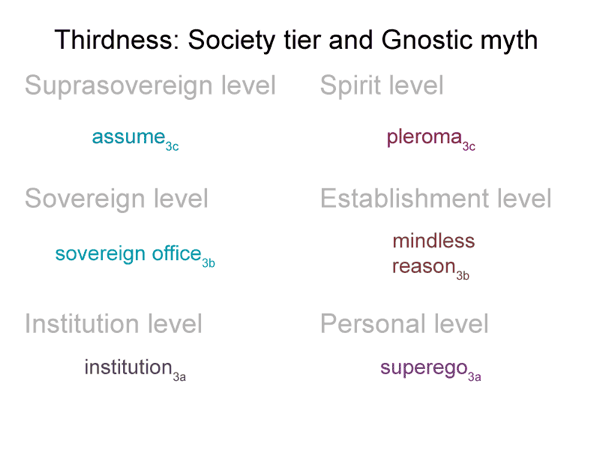
0278 When a Sufi mystic writes poetry, the superego is gone. There is no institution, no organizational objective and no righteousness. The Sufi poet revels in a mystical union with God. God occupies the place of Sophia. God is Personified Wisdom.
0279 Has the Sufi poet disappeared?
Don’t make assumptions, because the poet has been assumed.
0280 In Christian tradition, two figures were assumed. One was Enoch, whose assumption is mentioned in passing in the Genesis genealogies (Gen. 5:21-25). The other was Mary, the Mother of Jesus.
0281 Both mark the passing of one age into another.
Enoch marked the passing of the age of Adam. This age extends from (say) the first singularity to early religious and political consolidations within unconstrained complexity. It goes from the early Ubaid to the late Uruk. The story of the Flood is found in both Old Testament and Sumerian mythology. It corresponds a catastrophe in late Uruk period.
Mary also marks the passing of an age. This age extends from Adam to Jesus. It goes from 0 U0’ to around 6800 U0’. The Old Testament prepares the way for the coming of the Messiah.
Then, oops, Jesus appears and rises from the dead.
0282 Metaphorically, the Self who achieves ecstatic union with Sophia has been assumed. The Self does not walk in the halls of power. The Self does not dwell in the world of mindless reason. The Self de-institutionalizes the superego. The pleroma is the passing age.
0283 This is characteristic of type 1 Gnosticism.
Its objectorganization2a concerns Self-actualization regardless of the present regime.