0320 In the following figure, brown is evil and red is good.
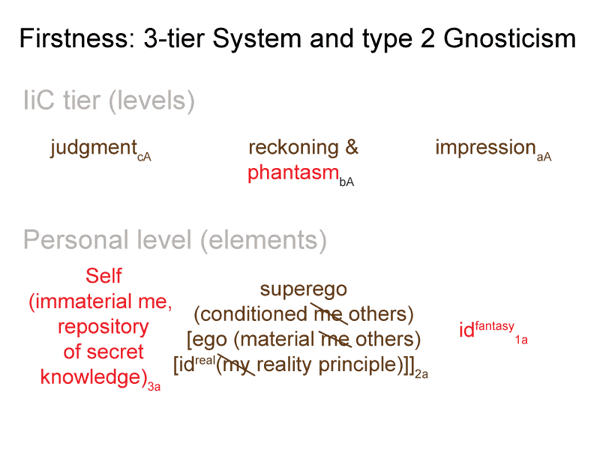
0321 Already, this looks a little scary, since the de-humanization of others is built into the realm of actuality.
Other people are machines or animals or little folk. They are people possessed by material concerns, the daemons of Yaltabaoth and the Establishment. As such, they are evil.
0322 In the Gnostic origin myth, the Establishment level is ruled by mindless reason. The Establishment level is dominated by the builder god and his establishment. It situates the ego through material concerns.
0323 The establishment level matches the organization tier in the 3-tier system. The comparison follows:
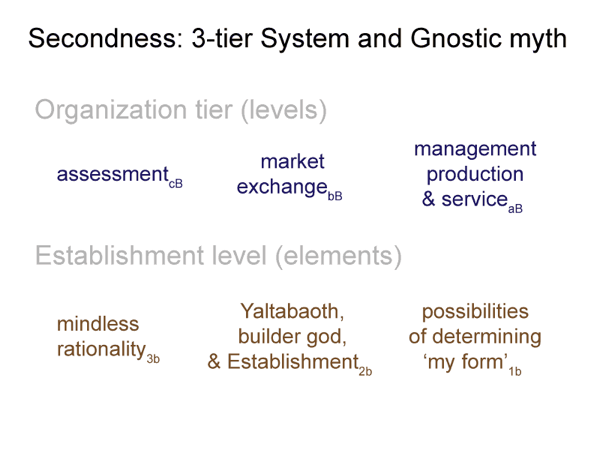
0324 Let me go over the storyline for the organization tier, before delving into the comparison.
Here is how the organization tier goes from content to perspective levels.
The individual in community (IiC) makes a judgment. The judgment inspires the individual to associate with others of similar judgment. If the judgment is about material concerns, then the individual may join or invent an organization. This organization will manage, produce or service these material concerns.
0325 If the organization is a factory, then management, production and service come into play in its operations. The money brought in from product sales must be greater than all costs of manufacture, delivery and sales. So, there may be conflict among the various parties within the content-level of the organization tier. Management always wants to pay less salary than factory workers think they deserve.
0326 The price of the product in the market minus the cost to the worker in the production of the product resembles Marx’s concept of surplus value. The price is always set to bring in more money than total costs. The cost to the worker cannot be measured since it involves lost opportunity. Consequently, Marx’s concept of surplus valueconstitutes secret knowledge.
0327 Goods and services must be marketed. In an open market, the exchange occurs when both parties are willing to exchange something of value. You give me this. I give you that. The exchange would not occur without benefit to both parties.
In market exchange, others participate in the corporation without directly belonging. Whenever I buy a loaf of bread or an automobile, I participate in an organization, even though I think that I am buying a simple commodity. This is the idea behind Marx’s concept of the commodity fetish.
0328 At crucial junctures, the entire organization must be assessed. The question is: Do we continue to do what we are doing?
The answer must take into account the institutional mission, as well as the people in management, production, and services. The answer must take into account market exchange, the sales division, the price of the good, subsidies and taxes, advertising and the participation of others in the organization through purchases.
0329 Marxist theory condenses all these difficult assessments into one factor: capital. This is remarkable, because the status of the balance sheet is a necessary, but not sufficient, feature of an organization’s assessment. Marxist theory reduces assessment to capitalism.
0330 That reduction constitutes secret knowledge. Anyone who decries “capitalism” talks Marxist Gnostic lingo. The lingo’s “secret” is that assessment in the organizationcB tier is equivalent to mindless rationality3b. If that were the case, then stressed-out assessors would be liberated from both responsibility and freedom. All the assessors would need to do is follow a recipe.
0331 There is no “ism” for “capital”. The word “capitalism” is not a religious belief. Communism, the belief that capital is an undead thing that possesses the souls of assessors, is. Capitalism is the name applied to assessment by communists.
0332 Capitalism is a projection. Balance sheets are not.
(These topics are discussed in the two Primers on the Organization Tier.)