0118 What about Jesus?
Covenant and election theology, as well as acquisitional theology, call to mind the stuff of Adam and Eve, Moses, Joshua, David, Solomon, Nehemiah and Isaiah. This is the stuff of the Old Testament and associates to faith alone3b.
Once Jesus serves as the Alpha (the Word in Genesis) and Omega (the Messiah of God’s chosen people), then Greek philosophy enters into the picture. Where does our world come from? Where do we (humans) come from? What went wrong? What is the cure? This is the stuff of faith seeking understanding.
0119 Where does theology, the “study of God”, begin?
If the Bible reveals the form of God (that is, the essence of God), then theology should start with the matter of God (that is, His esse_ce).
Thomas Aquinas (1225-1274) offers proofs of the existence (the esse_ce) of God at the start of his grand synthesis.
0120 Centuries later, the Puritans, now settled firmly in New England, cannot deny the intellectual richness of Christendom (that is, Catholic Europe before the Reformation). Their Protestant tradition rejects many of those riches. Nevertheless, members are aware that their own Calvinist traditions require a synthesis greater than what John Calvin (1509-1564) offered.
They need a systematic review of the theology of the Massachusetts’ Bay colony.
0121 This is the topic of Chapter 6.
0122 In 1727, Sam Willard publishes one attempt, under the title, A Compleat Book of Divinity.
In this treatise, the radical rupture between faith and reason is plain to see. The foundations of this Christian… or is it Judeo-Christian?… faction stands completely in the realm of Protestant faith and outside the realm of Catholic reason.
Unfortunately, there is another reason in town.
The mechanical philosophers of the 1600s propose “scientific reason” and take the literalism of the Reformers to the next level.
0123 What happened to reason?
Before reading my story about what happened, take a look at the following three situation-level nested forms and ask, “Which of these do I associate with faith and which do I associate with reason?”
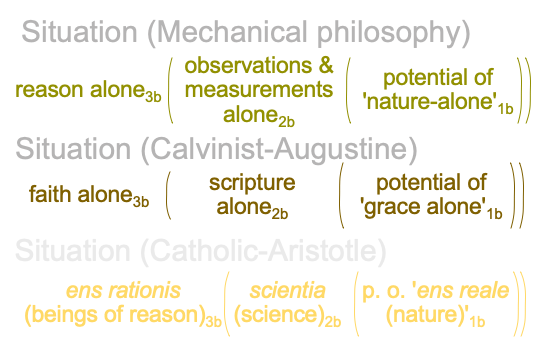
The mechanical philosophers propose a mirror image of the Protestant philosophers.
Now, here is a story about the fall of reason.
0124 God cast Adam and Eve out of the garden of Eden, while saying, “What the hell were you thinking?”
John Calvin puts it this way (more or less), “Adam replies to God as fallen humanity stands on the far side of the waterway, ‘Yeah, I guess that our behavior does not make much sense.'”
That admission does not stop the cherubim from replying, “Move along. Nothing to see here.”
Why does the angel not sympathize with Adam’s regrets?
The messenger knows (along with John Calvin) that fallen human reason is totally deranged.
Oh, I meant to say, “depraved”.
0125 It’s like a weird vitamin deficiency.
Or, it’s like a infectious agent that modifies the human genome.
0126 Before the Reformation, when goofy, philandering, friendly, intoxicated and otherwise collaborative monks operated vast estates, built over centuries by occasionally strenuous labor, grace inflowed nature. Patience and hard work tamed a wild landscape.
During this time, grace is like matter. Nature is like form. Nature without grace is not conducive to human flourishing. Nature with grace is like brewing beer. Since humans belong to nature, as well as to God, catholic intellects wove sacraments from the threads of the Lord’s words and actions. For example, the sacrament of confession forgives sins (unlike that cherubim, who had no kindness for Adam) that allows the wayward back into communion. The sacraments offer grace that flows into human nature, which is fallen, but not so fallen as to be unable to reason along with Aristotle and Plato.
0127 After the Reformation, the monastic communities are looted. The shared fields are fenced off. Manors are built on properties with titles. The titles represent capital. Ownership becomes a sign of God’s favor. The Puritans work diligently and do not waste their wealth on indulgences. The scriptures are now interpreted by faith alone. They don’t need priests to read the Bible for them.
0128 Here is the deal.
In this realm of total depravity, God offers a covenant to the chosen. The one’s predestined to say “yes” in reply become electors to the heavenly realm.
Here is the catch.
The “yes” that makes me an elector remains just a word, a thin thread that holds me from falling into the bottomless pit of total depravity, the world without faith or reason.
0129 Here is a picture of the dilemma posed by the matter of covenant-election2am [substantiating] the form of being suspended by the thin-thread of God’s mercy above the bottomless pit of total depravity2af.
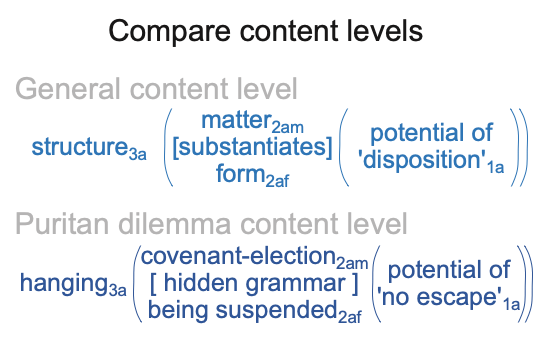
Willard’s systematic theology is supposed to assist by establishing firm footing.
But, it does not succeed.
0130 The elector says, “The uncertainty is killing me. But, what about joining a party to head out West?”
What about settling a new place, where I can cut the forest and build my own farm, and live with a nature that is open to God’s grace?
An escape from the Puritan’s total commitment despite complete uncertainty opens.