0127 At this point, I would like to touch base with section three of chapter one (S3C1), in order to further the develop the idea that a semiotic reading of human evolution lies below the surface of Dr. Noe’s text. The last section of chapter one is titled, “Art in Mind”. The section is devoted to the Garden of Eden.
0128 It is as if the author suggests that the Lebenswelt that we evolved in “entangles” our current Lebenswelt.
What on earth does that mean?
0129 Here are some key points for a semiotic reading of human evolution.
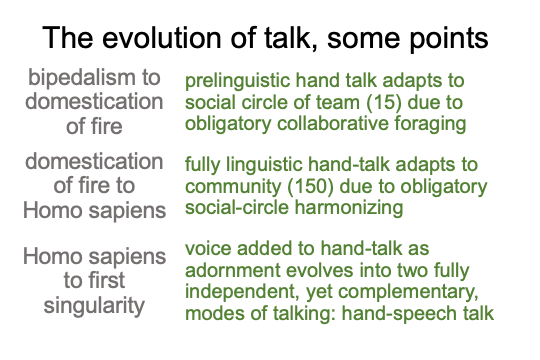
0130 The zero point is that the evolution of talk is not the same as the evolution of language.
0131 The first point is that hand-talk adapts to the niche of sensible construction.
A prelinguistic hand-talk evolves first as an adaptation to the social circle of the team (15), under conditions of obligatory collaborative foraging. Team activities require hand-talk for communication. Each team develops its own set of manual-brachial gestures. Hand-talk is prelinguistic in that only sensible construction is conducted. For example, the word, [image-RAVEN] may serve as a noun, a type of bird, or an adjective, a color such as [image-RAVEN][point to TREE], that black tree. Because the manual-brachial gesture pantomimes or points to its referent, interpretation follows the intuitively natural contours of icons and indexes.
0132 The second point is that hand-talk then adapts to the niche of social construction.
A fully linguistic hand-talk evolves as an adaptation to the community (150), the team of teams, under conditions of obligatory social-circle harmonizing. Once fire is domesticated, teams multiply and prosper. In order to achieve harmony among the teams and among all the social circles (family (5), friends (5), team (15), band (50), community (150), mega-band (500) and tribe (1500)), hand-talk must create counter-intuitive cognitive spaces through social (as opposed to sensible) construction.
For example, the fabled [image-RAVEN][image-MAN], sensibly interpreted as a man who is black, is socially regarded as a man who is a raven. The adventures of raven-man, told in a fully linguistic hand-talk, offers lessons on how to get along among teams and so forth. Perhaps, I may dare to say that hand-talk becomes fully linguistic in order to convey fairy tales in communal settings.
0133 The third point is that the voice is added to hand-talk as an adornment to fully linguistic hand-talk at the start of our species, Homo sapiens. Razie Mah examines this transition in the e-book, Synaesthesia and the Bicameral Mind in Human Evolution (also see his blogs for October and November, 2025).
0134 The fourth point is that a very recent cultural transition starts with the Ubaid of southern Mesopotamia. The Ubaid is the first neolithic culture to practice speech-alone talk. At that moment, say around 6800 B.C., all other cultures practice hand-speech talk. Today, all civilizations practice speech-alone talk. The North American Plains Indians and the Australian aborigines are the last cultures to practice a semblance of hand-speech talk.
0135 The story is told in Razie Mah’s nonfiction e-books, The First Singularity and Its Fairy Tale Trace, Comments on Original Sin and Original Death: Romans 5:12-19, as well as the fiction, An Archaeology of the Fall.
Indeed, the story is captured in Genesis 2.4 through 4.
0136 How weird is that?
It is so odd that Dr. Noe mentions this scripture at the end of chapter one (S3C1).
0137 The semiotic characteristics of hand-speech talk and speech-alone talk are very different.
Hand-speech talk relies on implicit abstraction, that is, works of abstraction that do not involve labels. Dr. Noe later calls this, “aesthetic work”.
0138 Here is my guess as to the appropriate sensible construction, assuming the current examination.
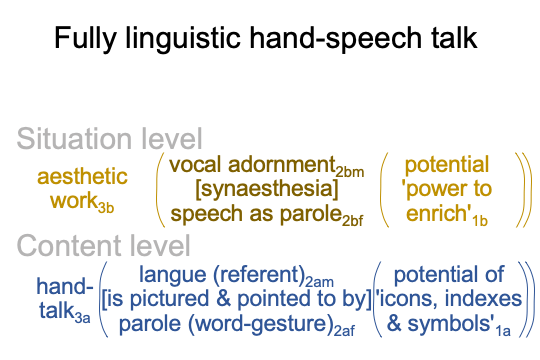
0139 On the content level, the structure-oriented normal context of fully linguistic hand-talk3a brings the dyadic actuality of {a langue corresponding to the referent2am [substantiates by way of picturing and pointing] a parole of a manual-brachial word-gesture2af} into relation with the possibilities inherent in ‘Peirce’s natural sign-relations’1a.
In sum, hand-talk is experienced as icons and indexes.
0140 On the situation level, the identity-oriented normal context of aesthetic work3b brings the dyadic actuality of {the voice as an adornment2bm [substantiates by way of synaesthesia] the form of speech as parole2bf} into relation with the potential of ‘the human to enrich the pictures and pointings inherent in hand-talk’1b.
The term, “synaesthesia”, means “sensory cross over”. In this instance, a visual impression is virtually situated with a sound impression.
0141 Speech-alone talk relies on explicit abstraction, that is, works of abstraction that involves labels. In fact, labels are all that speech-alone talk offers. Speech-alone talk cannot visually image or indicate their referents. So what do spoken-word labels refer to?
0142 Here is my guess as to the appropriate sensible construction, assuming the ongoing discussion.
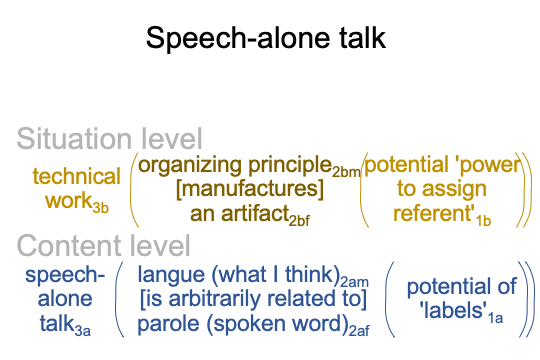
0143 On the content level, the structure-oriented normal context of speech-alone talk3a brings the actuality of Ferdinand de Saussure’s (1859-1913) definition of “language”2a into relation with the possibilities inherent in ‘labels’1a.
“Langue2am” labels cognitive activities that occur in response to a speech-act. Where did the referent go? Did it disappear into the potential to ‘label things’1a, only to be pulled back up by the situation-level potential to ‘assign a referent to a spoken word’1b?
0144 On the situation level, the identity-oriented normal context of technical work3b brings the dyadic actuality{an organizing principle2bm [manufactures] an artifact to serve as a referent2bf} in regards to the potential ‘power to assign reference’1b.
0145 For speech-alone talk, technical work3b conjures an artifact2bf that… allegedly… corresponds to what I think2am (that is, langue2am).
0146 The contrast between hand-speech and speech-alone talk makes prescient Noe’s mention of the story of Adam and Eve at the end of chapter one (S3C1). Eve follows the serpent’s instructions to label the fruit of the tree of the knowledge of good and evil as if it is the referent2am of a divine word-gesture2af. She proceeds to do aesthetic work3b, but really performs technical work3b.
The fruit of tree of the knowledge of good and evil2a does not ask Eve to sing of God’s creation2bm, like a voice2bm adorning a word-gesture2af. Instead, it2af requests a label2af that entangles an organizing principle2bm that turns what Eve thinks2am into a poisonous artifact of rebellion2bf.
Well, the fruit does not do all that. Rather, the fruit’s self-anointed agent does.