0185 Here is a picture for the entanglements in visual art, based on the interscope for speech-alone talk.
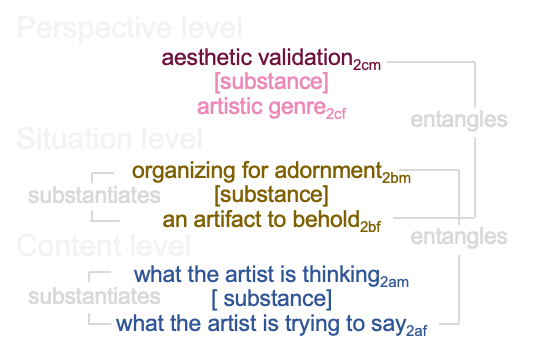
0186 The subject of the painting2am as matter transforms into what the artist is thinking2am.
The painting2af as form shape shifts into what the artist is trying to say2af.
The Renaissance style3b of paintings as decorative2bm shifts to what?… a modern style3b setting aside of architectural space for a painting as an adornment2bm?
After all, that is what experts do. They plan2bm that a painting2af should go into this particular location2bm. The space2bm substantiates the artifact2bf that validates the term, “art installation2af“.
0187 What does the viewer see?
I already discussed that in point 0174.
0188 Finally, beholding2bf entangles an aesthetic weighing2cm (“Yes, it looks like a bowl of fruit. The resemblance is amazing.”)… I meant to say… an aesthetic validation2cm (“Surely, whatever the artist is trying to say2af, the painting must be a work of art2bm, because it is located on the wall in a space reserved for artistic display2cm.”).
0189 In honor of what the author is trying to portray, while looking through the frosted lens of modernism and using the hazy vocabulary of the social sciences, I suggest that the above two images of the confoundings in the interscopes of hand-speech talk and speech-alone talk be copied and used as keys for appreciating the collection on display in any museum of contemporary art.
0190 That brings me to chapter five (C5), concerning the writerly attitude.
There is a straightforward view (S2C5, “Speech and Writing, The Simple View”) that writing simply records spoken words. Whatever one can say… (shaking my head “no”)… can be put into the written word.
0191 Why is this not the case?
If hand-speech is included in the basket labeled “spoken words”, then the spoken-work basket is 300,000 years old. In contrast, writing has been around for 5,000 or so years.
0192 Of course, to be fair, speech-alone talk is only 6,800 years old, more or less.
So, writing is a creature of speech-alone talk.
0193 However, writing starts in a way that calls to mind ways of hand-speech talk in a world of speech-alone talk. The first writing consists in ideograms (or conventional shapes) that are geared, not to adorn the things that they refer to, but to list them in some sort of economic and political transaction. For example, the temple sends four jars of wine to the widow of the former shaman.
Yeah, that is the one who refused to become a temple priest.
0194 The ideogram2af should be like a painting that renders its subject as present. However, since itemizing an economic shipment2am is not an aesthetic process2cm, the icon2af gets further and further simplified because it2af entangles the matter of organizing consensus2bm for things to be sent or received2am.
Here is a diagram.
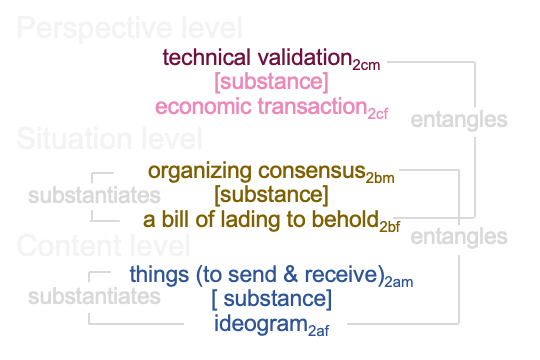
0195 In short, writing2af is invented to achieve consensus2bf in (what moderns will eventually label) “economic transactions2cf“, within, say, 2,000 years after the nominal starting point of the first singularity. When I look back from the present to the state of civilization 6,800 years ago, I have to proclaim, “My God!” That is a long time. A lot of crazy developments can pass, like water under a bridge, in six and four-fifths millennia.
0196 Among those developments is the idea that spoken words can be things to send and receive2am. The ruler of Kish sends a missive to the ruler of Lagash, saying, “Greetings and solicitations, that canal that your are building is on land that belongs to Kish.” To which, the ruler of Lagash writes back, “Kish, my ass.”
0197 A remarkable entanglement happens when spoken words are sent and received as things. Ideograms not only represent the idea of the thing that they supposedly picture, they also represent the sound of the word that proclaims the thing. The latter style3b is called “the rebus principle”. The ambiguity of ideograms creates great confusion among archaeologists who translate cuneiform tablets unearthed from the long-neglected ruins of royal libraries. Does this particular stylized impression represent the meaning of a spoken word or the sound of that word as a component of another word?
0198 Here is a diagram of the invention of the type of writing that westerners (the rebus peoples) are familiar with.
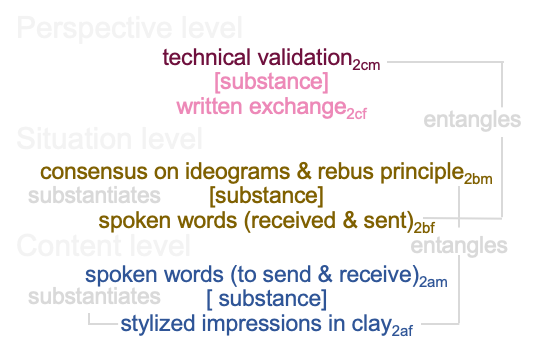
This diagram also applies to the type of writing that easterners (the ideogram and rebus peoples) are familiar with.
0199 Gottlob Frege (1848-1925) is a German philosopher (at University of Jena) who thinks about these topics. He comes up with the term, Begriffsschriff (“concept script”), for a purely ideographic script, perhaps without imagining that one could never write the word, “concept script” using ideograms. Nevertheless, one can imagine the possibility, therefore the technical term, “concept script” has a reference, even though it does not make sense, because one cannot ideate a “concept script” while talking in ideograms.
0200 To me, the preceding paragraph makes the rebus principle all the more attractive, as an avenue to a doctrine that can achieve even grander vistas of confoundings.