0201 Why did we (humans), at some point in our civilizational development, come to apply ideograms as symbols for the sounds of speech? Why did civilized people start to follow the rebus principle?
For westerners, the result is called, “the alphabet”, which only tells us the first two letters of the Greek syllabary. Greek writing is invented a little after 800 B.C. (or 6,000 U0′, Ubaid Zero Prime, nominally marking the start of the first singularity). Not much later, Homer writes the Iliad and the Odyssey based on the oral traditions of Greek bards. As it turns out, the stories tell of events during the Bronze Age, long after the Iron Age was in full gear.
0202 Today, our speech is conditioned by writing. We are convinced that our writing records our spoken words. Unfortunately, spoken words cannot be spell checked. Fortunately, written words can.
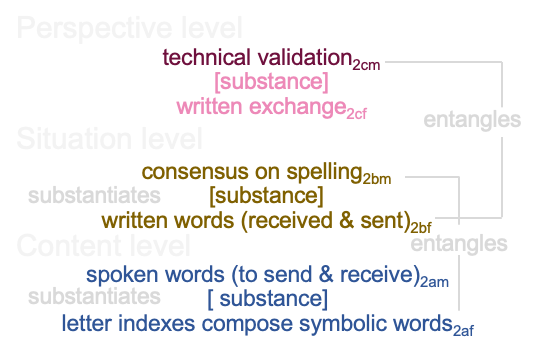
0203 The alphabet strangely re-enacts language, defined as two arbitrarily related systems of differences (by Ferdinand de Saussure (1859-1913), whose lifespan overlaps that of Gottlob Frege and Charles S. Peirce). The alphabet (like parole) and the spoken word (now, like langue) are each systems of differences. That is to say, they are finite symbolic orders. There are rules (symbolic operations) that motivate the relation. The rebus principle turns each letter of the alphabet into an index of a word-sound.
0204 After centuries, the old index has become a little sloppy. The letter “c” sounds like a “k” (as in “cryptocurrency”) or an “s” (as in “civility”) and then appears in lots of odd combinations (as in “chicken” and “discipline”). But, I am not complaining. All that I am saying is that the use of an alphabet2af entangles a consensus on spelling2bm, as an organizing principle2bm.
0205 The content-level confounding resolves into a situation-level dyad, where the spelling consensus2bm substantiates written words2bf as virtually (in virtue, rather than in simulation) situating spoken words2af.
This is not an easy requirement, explaining why grammar schools have changed their collective name to “elementary schools”. Spelling is to writing as grammar is to speaking. But, the amount of effort that it takes to technically validate both grammar and spelling is just too much for unionized labor to do as a work requirement, especially when negotiating with compromised politicians is so much easier.
0206 There are many “entanglements”, broadly painted, between speech and writing, and the author briefly considers the writerly attitude (S5C5), before arriving at a surprising conclusion. Art is a condition for language (S6C5).
0207 This examiner wishes to unveil an alternative, by looking back at the interscope for speech-alone talk and making a comparison to the prior figure.
Here is the interscope for speech-alone talk.
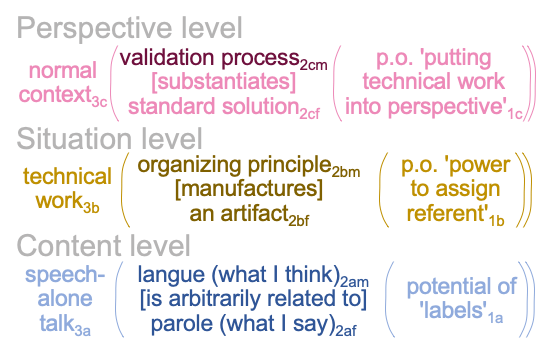
0208 If what I think2am corresponds to spoken words (that I send or receive)2am and if what I say2af compares to the alphabetic rendering of the spoken word that I think2af, then a consensus on spelling2bm dovetails into an organizing principle2bm.
0209 A consensus on spelling2bm as matter substantiates the form of written words2bf.
An organizing principle2bm as matter substantiates the form of an artifact2bf.
0210 If these two situation-level actualities2a correspond, then it seems to me that, technically, a written word2bf could be regarded as an artifact2bf that serves as a reference to the spoken word that I put into script2af.
0211 What a predicament.
The written word2bf may serve as an artifact2bf that validates its content-level spoken form2af.