0212 Part One introduces the author’s broad concept of “entanglement”.
This examiner offers a narrow definition. An entanglement occurs in confoundings, where one form is related with two matters, one originating and one entangled.
0213 Part Two introduces the concept of “aesthetics”.
The author places “aesthetic phenomena” as (second-order) art looping down to alter (first-order) habits and technologies.
To me, this portrays the second confounding (on the situation level) influencing a first confounding (on the content level).
0214 This examiner proposes that the author, as if peering through a translucent surface, intimates that two interscopes are entangled. These two interscopes portray elements from hand-speech talk and speech-alone talk. These two elements represent the Lebenswelt that we evolved in and our current Lebenswelt.
0215 In both interscopes, a participant cannot see the confoundings and operates as if the entanglements have been resolved.
The author uses the term, “aesthetic blind”, in word-play on “aesthetic bind”.
0216 For example, aesthetic blind dwells beneath the points 0089 through 0098.
The argument in this segment goes from the thing itself, the little noumenon, to a big noumenon, to an even bigger big noumenon.
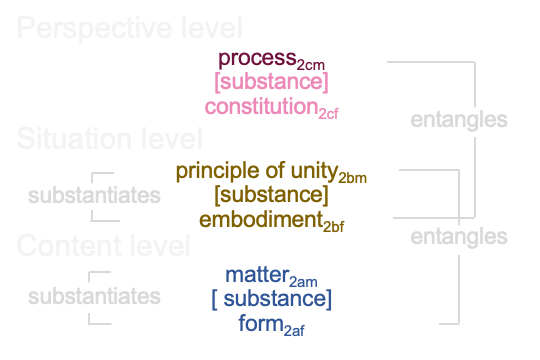
Twice, a confounding, in an aesthetic blind, resolves after much… shall I say?… wandering around.
Often enough, if one sees the little noumenon, then one does not need to realize the big noumenon. That goes again for the confounding that leads to the bigger big noumenon.
0217 To recall, here is a picture of Aristotle’s hylomorphe2a in the normal context of structure3a, emerging from the potential of ‘the disposition of things to manifest as matter and form’1a.
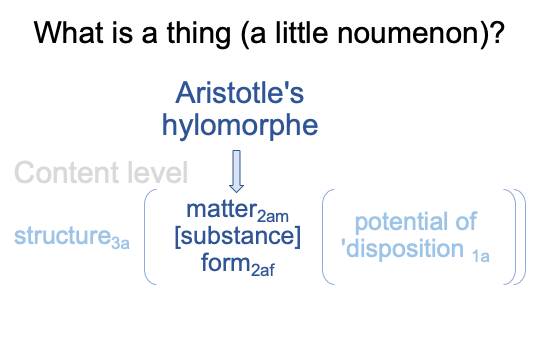
0218 The form2af in the little noumenon entangles all sorts of matter. For example, the originating matter of a pendulum clock consists of all sorts of pieces, gears and what not, that assemble with high-precision. However, there is ‘something’ that a pendulum clock, even when correctly assembled in its functional form2af, does not contain within itself. Plus, that thing makes the clock work.
Can you guess what that ‘something’ is?
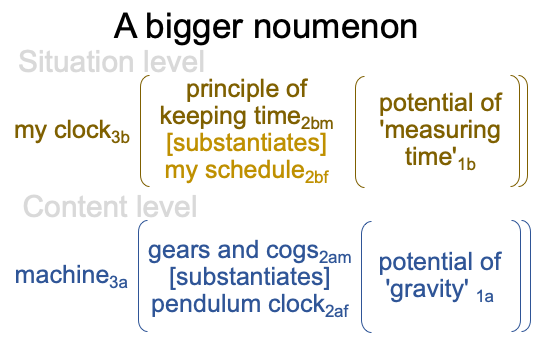
0219 If I wrote a technical paper on a pendulum clock, then I would describe the actuality of {gears and cogs and so forth2am [substantiating] a pendulum clock2af} in the normal context of a machine3a operating on the potential of ‘measuring time’1a.
My technical paper would satisfy the Positivist’s judgment, in so far as the little noumenon1a is taken for granted. I observe and measure the phenomena1a of a pendulum clock, then use the disciplinary language of physics2a to construct a model2a of the little thing1a based on those observations and measurements2a. I exercise a positivist intellect3a, which insists that Aristotle’s formal and final causalities only get lip service. Here, my lip service3a says, “The pendulum clock2a has the potential to ‘measure time’1a.
0220 Of course, I could be wrong in my lip service3a.
How so?
Consider the way that the content-level confounding resolves in the general case.
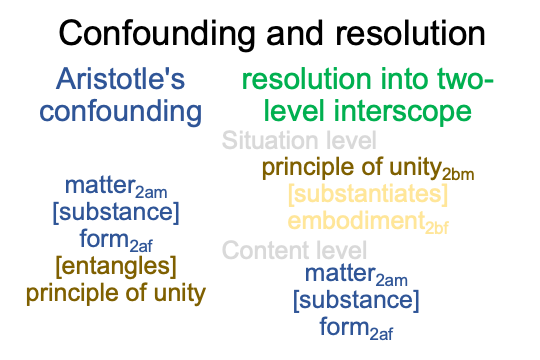
0221 If matter2am consists of all sorts of gears and cogs2am and if form2af is the composition of that matter into a functioning pendulum clock2af, then the thing2a has the structure of a machine3a operating according to the potential of ‘what?’1a.
Is that an awkward way to fashion a question or what?
0222 Obviously, the entangled principle of unity emerges from and situates the potential of ‘measuring time’1b. So, the potential1a that supports the pendulum clock must be ‘something else’.
0223 Here is a plausible solution for the big noumenon, which resolves the content-level confounding.
0224 Of course, this big noumenon is obvious.
It was not obvious at first.
The trick is that all pendulum clocks rely on gravity, yet gravity is not one of the gears and cogs, nor is gravity the entangled principle of unity.
Gravity1a is the content-level potential1a.
0225 This is how I see the second section of chapter six (S2C6).
Our inability to see the obvious, until the obvious is pointed out, is called the “aesthetic blind”.