0260 Chapter nine (C9, “Toward an Aesthetics for the Entanglement”) starts with the bigger big noumenon.
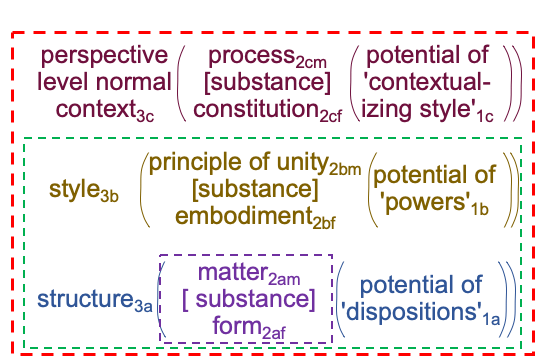
0261 The little noumenon, in the purple box, is what the natural sciences investigate.
The big noumenon, in the green box, is subject matter for social sciences.
The bigger big noumenon, in the red box, draws the reader towards an aesthetics of entanglement.
0262 Section one (S1C9, “Uncovering the Questions”) asks, “What do you see now?”
I see a three-level interscope swimming below the surface of Dr. Noe’s liquid prose.
I see, on the content level, that the normal context of structure3a brings the dyadic actuality of a thing2a into relation with the potential of ‘the thing’s dispositions’1a.
On the situation level, the normal context of style3b brings the dyad, {a principle of unity2bm [substantiates] an embodiment2bf}, in relation to the potential of ‘the situational thing’s powers’1b.
On the perspective level, a big-picture normal context3c brings the dyadic actuality2c, {a process2cm [substantiates] a constitution of ‘something’2cf}, into relation with the potential of ‘contextualizing style’1c.
0263 Now, I go down the columns. Each column is a virtual nested form in a particular category.
For the category of thirdness, a perspective level normal context3c virtually brings the actuality of style3b into relation with the potential of ‘structure3a‘.
In the category of secondness, a perspective-level thing2c (process2cm [substantiates] constitution2cf) virtually brings a situation-level thing2b (principle of unity2bm [substantiates] an embodiment2bf) into relation with the potential of a content-level thing (matter2am [substantiates] form2af).
In the category of firstness, a perspective-level ‘contextualizing style’1b virtually brings situation-level ‘power’1b into relation with the possibility of ‘dispositions’1a.
0264 How do I label the perspective-level normal context3c?
According to the author, the first vision that I should see entails a reorientation3c of my experience3b of what is happening3a.
To me, the reorientation3c matches the perspective-level normal context3c in so far as confoundings make us who we are3c. My experience3b goes with identity3b and style3b in so far as I experience3b an embodiment2bf of a principle of unity2bm.
Finally, ‘what is happening’3a associates to structure3a because a thing2a emerges from (and situates) the potential of ‘something happening’1a.
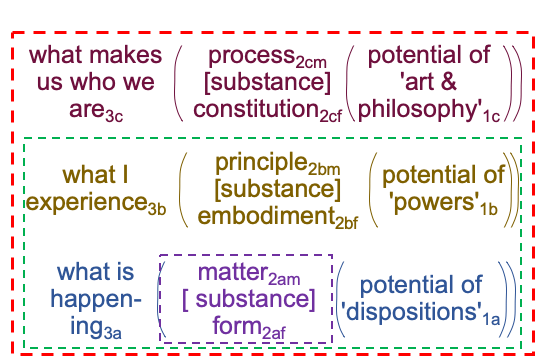
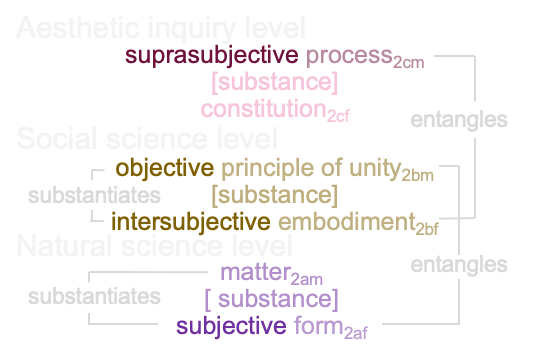
0265 The author goes on to say that the perspective-level normal context3c makes us into a creation2c made by us, because what is revealed as intersubjective (objective situation-based and subjective content-level things) is put into perspective by a suprasubjective process2cm (as matter) and constitution2cf (as form).
0266 In order to further appreciate the labels, subjective, objective, intersubjective and suprasubjective, please regard Razie Mah’s blog for October, 2023), titled Looking at John Deely’s Book (2010) Semiotic Animal, as well as the following figure.
0267 In section four of chapter eight (S4C8, “Afterthoughts on Artificial Intelligence”), the author discusses the possibility that machines will be artificially intelligent. He parodies the possibility by claiming that humans are artificially intelligent.
Is this a language game?
Does the above diagram of the Noe three-level interscope portray an artifice of intelligence or should I say, “an artifact”?
0268 Is the above figure an artifact that validates the label “the bigger big noumenon”?
If so, then this book tracks the journey of Dr. Noe, who starts as a natural scientist (interested in the purple little noumenon), develops into a social scientist (curious about the green big noumenon), and then steps into a new field of inquiry that he wants to call “aesthetics” (delineating the red bigger big noumenon).