0269 Questions are raised in section one of chapter 9 (S1C9). Then, the remaining sections develop the conceptual apparatus of aesthetic inquiry. Aesthetic inquiry brings to consciousness the confoundings that are resolved in Noe’s three-level interscope.
0270 Here is a picture portraying the two confoundings.
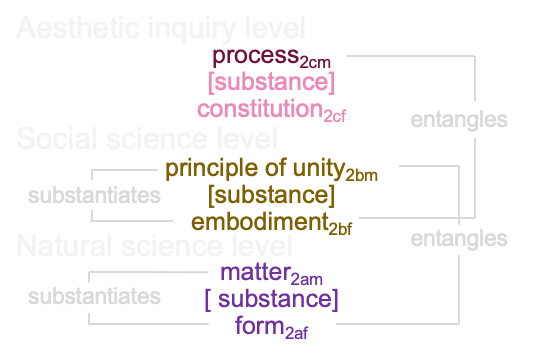
Notice how I have changed the labels of the different levels.
Natural science studies the little noumenon.
Social science considers the big noumenon.
Aesthetic inquiry wrestles with the bigger big noumenon.
0271 Chapter ten (C10, “Reorienting Ourselves”) offers a few techniques for aesthetic labor.
0272 First, in order to appreciate an entanglement, one must intellectually block out (or “bracket” or epoche) the originating matter. Practically, that means putting on blinders that block out natural science for social scientists, and then, social science for aesthetic inquiry. This is covered in section one (S1C9, “Husserl’s Bracketing”).
0273 Second, if Ludwig Wittgenstein (1889-1951) is on target, then in art, nothing is hidden. So, aesthetic inquiry3c reorganizes what one pays attention to. For example, once someone else points out a particular aspect of a portrait painting, then one pays attention to that aspect in an insistent way. Artists and philosophers do this all the time, which upsets a lot of people, especially those who did not make the observation first.
In other words, artistic and philosophical comments may cause something to seem more… what?… suprasubjectively real. That goes with process2cm. The process2cm does not care that so-and-so cannot take credit. But, professors of art and philosophy do care. When a student says, “Hey, I don’t know my way about this topic. I am lost.”, these instructors have syllabi ready-at-hand. Plus, their artifacts2bf are very well… um… “constituted2cm“.
0274 “Documented2cm“? “Certified2cm“? “Well respected2cm“? “In good taste2cm“? “Highly regarded2cm“? “Credible2cm“?
0275 Chapter ten concludes by proposing that philosophy1c, like art1c, is creative work.
Is it the same creative work performed by Eve, in regards to the fruit of the tree of the knowledge of good and evil?
This question is not raised in Part III.
Part III is scripted as an afterthought, or perhaps as a launching point for the next literary exposition.
0276 What do I mean with that aside?
Among other questions, our current Lebenswelt asks whether the artifact2bf that virtually situates a label2af credibly embodies2bf “what I think2am“, in the normal context of structure3a operating on the potential of ‘my dispositions’1a.
Is the big noumenon grounded on my dispositional will to knowledge1a (like Eve) or my dispositional regard for truth1a or the good1a (not so much like Eve)?
What an interesting question.
Unfortunately, it must be put aside.
See Razie Mah’s three-part e-book, Original Sin and the Post-Truth Condition.
Also, see Part III of the text under examination.
0277 I wonder whether the author knows the character of his audience?
Are they scientists, or what?
Let me start with the scientists.
0278 Here is a sensible construction that composes one of the steps on the way to triumphalist science.
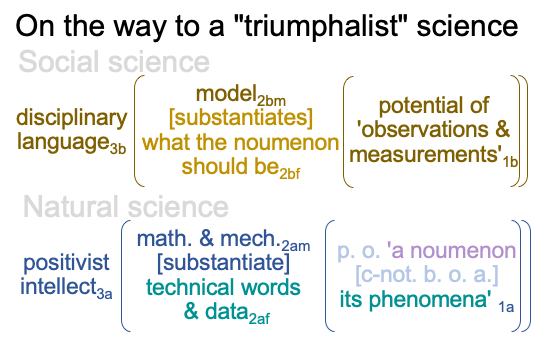
0279 What do I (the scientist) experience3b?
The little noumenon1a, the thing itself, belongs to the realm of possibility.
Do I experience technical words and data2af as a content-level form entangling a model2bm as a principle of unity?
0280 What else?
The big noumenon, the sensible construction itself, says, “I do not need to be put into perspective by philosophy and art1c, because once my model2bm serves as situation-level matter2bm then the form2bf is what the noumenon should be2bf.”
0281 Is this the topic of chapter eleven, (C11, “The Seepage Problem”)?
Is triumphalist science closed to aesthetic inquiry3c?
Is the perspective-level reality2c closed… or “hidden”… to prying eyes?
Is this the problematic Age of Seep?
0282 Let me close my eyes and seep.
I recall the high-pressure machinations required in order to stuff the triadic empirio-schematic inquiry into a dyadic actuality (points 0049-0058). Did the applied pressure cause a leak?
0283 Does the following content-level confounding make sense?
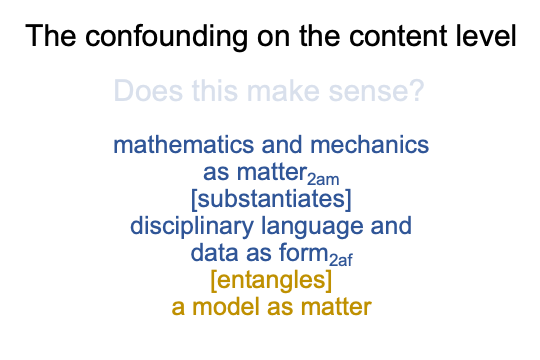
0284 Okay, a content-level reified empirio-schematic judgment2a entangles a principle of unity.
A scientist should be comfortable with that confounding.
0285 What about someone who is not a scientist?
As noted before, the first step in natural philosophy is to regard the noumenon, a thing itself, in terms of matter and form.
0286 If a noumenon2 is {matter2m [substantiates] form2f}, then what if the form2f entangles mathematics and mechanics as matter?
Then the originating matter2m (of the noumenon2) cannot be what scientists insist it must be… that is… mathematical and mechanical.
0287 It is as if the form2f of the noumenon2 (for the layman) belongs to a nested form residing one level lower than the content level (for the scientist).
0288 Am starting to feel a “reorientation” coming on?
0289 If a reorientation places the noumenon2 in the realm of actuality (rather than the realm of possibility), then the entangled matter of mathematics and mechanics may end up as matter2am on one levela higher than a noumenal basement levelz.
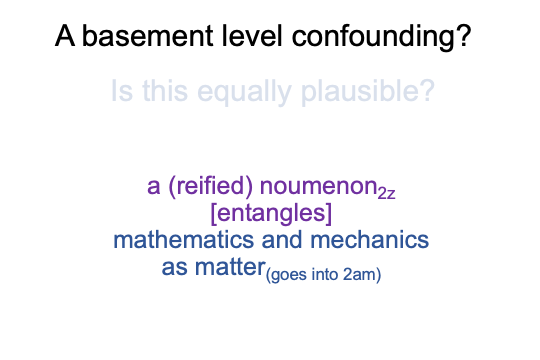
0290 The reorientation offers a confounding, that is consonant with what a layperson thinks about the scientific method. The noumenon is real and consists of matter and form, as expected from Aristotle’s hylomorphe. The form has facets that can be regarded in terms of mathematics and mechanics.
0291 When this confounding resolves, then the content-level of natural science moves to the situation level of an alternate (“reoriented”) interscope.
0292 I am not going to change the subscripts, because that would ruin the weirdness of the ongoing conclusion.
However, I will note that a similar shift in levels occurs within Lacanian psychoanalysis as discussed in Razie Mah’s e-book, Comments on Jacques Lacan’s (1960) Discourse to Catholics.
0293 For the layman’s reoriented interscope, the following nested form resides on (what appears to be) the situation level.
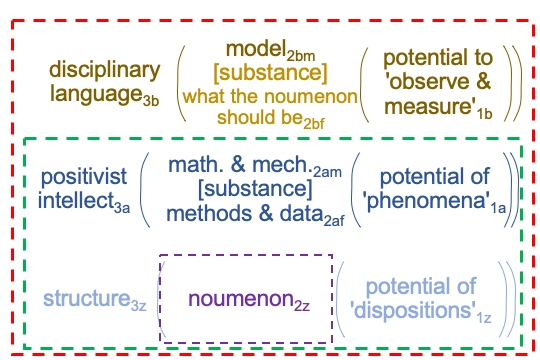
A positivist intellect3a brings the dyadic actuality2a, {mathematics and mechanics as matter2am [substantiates] disciplinary language and data as form2af}, into relation with the potential of ‘phenomena’1a.
For the triumphalist scientist’s two-level interscope, the above nested form stands on the content level.
0294 This crooked line of development produces the following re-oriented three-level interscope.
0295 So, what am I saying?
When a scientist considers a thing2a, the scientist views the form2af as if mathematics and mechanics2am apply.
When a non-scientist regards a thing2z, the natural philosopher views the thing2z just as Aristotle does, as the dyad, {matter2zm [substantiates] form2zf}.
0296 I know this sounds shifty.