0226 When the Mariusz Tabaczek O.P. published an article in the journal, Vetera Novis Augere (A Resource for Traditional Thomists in the Current Context II: Philosophical Themes and Historical Research, 2025, pages 343-382), titled “Contemporary and Classical Versions of Hylomorphism: A Critical Evaluation”, he did not imagine that an egghead steeped in the semiotics of Charles Peirce would craft a response and post it as a draft on his… whatever.
0227 This response turns out to be an exercise in, what Dr. Noe calls, “aesthetic work”.
0228 This egghead’s exercise builds a big noumenon from the little noumenon. In the process, this eggspert offers an alternative to the little noumenon of natural science.
0229 In the following figure, the little noumenon, the thing itself according to natural science, stands within the box with purple dashed lines, and the big noumenon, the noumenon that may be constructed by reviewing philosophical publications concerning Aristotle’s hylomorphe, stands with the box with green dashed lines.
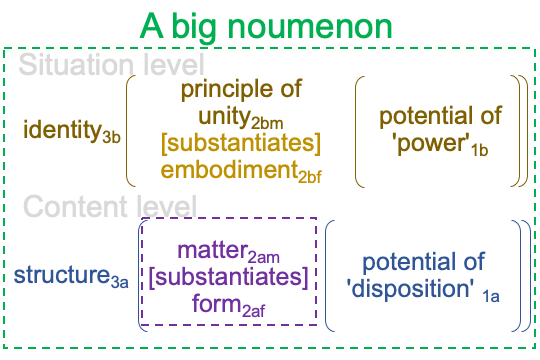
0230 In order to pass from the little noumenon to the big noumenon, the inquirer must pass through a content-level confounding.
In this instance, the inquirer is simultaneously an artist and a philosopher, because the diagrams contain elements that picture and point to a referent, a langue, corresponding to what the philosopher is thinking2am.
0231 The trick is that the only way to achieve the big noumenon is to realize that a principle of unity is the matter that the form2af entangles.
Another trick is to figure out what form2bf that matter2bm, resolved to the situation-level of sensible construction, substantiates.
0232 The later sections of chapter six, including the third (S3C6, “Art and the Staging of the World’s Obscurity”, the fourth (S4C6, “The Artwork Gets in the Way”) and the fifth (S5C6, “Achieving the Object”) discusses the big noumenon as what is already right in front of you. It would be obvious if someone points it out.
0233 Indeed, when I look at a pendulum clock2af, I see a little noumenon, a machine3a with gears and cogs and a pendulum2am that exploits the potential of ‘gravity’1a. The attitude is scientific, including the technical work where I might have to kill the clock in order to dissect it.
0234 If I killed the clock in order more clearly build a mechanical model of its material and efficient causalities, then I would eliminate the ability for the social scientist to investigate the bigger noumenon. When a social scientist looks at a little noumenon, the bigger noumenon comes into view, due to all the aesthetic work already done by social scientists, including Dr. Noe, whose exposition of entanglement discusses phenomena associated with the big thing itself, a confounding that has resolved into a sensible construction.
0235 What does a social scientist see?
The normal context of my clock3b brings the dyadic actuality of {the principle of keeping time2bm [substantiates] my schedule2bf} into relation with the potential of ‘measuring time’1b.
Plus, the potential of ‘measuring time’1b situates the form of the pendulum clock2af.
The normal context of a machine3a that operates on the potential of gravity1a gets bracketed out.
0236 These are not easy abductions to perform, because the situation-level form2bf of embodiment entangles matter. Plus, that matter may end up in a perspective-level thing2c.
0237 If that is not enough, then in section six of chapter six (S6C6,”Playing Philosophy”) the author argues that philosophy and art are two different types in a common genus. That genus has the potential to ‘reorganize practice’1c.
What does that imply?