0238 One implication is that philosophy and art answer a call that is not addressed by identity3b and structure3a. Identity3b and structure3a are relevant to social science and natural philosophy, whose subject matter are the big and the little noumenon, respectively.
0239 Chapter seven is titled, “Fragile Bodies”. Section one (S1C7, “Here We Are in Team Colors”) opens with the contrast between the Frenchman, Rene Descartes (1596-1650) and the Italian, Giambattista Vico (1668-1744). Descartes’ masterwork, Discourse on Method, is published in 1637, followed by Meditations on First Philosophy in 1641. Vico’s masterwork, The First New Science, is published in 1725.
0240 Perhaps, the distinction resides in the lifespan rather than the nationality. Descartes is regarded as one of the mechanical philosophers who founded the natural sciences… er… the Positivist’s judgment. Vico tends to be ignored, for no other reason than he is… you know… a citizen of a nation populated with highly voluble and passionate folk who love their shopworn rituals.
0241 However, there is an interesting thread running through the author’s discussion. What is the thread? It is not that Descartes is wrong about the mind and body as a little noumenon, where the mind2am is like matter and the body is like form2af. Certainly, the human can be regarded, by natural science, as a thing2a. Rather, it is that the form2af of the human, however one regards the matter, is entangled in a principle of unity2bm, that is artistically on display in sports, where one team wears its uniform and the opposing team wears another uniform2bf.
0242 When I pull on that thread, I come up with the following figure.
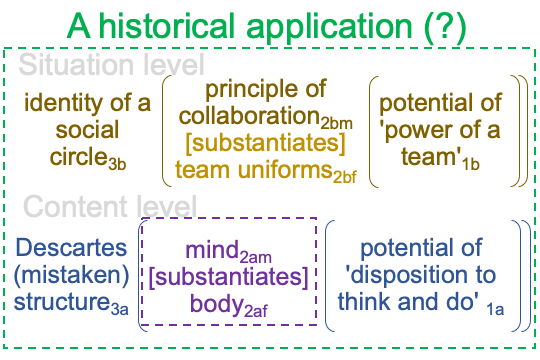
0243 To me, it looks like Descartes, an early mechanical philosopher, focuses on the little noumenon.
My guess is that Vico prefigures the social sciences, by illuminating the big noumenon.
0244 My guess in indirectly confirmed by Dr. Noe’s discussion in section two of chapter seven (S2C7, “A Fragile, Dense, Intersubjective Skein”).
0245 Concerning the terms, “fragile, dense and skein”, even if Descartes is off target in relegating the mind and the body into different real elements (perhaps, mind as matter and body as form is too facile a comparison), he anticipates Peirce’s definition of secondness as a dyadic structure. Plus, that dyadic actuality2a emerges from the potential of ‘a disposition to think and act’1a in the normal context of a machine-like structure3a.
Are humans machines?
An affirmation seems to be Descartes (mistaken) structure3a.
0246 Concerning the term, “intersubjective”, Vico is on target by talking about a new science (of humans), where the noumenon is not a mere thing2a, but the thing2a confounded with situation-level matter2bm.
In this examination, and maybe generally, this situation-level matter is a principle of unity2bm and accounts for why the content-level is not enough. For phenomenology, the content-level is so “not enough” that it is entirely bracketed out, leaving the new science to investigate a sensible construction as the noumenon. A sensible construction is the situation-level virtually emerging from (and situating) the content level. The big noumenon is a sensible construction.
0247 Now, I get into controversial terminology.
The content-level is subjective. The subject is the little noumenon2a. Subjectivity is assumed by a new science of the big noumenon.
The situation-level is objective. The little noumenon2a is an object once it is virtually situated by the actuality2b of the big noumenon.
0248 If Vico strictly followed Descartes’ content-level parsing, he might have arrived at oddly familiar terminology portraying the situation-level actuality2a as an “extended mind2bm” that substantiates an “extended body2bf“. The principle of collaboration2bm (an extended mind2bm) says, “Everyone on the team wears the same uniform2bf.” (an extended body), in the normal context of advertising the identity of our social circle3b operating on the potential ‘power of the team’1b.
0249 Where does the term, “intersubjective” apply?
Situation-level matter2am objectifies the subjective form2a of each person on the team.
Situation-level form2bf is intersubjective, in so far as the situation-level normal context of identity3b advertises – what Vico, mimicking Descartes – might have labeled “the intersubjective objectivity” of an extended being2b.