0170 Chapter four (C4) concerns visual art.
Pictures have been made by humans for as long as we have been around.
The question is, “Who are we?”
0171 If “we” are the civilized people who adhere to the forms of spoken labels2af, artifacts2bf and standard solutions2cf, then “we” are are not the humans who made – what experts currently call -“Paleolithic art”.
Perhaps, anthropology needs a new technical term, such as “Paleolithic cave adornment”.
0172 Here is a picture of the hand-speech interscope, with all but the virtual nested form in the category of secondness grayed out.
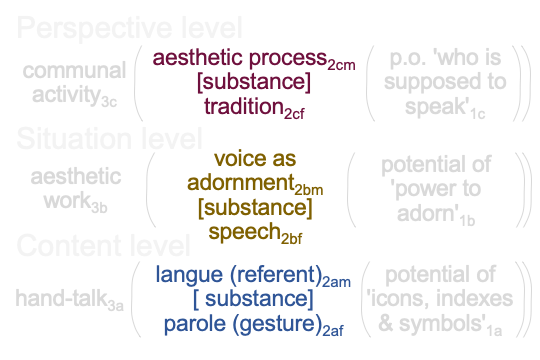
0173 Now, let me consider an ibex that is carved into the handle of a launcher, designed to sling rocks towards an adversary. Does the ibex correspond to parole, since it pictures its referent? Or does the launcher gesture for itself, since it is what it refers to? Then, the ibex is an adornment that substantiates something that the hand-speech talker can… um… speak to. I could say to the ibex, “Guide my rock to the bison’s flank.”, while setting my rock in the device. The ibex will assist my aim and bless my achievements.
0174 The launcher is like a manual-brachial word-gesture2af. The ibex is like the corresponding spoken word2bf. The aesthetic work3b of the ibex2bf enhances the process2cm of hunting bison with the team. The stone will inspire the bison startle and race towards the cliff, that it does not realize is there. A thirty-meter drop is as good as a lance.
0175 The first section of chapter four (S1C4) opines that picture-making is first order and pictorial art is second order. Does this imply that I must turn my gaze to the speech-alone interscope, since the labels of “first-order” and “second-order” operate as explicit abstractions?
Or, do I retain the hand-speech talk interscope because it calls to mind implicit abstractions and who we evolved to be?
0176 Using, say, a Renaissance oil painting of a bowl of fruit as an example, I associate the painting itself to a hand-talk word2af that pictures and points to its referent2am. The referent2am is the subject of the painting2am. The referent2am substantiates the hand-talk word2af. The subject matter2am substantiates the painting2af.
0177 Here is a view showing the confoundings.
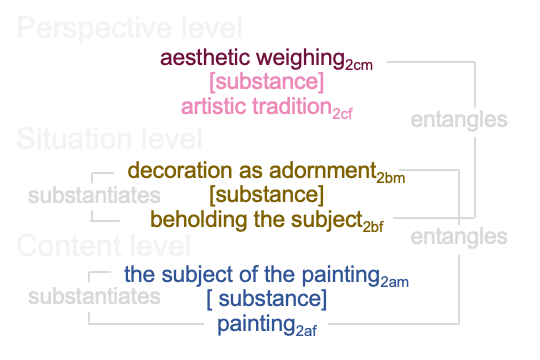
0178 The painting as form2af entangles the presence of an adornment, otherwise labeled a “decoration”. Aesthetic work3b brings the dyad, {decoration as adornment2bm [substantiates] the beholding of the subject2bf}, into relation with the potential of the ‘painter’s power’1b. Then, the situation-level form2bf, entangles a perspective-level matter of aesthetic weighing2cm, which may or may not be cultivated, because the human transcendentals of beauty and truth are ready to serve as perspective-level potentials1c in the normal context of communal viewing3c.
0179 These associations to the hand-speech talk interscope complement the early sections of chapter four, titled “Pictures in Context” (S1C4), “Surreptitious Substitutions” (S2C4), “The Painterly Attitude” (S3C4) and “The Snapshot Conception” (S4C4), and lead to the conclusion that vision is pictorial.
0180 The irony, of course, is that a painting is a technical work3b and there are many tricks that the artist employs in order to provide the illusion that the subject matter of the painting2am substantiates a work of art2af that entangles matters of decoration2bm in such a fashion that the decoration2bm substantiates an experience that the viewer is beholding the subject2bf.
Then, the form of that experience2bf entangles an aesthetic weighing2cm.
0181 Pictures generate experiences by proxy.
This is what pictures are meant to do.
This is what I see when I look at sections five (S5C4, “The Enactive Approach”) and six (S6C4, “Pictures as Proxies”).
0182 The broad strokes of an “entanglement”, where second-order pictorial arts loop down to the first-order work of picture making, demands purchase. Do I buy it? Pictorial art offers experiences by proxy. Making pictures offers… something… that seems more like speech-alone talk. Making pictures is like writing with ideograms.
Does that weave an “entanglement” between language (speech-alone talk) and thought (beholding the subject2bf)?
What am I buying here?
0183 The author unveils an “entanglement” between making pictures and pictoriality, between first-order and second-order, and between… dare I say?… the interscopes of hand-speech talk and speech-alone talk.
Section seven (S7C4, “World Styles”) seems to mark a transit from the former to the latter.
0184 The transit remakes what seeing is.
If the aforementioned painting2af is regarded in a hand-speech talk manner, then the viewer beholds a bowl of fruit2bf in the painting2af.
If viewed in a speech-alone talk manner, then the viewer beholds an artifact2bf of what the artist is trying to say2af.