0147 Chapter two (C2) is titled “Domestic Entanglements”.
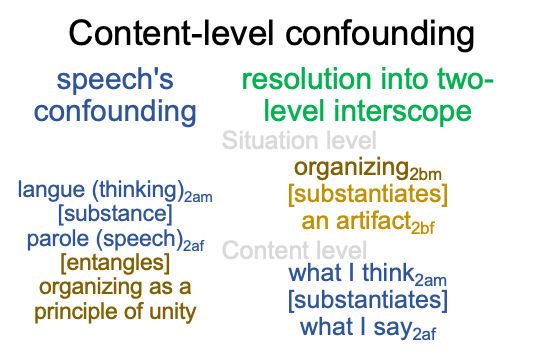
0148 I ask, “What is the content-level confounding beneath the resolution of speech-alone talk into a sensible construction?”
0149 Here is a picture of the answer.
0150 Even though chapter two (C2) discusses Paleolithic art, the author compares the glyphs to writing, and leaps form the Lebenswelt that we evolved in to our current Lebenswelt.
0151 In the Lebenswelt that we evolved in, social circles are always present and operating as sites for organization. Manual-brachial word-gestures2af and speech2bf occur within social circles. They do not call organizations into being. In fact, there are no labels corresponding to spoken terms such as “institution” and “organization”. Modern theory requires labels. So, one wonders, “What were the Paleolithic people who adorned the walls of caves some thirty-thousand years ago thinking?”
Obviously, they weren’t using labels.
0152 Not only that, they were not validating their labels, which plays an important role in the situation-level confounding for our current Lebenswelt.
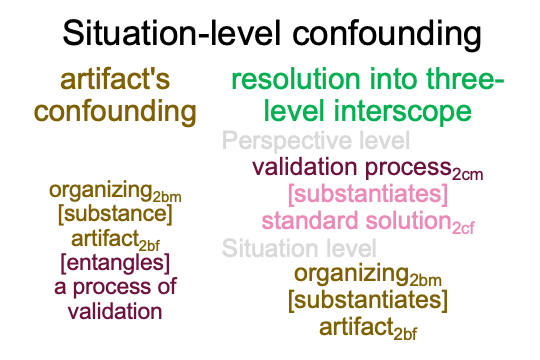
0153 The form of the situation-level thing2b entangles. the matter of a process whereby the artifact2bf validates the spoken word2af
How can that be accomplished?
The validation process2cm substantiates a standard solution2cf… or maybe… a solution that becomes standard2cf.
0154 What is the nature of this standard solution2cf?
Did I hear someone say, “Conformity”?
That sounds first-order to me.
How can conformity be second-order?
0155 According to the author, a second-order solution makes explicit an unveiling of ourselves to ourselves. What does the standard solution unveil? It says, “Look at how we conform to the idea that this artifact validates its spoken label. The label speaks of meaning, presence and message.”
0156 Does that seem crazy?
Welcome to our current Lebenswelt, where the second-order solution may be just a capricious as the first-order habit.
0157 At the end of chapter two (C2), the author is clear (S). “Entanglement” refers to ways that we escape from the ways that we find ourselves habitually organized. “Entanglement” entails acts of resistance.
However, in the following figure, the validation process2cm reinforces the artifact2bf in so far as it substantiates a standard solution2cf that virtually contextualizes the artifact2bf as the referent for its spoken label2af. The entanglement ends up solidifying habits, or adjusting existing habits as to yield better conformity (R).
0158 I wonder whether above can be framed as “thesis” and “antithesis”?
I suspect that the perspective-level normal context3c in the following figure can either resist3c (S) or reinforce3c (R).
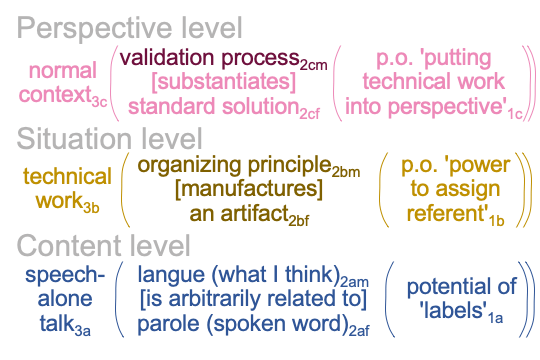
0159 The second-order sollutions2cf of art and philosophy have at least two options, including “resist” (S) or “reinforce” (R), in regards to an established conformity2cf. In conformity2cf, everyone assumes that the situation-level artifact2bf is the referent to the spoken label2af. Such conformity may be productive or it may lead to disaster.
0160 In chapters three (C3), four (C4) and five (C5), the author promotes the first option (S), without regarding the second (R).