0161 Chapter three (C3) applies the broad brush of “entanglement” to dance… er… I mean… dancing.
Dance is different than dancing.
Many civilized folk enroll in introductory dance classes, aiming to learn how to perform the proper steps for each dance style. The classes are awkward, but rewarding. The instructor, who is a dancer, works as a second-order guide. The dancer is one who achieves virtuosity, makes moves, and then studies under a choreographer.
0162 To me, introductory dance classes associate to the three-level interscope for hand-speech talk. Instead of hand-speech parole, there are dance steps for any particular style of dance. These dance steps2af are forms that are substantiated by stylized motions2am. In effect, the steps2af are images and indicators1a of their referents2am in the normal context of dancing3a. Dancing3a is like structure3a. We are disposed1a to imitate by pantomiming and pointing to an exemplar1a. The exemplar is the dance instructor.
0163 Here is a picture of dancing as a reproduction of the hand-speech talk interscope.
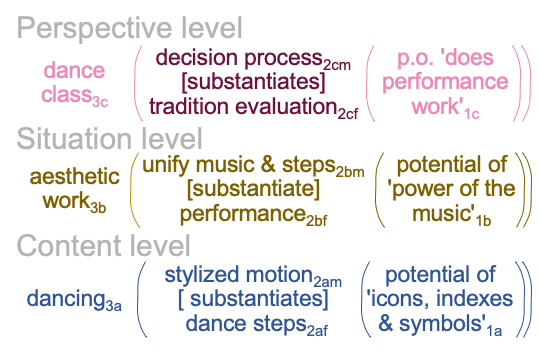
0164 The instructor assists with the situation level by telling students to move their bodies with the music2bm, and so on. This is the awkward part, because most Western cultures simply do not encourage children to move with the music, because dancing is not regarded as… well… “necessary”. Since the mechanical revolutions, experts in education have devoted their efforts to restricting motion and elevating obedience and recitation.
0165 I suspect that this is why Dr. Noe regards dancers… I mean… dance instructors as “resisting” the habitus of their students, inculcated in the civilizational expectations of our particular civilizational Lebenswelt.
I suspect that the author is only dimly aware that dance instructors are reinforcing their students at the same time. They introduce their students to a restrained re-enactment of the Lebenswelt that we evolved in, where dance was a communal tradition2cf that virtually contextualized an adornment2bf to exchanges that were negotiated earlier2af. The student’s reward comes outside the instructor’s view, when the individual is called to dance in a celebratory setting.
0166 What does a choreographer do?
A dancer works with a choreographer, who sculpts a dance show3c.
The atmosphere of choreographer’s studio differs from introductory dance classes. The students already know many steps. They want to participate2cf in the artifact2bf that validates2cm the choreographer’s spoken words2af.
0167 Here, I shout out the choreographer Kyle Hanagami, whose business is built on serving as a video-based dance instructor. In his numerous videos, recording dancers performing his choreography, he conveys the feel of the hand-speech interscope, while executing a reproduction of the speech-alone talk interscope, pictured below.
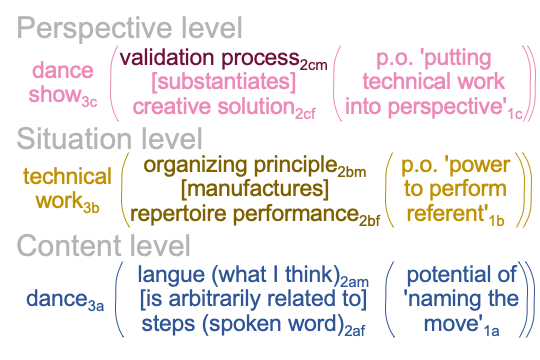
0168 For example, many of the moves1a that Hanagami names (by consciously creating them) operate as icons, indexes and symbols of pop-song lyrics. On one hand, his thinking2am entertains stylized motions2am that substantiate dance steps2af and, on the other hand, his thinking2am is arbitrarily related to the steps2af in the same way that, in speech, what I think2am does not necessarily substantiate what I say2af. Or, maybe I should say, what I say2af does not necessary sculpt what I think2am.
0169 Similarly, Hanagami’s organizing principle2bm is to unify the music and the dance steps2bm in the normal contexts of technical3b and aesthetic3b work. The resulting performance2bf emerges from (and situates) the potential of ‘the pop music as well as the lyrics (serving as the referent)’1b.
The overall impression is that his dance class3c is a dance show3c. The proof2cm is in the dance itself2cf, performed on computerized screens, calling individuals to not only engage in dancing3a, but to dance3a.