0107 Chapters 3 and 5 brings the reader back to Virginia.
One nice feature of a prosperity gospel is that one person is chosen and everyone else is expected to work for free for that person. Henry VIII sets the paradigm. After all, he reaps what he does not sow. And, for the most part, the Anglican bishops do not disagree. After all, the ones who do fail to get ahead.
0108 Here are my associations to this chapter on Virginia.
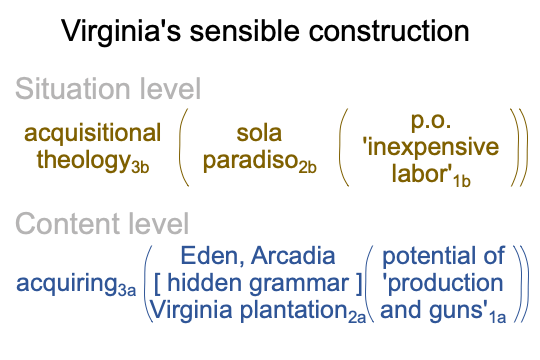
0109 Why do plantations2af require guns1a?
Is ‘inexpensive labor’1b an appropriate substitute for ‘plucking fruit from the tree of the knowledge of good and evil’1b?
0110 If the bourgeois owner wants the lowest cost for labor, then why not slaves?
0111 Of course, no one imagines that Adam and Eve ended up as slave owners, but that knowledge must have been embedded within the fruit that they ate. The knowledge is obvious. The cheapest laborer is the slave.
Enterprising British traders started with the poor Irish. They shifted to African tribes selling people that they kidnapped from other tribes. The price was right. Shipping human cargo like cattle minimized costs. Selling them to other humans was perfectly justified, because slavery is common in the Old Testament. Plus, the plantation owners were willing to pay.
0112 I imagine that only a modern genius of the greatest acumen could re-articulate this travesty by applying Marxist nomenclature. According to Marx, acquisitional theology3b does not bring the actuality of a deal that is election for the owner and damnation for the slave2b into relation with the potential of ‘the most inexpensive labor possible’1b. Rather, material arrangements2m [substantiate] human conditions2f.
0113 So, what is the most obvious material arrangement2m that an enterprising Marxist can envision?
Obviously, the African slave is colored “black” and the English plantation owner is colored “white”.
Does the modern Marxist genius say that the material arrangement of “whites” and “blacks” [substantiates] the human condition of slavery in the plantations of Virginia?
0114 Here, Jones does not argue that the modern Marxist genius constructs a literary text as fictional as Nathaniel Hawthorne’s novel, The Scarlet Letter.
Rather, the author claims that the Marxist intellectual makes a categorical error.
0115 At the time, the Virginian is deeply religious, in the Anglican tradition.
Here are my associations to the ongoing sensible construction.
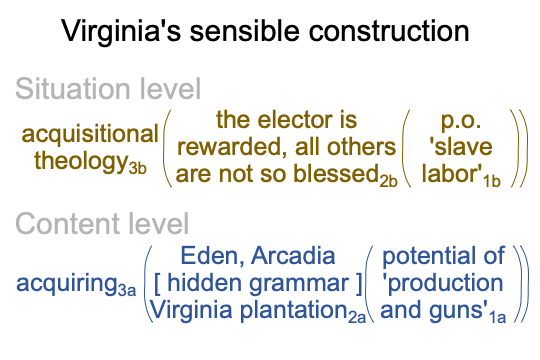
0116 To me, the question should be, “Does the Old Testament really justify labeling others as subhuman and slaughtering or enslaving them?”
It is as if Jesus never walked the Earth.
0117 The student should read chapters 6, 7 and 8.