0099 Nothing unites a community more than a common enemy.
But, what happens when the enemy enters into the community?
0100 Chapter 2 concerns the Salem Witch Trials (starting in 1692) and fictionalized by Nathaniel Hawthorne (1804-1864), whose family lived in Salem since the 1660s.
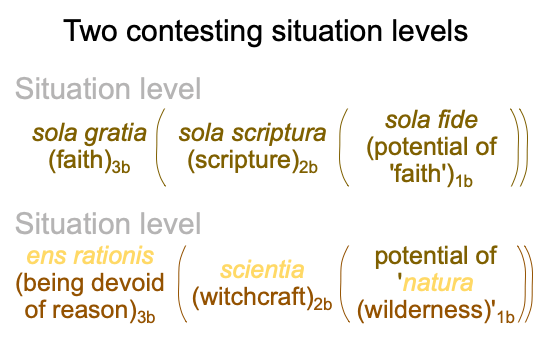
The elected members of the Massachusetts Bay Colony adhere to the upper situation level, yet project their fears, anxiety and guilt onto the situation-level that would have corresponded to classical Christian reason.
According to the author, one of the drivers of this projection is the Calvinist rejection of the Catholic sacrament of confession. Confession is a sacrament built on Christ’s commissioning his disciples to preach and forgive sins. The Puritans turned their backs on those sacraments that empowered Catholic priestly institutions. So, the Puritan rejection of reason really applies to Catholic reason, not to plain commonsense reasoning.
0101 Okay, even plain commonsense reasoning may be suspect, especially, when the Fall of Adam has left humans devoid of reason3a and willing to use witchcraft2a in order to cast spells from the wilderness1a. Here, the “wilderness” is both literal (the forests outside the colony) and figurative (the desires inside our bodies).
0102 In effect, the lower situation-level nested form becomes a mirror of the upper situation-level nested form.
Because the Puritan’s vocabulary is inspired by scripture alone2b, they have no words2am (or categories of the mind) for contradicting an impression that witches are operating on the premises. They have no vocabulary for conducting an inquisition into whether the rumors have “natural” (not supernatural) formal and final causes (designs and intentions).
0103 Jones discusses Nathaniel Hawthorne’s story about Goodman Brown. Brown’s Calvinism takes whatever matter that cannot be unified with the principle of sola scriptura2bm into the form of the Satanic2bf.
Jones’s consideration reflects the following associations.
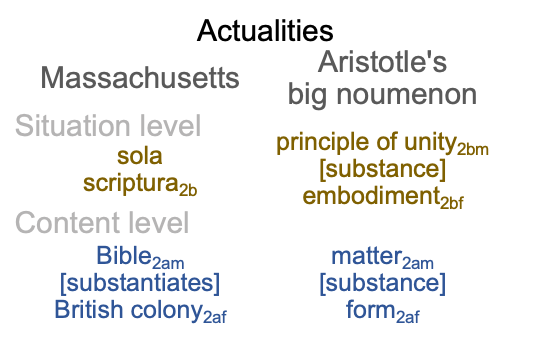
0104 Sola scriptura2b is the category of the mind2b where a principle of unity2bm [substantiates] the embodiment2bf of the Puritan identity3b. An election to receive a covenantal relation with God characterizes the principle of unity2bm. Membership in a church in the Massachusetts Bay Colony figures into the embodiment2bf. Sola scriptura2b emerges from (and situates) the potential of ‘grace alone’1b.
Sola scriptura2b virtually situates the Biblical thing2a of the Massachusetts Bay Colony, which emerges from (and situates) the potential of ‘the gun’1a.
0105 The Biblical thing2a also constitutes a category of the mind2a, because the Exodus, when applied to British colonialists, grants immunity of guilt for their displacement of the Amalek… I mean… native population. Of course, the so-called “Indians” may have deserved their misfortune, because rumors have it that the Indians kidnapped and cooked a couple of wayward colonists.
Isn’t that Satanic?
0106 The student should read Chapters 3 and 5.