0140 Chapter 8 discusses Benjamin Franklin (1706-1790).
Rather than admitting that virtue arises from God’s covenant to a chosen few and from our election to choose God, Franklin devises a homespun program for moral self-improvement.
How enlightened!
0141 Years later, he concludes that he is a reasonable creature and that he is under no religious constraints not to… you know… construct his own “religion”.
T the term, “religion”, expands during the so-called “Western Enlightenment”. At first, the label refers to Christian factions. Then it broadens to all creeds. Then, it broadens to what the native Americans are practicing as well as the metaphysical traditions of all those other people around the world. Finally, the label broadens to sort of include what Benjamin Franklin is working on (but, not really).
0142 Does Jonathan Edwards favor esse_ce over essence?
Does Benjamin Franklin favor esse_ce over essence?
Or do both the following two content-level nested forms structure3a the American identity3b?
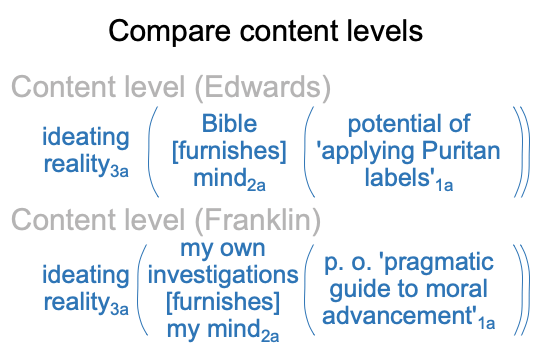
0143 One could say that, as far as mental furniture goes, the Bible2am offers ideas and my own investigations3am offer ideas as well.
Both are in the business of ideating reality3a at around the time when the American Revolution plays out. It makes me wonder about the literary character of the American founding documents. Do they assume Puritan labels1a? Do they express a pragmatic guide1a to forming a government under the conditions when anyone can formulate his own pragmatic guide to moral advancement1a?
Why work so diligently to divide the federal government into three interdependent institutions, the legislative, the executive and the judicial branches, with the intent that each will hold the others in check? Why attempt to retain sovereignty in the states? The states will never unanimously agree to losing their sovereignties.
Will they?
Uh oh, see the March 2026 issue of Culture Wars Magazine.
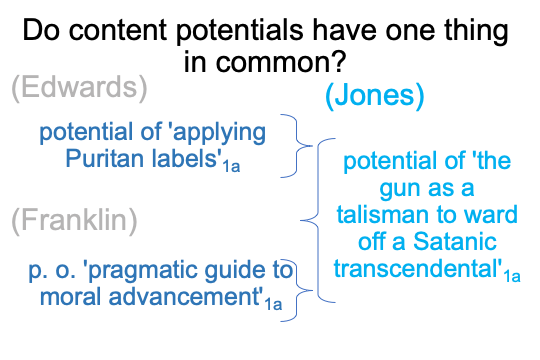
0144 To me, its seems that the two potentials1a, both contextualized by idealism3a, have something in common. This reflects the logics of firstness. The logics of firstness are inclusive and allow contradictions. Why? The logic pertains to a monadic realness, where one can see only one side of something in the sea of possibility1a at a time. In the realm of firstness, Edward’s application of Puritan labels1a to ideas2a and Franklin’s application of his own conclusions1a to ideas2a may portray facets of a single ‘something’, a single ‘wilderness’ that demands some sort of precautionary mechanism, like a gun1a.
0145 Here is a picture.
0146 Chapter 9 describes the Great Awakening (1734-1749).
When I look at the above potentials1a, on the left, I see the agenda of elites, whether Puritan (Edwards) or Enlightenment (Franklin). These positions are convertible, because both walk3a the path of idealism3a.
On the right, I see a dawning awareness that allowed the original Puritans to regard the forest wilderness as Satanic (on the outside of the colonies) and to see witches in the solitary ladies in Salem (on the inside of town). This is the position driving the Great Awakening.
0147 The Great Awakening starts outside the coastal, European-facing townships, who still care about the doctrinal distinctions between Puritans (Massachusetts) and Anglicans (Virginia). These outsiders ask questions. Who cares about Protestant doctrinal distinctions? Do they tell me how to live a moral life? And, don’t tell me that I am supposed to come up with a moral life through my own reckoning. I don’t have the book-learning for that.
Prior to the American Revolution, the Great Awakening sweeps through all the colonies.
Americans begin to wake up to an identity3b that is based on a structure3a that contextualizes what it means to own a gun1a.
0148 The Bible2am matters. The Bible2am inflows into us2af, and calls us into a form2af. The Old Testament tells stories of war, conflict, and entering into a promised land. When Nehemiah returns with his remnant, he builds a wall. He carries arms. The Bible2am allows me2af to carry a gun1a for my own self-defense1a in a world where kings are ruthless and uncivilized folk are occasional adversaries. Americans wake up to walking3a in faith3b as one people2bm, even though each one of us will stand before the Lord2bf. That is our covenant with God. That is what we elect to do.
0149 Here is a diagram for the above statements.
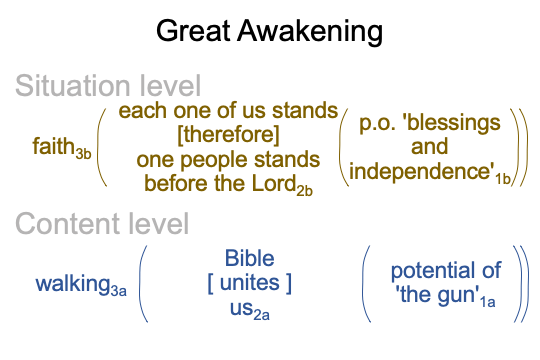
This is a diagram of the Great Awakening. Walking3a gives structure3a. Faith3b offers identity3b.
0150 The student should read Chapters 9, 10 and 11.