0151 Why go to a tent-service to hear a preacher call me into the presence of the Lord?
Why let the spirit overcome me, when I all I want to do is walk with my Bible and my gun?
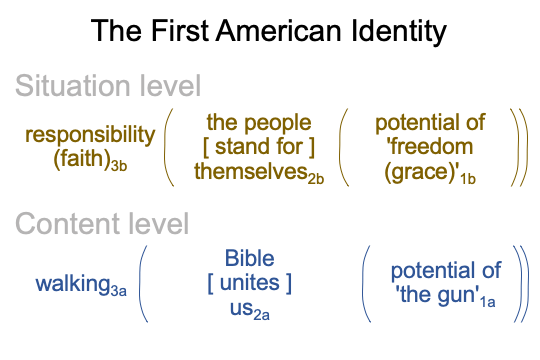
Sola fide3b does not mean “without reason”. It3b means that I feel a responsibility to turn to the Lord. The covenant that God offers me is like the covenant that God offers Abraham. Yes, God makes a deal. Take my offer, elect to follow me, and you will be free. You will gain a land for your descendants. You will stand for yourself.
Abraham walks in the path of the Lord.
He finds God’s blessing. He becomes independent.
0152 Surely, the American identity3b is no longer yoked to the Puritan identity3b.
The structure3a of the colonies has changed between the mid-1600s and the mid-1700s.
0153 Esse_ce precedes essence.
The potential of the ‘gun’1a is virtually situated by the potential of ‘blessings and independence’1b.
What do ‘blessings and independence’1b imply?
Freedom1b.
What does faith3b suggest?
Responsibility3b.
0154 Is the following a diagram of the American Identity achieved during the Great Awakening?
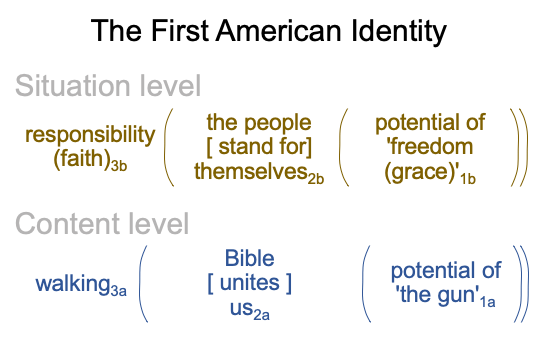
0155 The American people want to stand before the Lord.
They don’t want to stand before King George III, not anymore.
0156 The two-level interscope portrayed above constitutes a psychological earthquake, turning away from the familiarity of English sovereignty, but not towards utopian Enlightenment ideals. It shakes both Puritanism and Anglicism, lightening up on Calvinism and no longer recognizing what Anglicanism pretends to be (the third way between Protestantism and Catholicism).
0157 Chapter 10 (on George Whitefield (1714-1771) and John Wesley (1703-1791)) and Chapter 11 (on how the Great Awakening leads to the American Revolution) complete Part 1.
0158 Part 1 addresses the rise of the American Identity.
Part 2 considers the fall.
0159 So, before leaving Part 1, allow me to restate my initial guess concerning the author’s model that puts American history and literature into perspective. The guess relies on the title, Introduction and Chapter 4.
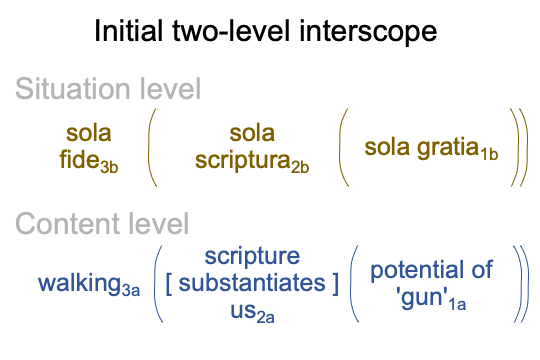
0160 The above figure comports with the author’s expression, “existence precedes essence”, writ large.
The esse_ce of the content level precedes (or calls forth) the essence of the situation level.
0161 When the author proclaims that existence precedes essence, he initially points to Aristotle’s thing. Aristotle’s hylomorphe is matter2am [substance] form2af.
In Peirce’s philosophy, actuality2 consists of two contiguous real elements. On the content level, the two real elements parallel the real elements in Aristotle’s hylomorphe: matter2am and form2af. The contiguity is labeled with a much-abused word, “substance”. [Substance] can be either noun or verb. In the above figure, [it] is rendered as a verb.
0162 However, the author’s proclamation writ small is open to an expansion writ large.
Contemporary scholarship on Aristotle’s hylomorphe ends up generating the following sensible construction. Aristotle’s hylomorphe2a portrays a thing2a which is also (for scientists, more or less) a little noumenon. I call it “little” because the corresponding two-level interscope may be regarded as a “big” noumenon.
Here is a picture of the big noumenon.
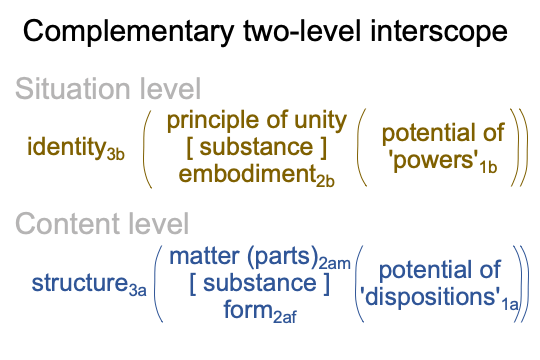
The big noumenon contains the original little noumenon as the content-level actuality2a.
0163 A comparison of the above sensible constructions allow the inquirer to visualize how the author’s model induces the reader to appreciate historical texts in terms of contemporary meanings, presences, and messages.
0164 Plus, a comparison permits an appreciation for the rise of American identity in the constellation of a co-opposition. A co-opposition is a pair of terms where, when one serves as a normal context, the other tends to serve as the potential.
The normal context of responsibility3b operates on the possibilities inherent in ‘freedom’1b.
0165 Here is a picture of the American Identity at the time of the founding revolution.
0166 The inquirer must wonder.
Why doesn’t Jones present his argument with diagrams like this?
The author is practicing what this examination is displaying.
This examination shows a theoretical model within Jones’s argument.
This model is directly based on Thomism. My diagrams follow the Thomist tradition after it passes through Peirce. Peirce’s philosophy begins where Baroque scholasticism leaves off.
0167 The student should now read Chapters 12, 13, 15 and 17.