0089 I ask, “What are the implications of my initial associations to Chapter 1?”
0090 First, the identities3b of the Massachusetts Bay Colony and of the Virginia plantations are characterized by Protestant theology3b. Both colonies are structured3a as settlements3a from English civilization, which had passed through revolution (1533-1547) then civil war (1642-1651) then restoration (1660-1688).
0091 Second, the following purely relational structure is mind-independent reality (in Latin, ens reale).
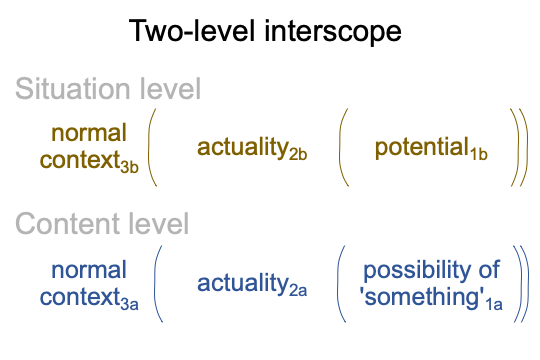
However, once spoken words are placed into the empty slots of the two-level interscope, then one can visualize mind-dependent reality (in Latin, ens rationis).
0092 The content-level and situation-level actualities are the slots most likely to gain associations. The author calls these associations, “categories of the mind”.
Here is a picture.
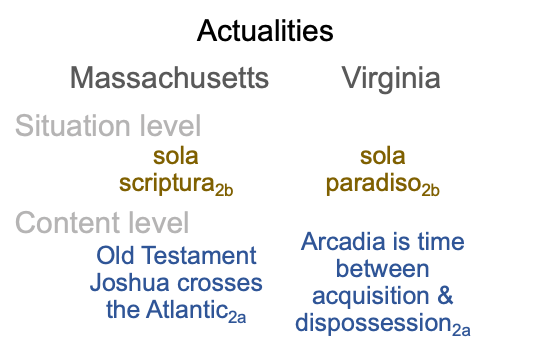
0093 Surely, categories of the mind allow free-floating associations. After all, the forests outside the Bay colony are not like ancient Middle Eastern landscapes. The plantations of Virginia are not like the Garden of Eden, except for the acquisition and dispossession business.
The author mentions the Puritan Grand Marshall, General Oliver Cromwell, of unhappy memory. Cromwell categorized the Catholic Irish as “Amalek”, that is, inhabitants of Baal-worshipping Canaanite cities. Once declared “Amalek”, the Irish were slated for slaughter.
0094 Third, a category of mind2, a label for an actuality2, no matter how goofy, occupies the foreground. Its normal context3 and potential1 stand in the background.
The Exodus story where Joshua crosses the Jordan River in the pursuit of conquest2am is like matter. The Massachusetts’ Bay Colony2af is like form. This matter and form goes with the Bible2a. The Bible2a is the Puritan’s thing.
The ancient Greek stories of Arcadia and the Genesis tale of Paradise2am are like matter. The Virginian colonies2af are like form. Just as in ancient Greece, slaves can do the labor on the plantations.
0095 At the end of Chapter 1, the author draws a contrast… a mirroring (so to speak)… that portrays a rupture during the Reformation. A single situation level shears into two.
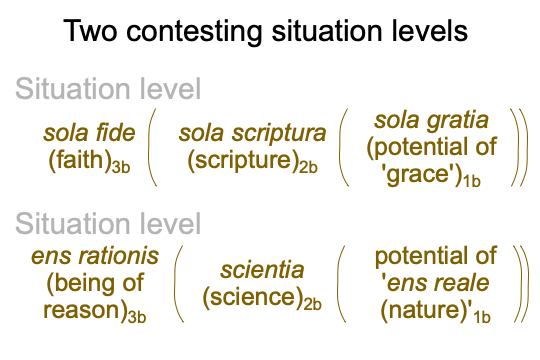
The nested form above is the Protestant slogan.
The normal context of faith alone3b brings the actuality of only scripture2b into relation with the potential of ‘spiritual blessings’1b.
The nested form below addresses Catholic scholastic inquiry.
The normal context of beings of reason3b brings the actuality of scientia (or science, writ large)2b into relation with the potential of ‘mind-independent being’1b.
0096 These two situation-level nested forms stand in dynamic tension.
With the Reformation, the second nested form (which expresses the doctrines of the Catholic Church in Thomistic formulations) falls into shadow with the Puritans and Calvinists, but not so much with the Anglicans (in England) and the Lutherans (in Germany).
Imagine a colony of Puritans sailing across the Atlantic in a wooden boat and arriving in a place that they will call, “New England”. The forest, the wilderness, stretches before them. The inland is full of danger. Then, after the colony becomes a bustling town and the forests have been pushed back by hard-working farmers, it seems as if the wilderness has entered the colony. The second nested form reflects a projection of… what?… their disconnect with England, or worse, their disconnect from Christ.
It’s hard to tell.
0097 According to their own reading of the Bible, the Massachusetts’ Bay colony is the New Israel.
0098 The student should read Chapter 2.