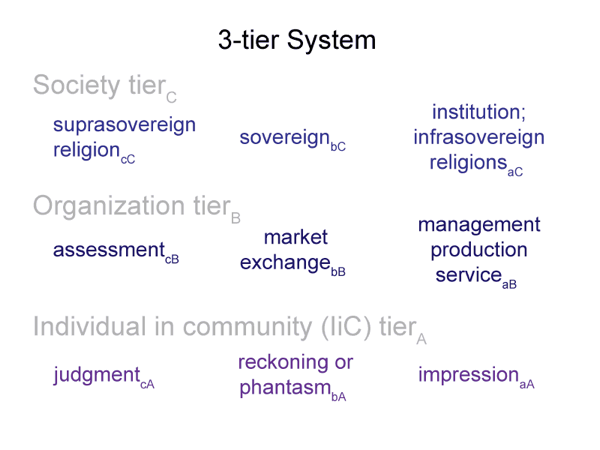
0284 I now compare the Gnostic myth to the sociological model of a three-tier system.
The three-tiered system of societyC, organizationB and individual in community (IiC)A consists of three tiers of interscopes. The model contains nine nested forms. In the following diagram, I merely label each level within each tier. Each level represents a nested form.
0285 Typically, the three-tier system is depicted as three columns of interscopes.
Here, the three-tier system is depicted as three rows.
0286 The working model of the Gnostic origin myth looks like this:
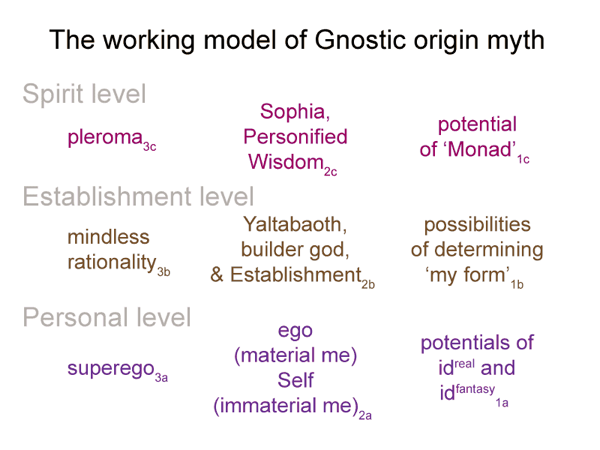
Each element in the working model of the Gnostic origin myth will associate to a nested form (or level) within a tier. This explains why the tiers are set as rows, instead of columns.
0287 Let me look at each virtual nested form according to category, starting with first row.
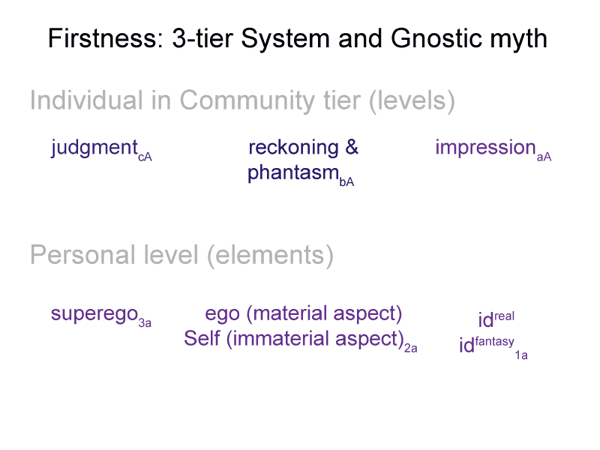
0288 The correspondence is rich and nuanced.
The content or impression level of the IiC associates to the id, implying that the id colors my impressions right from the start. I am always on the lookout for impressions that actualize idreal and idfantasy. I am always on the lookout for desire.
0289 If I have good Freudian ego-function, I spend my time reckoning. The relation between reckoning (taking care of business) and phantasm (fantasizing me in the situation) parallels the relation between the ego and the Self. Reckoning and phantasm divide along the material-immaterial axis that defines the Gnostic worldview.
0290 The superego is the normal context in which the ego takes responsibility for the Self. The ego also acts in the Name of the Self. The superego associates with judgment. Judgment is an operation of the formal intellect. Judgment puts reckonings and phantasms into a normal context.
0291 The correspondence becomes more nuanced when the entire nested form is substituted in for each level.
Here, I use Suarez’s model of ens rationis for the IiC tier.
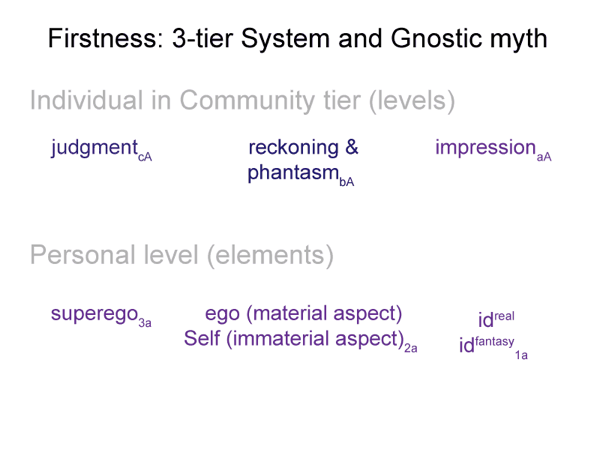
0292 To me, these associations show how Freud was on target. However, Freud’s model of the human psyche did not include the Self. Instead, Freudian therapy tried to identify causes giving rise to idfantasy.
0293 Theoretically, if idfantasy could be attributed to some past trauma or poorly regulated drive, then the ego could adapt to the cause through the reality principle. That, at least, is what Freud reckoned.
0294 Jung knocked the wind out of Freud by proposing the other element in the dyad of actuality, the Self. Freud, following the scientific tradition, never even imagined a feature of actuality that experienced, but was not concerned about, what was actually going on.
0295 Idreal was focused on what actually was going on.
Idfantasy was a separate river within the human psyche, generating wishes that could not be fulfilled by the ego. Why could the ego not fulfill them? They belonged to an immaterial world. They were fantasies.
0296 Ironically, Freud tried to correct for a Gnostic infiltration. Jung revealed the Gnostic infiltration and declared it to be a goal in itself. The goal is to listen to the phantasms.
This is all part of Burfeind’s story.