0276 Chapter nine (C9) is on method. Chapter ten (C10) considers an “entangled string theory” as well as other approaches. Chapter 11 (C11) draws a short conclusion.
All these chapters deal with the issue of what the noumenon must be, in order to conduct the most informative archaeological inquiry.
0277 In this examination, I conclude that the conceptual apparatus of entanglement corresponds to a phenomenological presentation of what the noumenon of archaeology must be.
0278 The basis for such a conclusion is found in Razie Mah’s four part e-work Biosemiotics as Noumenon (2025).
0279 Here is a picture of the Positivist’s judgment, which ground natural scientific inquiry.
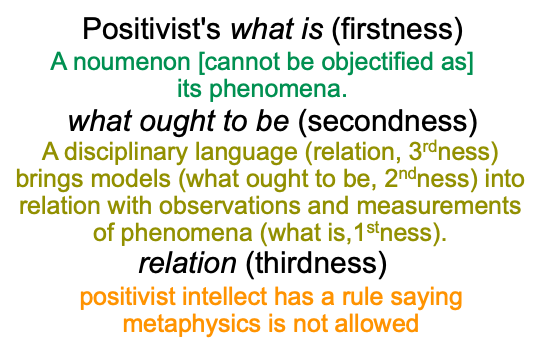
0280 A judgment brings what ought to be into relation with what is. The three elements are what is, what ought to be, and relation. In the above figure, the positivist intellect belongs to the relation (and the relation is imbued with the category of thirdness). The empirio-schematic judgment belongs to what ought to be (and is imbued with the category of secondness). The dyad of the noumenon and its phenomena belongs to what is (and is imbued with the category of firstness).
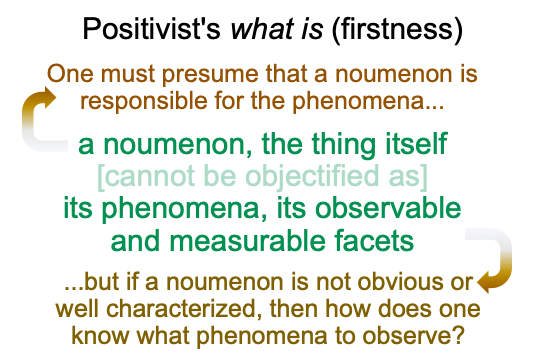
0281 From this, I would expect a benefit from a robust conceptualization of the noumenon.
Otherwise, the noumenon is simply the thing that must be responsible for the phenomena.
But, what does that imply?
Obviously, one wonders whether what one is measuring really corresponds to phenomena of a real noumenon or an imaginary one.
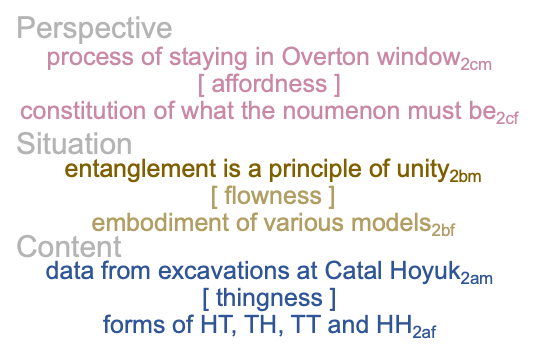
0282 In other words, Hodder’ entanglement is relevant because it reveals what the noumenon must be.
Here is my picture of his theory as an exercise in thingness, flowness and affordance.
0283 Chapter 9 discusses methods as if the noumenon is not under question. He mentions tanglegrams (S2C9), formal networks (S3C9), sequencing concerns (S4C9) and other diachronic aspects (S5C9), as well as other interpretations (S6C9) without mentioning that… well… what exactly is the thing itself?
0284 I wonder whether all the other approaches elucidated in chapter ten (C10) confront the conundrum that I am trying to articulate.
If scientific appreciation of what the noumenon must be stands within the Overton window of Hegel’s and Marx’s things, then what if that is not enough?