0261 In the e-work, The First Singularity and Its Fairy Tale Trace (2012), Razie Mah proposes that the late Neolithic is subject to two trends. The first is material and associates to the domestication of plants and animals. The second is semiotic and associates to a transition from hand-speech to speech-alone talk, initiated by the Ubaid of southern Mesopotamia.
To date (2026), archaeologists have focused only on the first trend. They are not even aware of the latter trend, even as a possibility.
0262 Why is this the case?
0263 As previously mentioned, Hegel’s thing entangles Marxist matter and the confounding resolves into a thesis and an antithesis for modern social science.
Here is a diagram of the confounding.
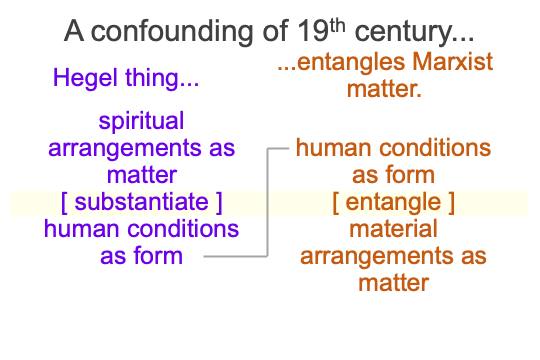
0264 The resolution of this confounding turns into the two limits of an Overton window for the positivist social sciences during the entire twentieth century.
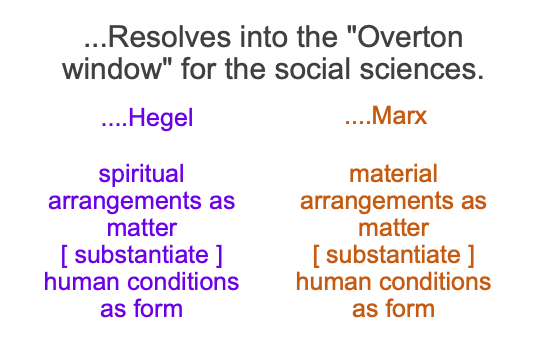
0265 The Hegelian thing addresses adaptations in the style of social constructions. The emphasis is on symbolism. For example, a display of a recovered skull is labeled, “symbolic”, by many social scientists.
The Marxist thing addresses adaptations in the style of sensible construction. The emphasis is on dependencies, human-thing, thing-thing, thing-human and human-human.
0266 As far as I can see, Hodder’s work runs between these two end-posts.
0267 Are human conditions substantiated by way of spiritual or material arrangements?
Hegel says spiritual. Marx says material.
0268 Hegel’s and Marx’s things are reifications of fully triadic category-based nested forms. The normal context3 and potential1 are set as matter2m. The actuality2 serves as form2f. Since the category-based nested form for each thing is different, the human conditions2f are distinct, yet… may I say?… bound to one another.
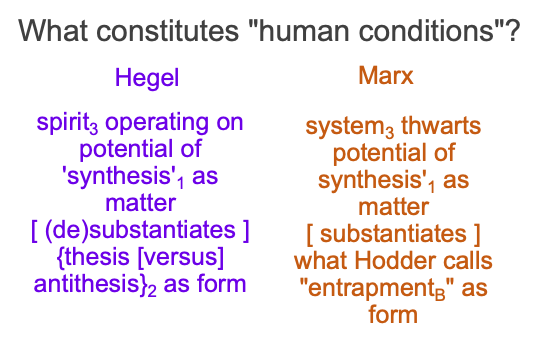
0269 The spirit3 operating on the potential of ‘synthesis’1 as matter [(thwarts) the continuation of] the dyad of thesis in perpetual conflict with antithesis2 as form.
The system3 operating on the potential of ‘(thwarting) synthesis’1 as matter [maintains] entrapment in the condition where thesis and antithesis are never allowed to end2 as form.
0270 If Hegel’s and Marx’s things constitute one’s perception of what the noumenon must be, then that perception will influence what one observes and measures.
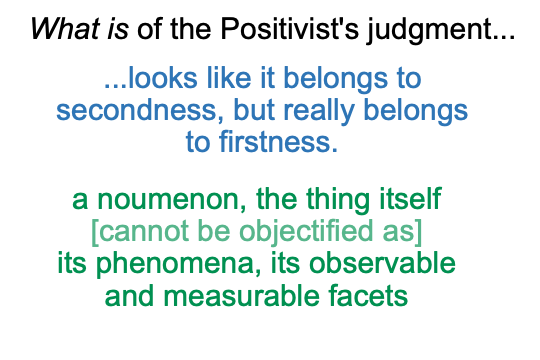
0271 The Positivist’s judgment is foundational for science, as discussed in Razie Mah’s four part e-book, Biosemiotics as Noumenon. The Positivist’s judgment contains three elements: what is, what ought to be and relation.
0272 Here is a picture of what is for the Positivist’s judgment.
0273 I now ask, “What happens when the Overton window anchored by Hegel’s thing and Marx’s thing characterizes what the noumenon must be?“
0274 Obviously, the researcher will look for particular types of phenomena.
For example, in an archaeological excavation, if material artifacts do not change over time, then the anthropologist will build models based on a system3 that excludes the potential of ‘synthesis’1.
If the anthropologist excavates phenomena that change over time, then models will reflect changes in outlook3, attitude3 and so forth.
0275 Consequently, I suspect that Hodder’s book attempts to portray a noumenon, with the goal of influencing which phenomena become salient during archaeological excavations.