0472 The surplus value of labor is a slippery topic.
The term describes a circulation within the subject of commodities.
To me, that means the organization tier.
0473 At the same time, the term puts the machinations of the organization tier into perspective.
So, the theory of the surplus value of labor belongs to the institution level of the society tier.
It sustains righteousness1aC.
0474 My question is: Does the theory of surplus value project a political theology from the society tier onto the organization tier?
This requires a derivation.
Let me start with the original presentation of the organization tier.
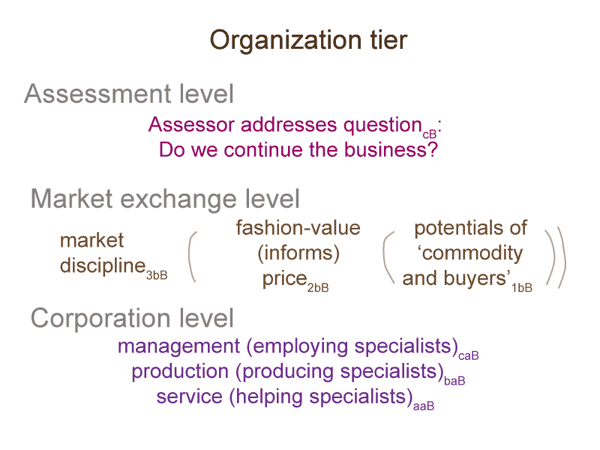
0475 According to Marx, as soon as the exchange of commodities is conducted with money, the specializations of laborbecome a matter of indifference.
Price2bB situates the content-level of the organization tier2aB, just as adoration2bC situates the human body2aC that initiates the upward cascade of glory. (See point 441.)
0476 Adoration2bC looks upwards, towards what defines its existence2cC.
Does price look upwards also?
So far, what do I know?
Price2bB moves up and down according to fashion value2bB.
However, the word “fashion” is too restrictive. So, I will replace it with the term “supplementing”.
0477 Price is significant to the assessor level. The costs that went into producing the product are also significant. Labor is one of costs. So are regulations, taxes and so forth. Assessors weigh many items.
0478 Marx reduces all the assessed items to a single term: value-producing labor.
To Santner, the term value-producing labor ought to inform the price.
But, he is not sure how.
Value-producing labor is a generalized term for all that goes into corporate-level activities. Some types of labor are very expensive. Others are less so. However, they all congeal into the life-blood of the organization.
0479 But, what is life-blood if there is no life?
What is life without purpose?
Institutional purpose brings the organization to life.
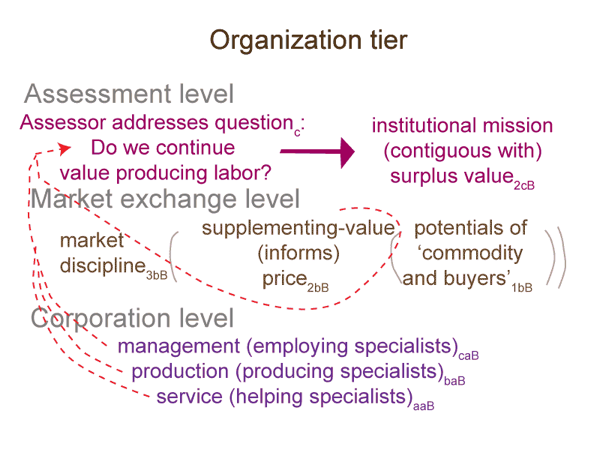
So, where does value-producing labor fit in the organization tier?
To me, value-producing labor enters into the question posed to the assessor:
Do we continue this value-producing labor?
0480 Okay, then the assessment might go like this:
Value-producing labor will continue as long as the organization experiences surplus value.
This places value-producing labor into the realm of possibility.
What about the realm of actuality?
Could an organization’s institutional mission exist without surplus value?
If not, then I may assume that an institution’s mission (reflecting the society tier) is contiguous with surplus value?
The organization depends on surplus value.
Surplus value depends on the way that a supplementing value informs (and often enhances) the price of a commodity.
0481 A picture of the changes in the organization tier follows:
0482 These changes settle into a picture that looks more like the society tier.
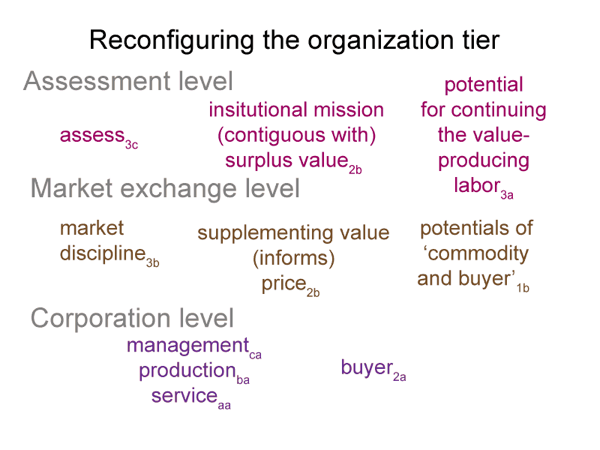
0483 Now, Marx’s terms begin to meld with Freud’s.
Value-producing labor goes into constructing the shape that is called “commodity”.
So I will replace “commodity” with shape as situational potential.
In addition, what the buyer’s money is looking at concerns both the commodity and money itself. Money does the talking.
So, I will replace “buyer” with money as situational potential.
Instead of price, I substitute what money regards.
Figuratively, what the money sees parallels the mortal body of the king, suggesting that the supplementing valuecoincides with royal values. Like royal values, the supplementing value exhibits an abstract materiality.
The situation-level actuality2bB becomes an abstract material [informs] what the money regards.
What else?
Market discipline parallels the glorious body of the king.
But, market discipline is not sublime. It is subliminal.
Does that seem Freudian?
The situation-level contiguity, informs, equals the commodity fetish.