0085 All this goes into the drawer labeled, “methodology”.
Before skipping over the frequently asked questions portion in this chapter, I want to review one caveat and introduce one implication.
0086 The caveat is that the Lost World hylomorphe descends from mediation as a triadic relation. The substance is efficient causation2 along with formal requirements2.
0087 Here is a picture.
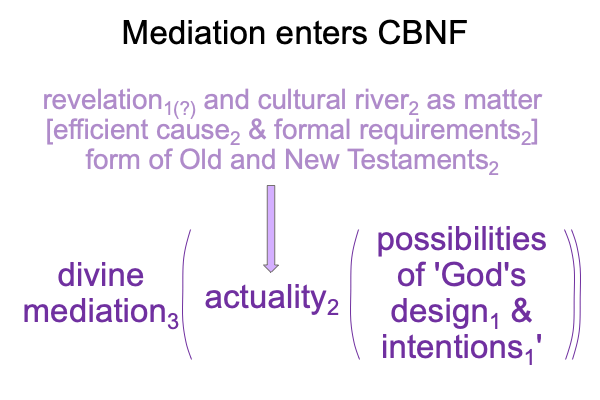
Keep in mind that a thing is composed to two contiguous real elements. So, the actuality2 constitutes the object of Walton’s Lost World Inquiry.
0089 Walton assumes that the above category-based nested form is shared by fellow inquirers, especially evangelicals in the plain-speaking traditions of the Reformation.
One problem is that this assumption does not receive the attention that it deserves. This category-based nested form is key to the success of the Lost World Project.
Unfortunately, the normal context3 of divine mediation3 and the potential of God’s design1 and intentions1 does not limit itself to the slogan, sola scriptura, now that God has revealed the archaeology of the ancient Near East to the still-Christian western civilization.
In other words, modern excavations and reconstructions of ancient Near East civilizations cannot be ignored by Christian theologians.
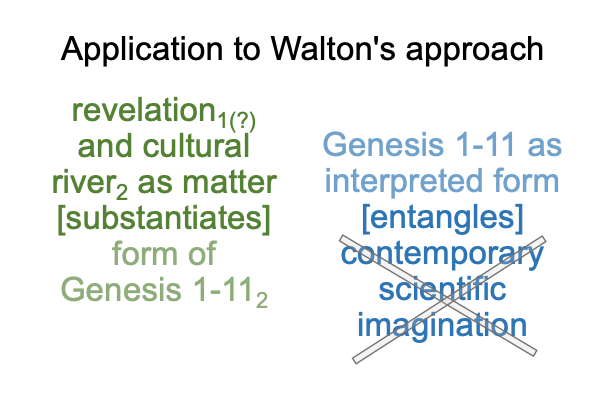
0090 As noted in points 0079-0084, Walton’s resolution occurs once the hylomorphe of traditional theological inquiry into the Creation Story and the Primeval History as objects of inquiry entangles the archaeological discoveries of the ancient Near East (ANE).
0091 Fortunately, Walton’s resolution resists entanglements with the science-informed Christian imaginations that were formulated before the Lost World Inquiry.
Here is a picture.
0092 Say what?
John H. Walton does not want entanglements. He wants a plain reading of the Genesis 1-11 text in light of ANE civilizational conditions and history. This permits the exclusion of all preceding science-Christian entanglements.
Indeed, the frequently asked-question section in the chapter on methodology beats back many expressions of Christian imaginations informed by science.
Many of these expressions are ruled out as not relevant, once one regards Israelite thinking as embedded in the conceptual world of the ANE.
0093 This examination suggests that Walton’s lockdown of the science-informed Christian imagination will not last long.
Why?
We have entered the fourth age of understanding, the Age of Triadic Relations.
0094 If Juri Lotman, a Marxist atheist, ends up convinced that we live in a semiosphere, a world perfused with signs, and if that conviction resurrects a theological insight buried deep within the Orthodox Church and Slavic civilization, then what happens when plain-speaking reformers embrace semiotic points of view?
Will such an embrace fire the Christian imagination, already informed by science?
Yipes!
0095 What happens when, in question number seven on page 36, scholars suggest that both Israelites and other people in the ANE believed that the sky is a solid dome?
Akkadian texts contain passages that proclaim that the stars are engraved on the underside of a solid sky.
Egyptian art portrays stars embedded in the underside of the body of Nut, the god of the firmament.
0096 The thing that is the “sky” is considered solid to the peoples in the ANE. Solid matter substantiates the form of the term “firmament”.
But, this claim sets up the occasion for an entanglement with… gasp… the semiotics of natural signs.
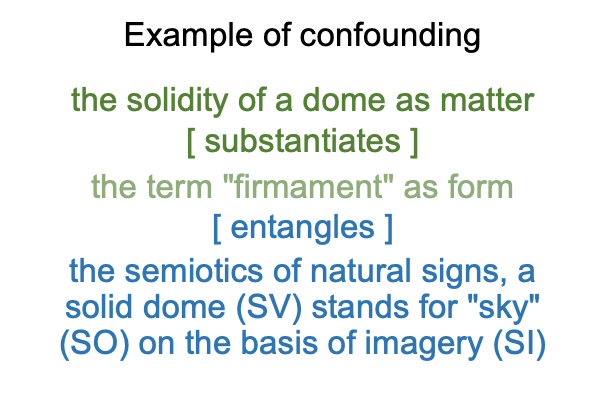
0097 To the Israelites and the peoples of the ANE, the solid dome is a sign-vehicle (SV) that stands for the sign-object of the word “firmament” (SO) in regards to imagery, appearances and so forth (SI).
The referent (as matter) precedes the spoken word (as form).
At the same time, the referent (as sign-vehicle, SV) stands for the spoken word (as sign-object, SO) on the basis of imagery (a sign-interpretant, SI).
How confounding!