05/7/26

Semiotics and History – Baroque Scholasticism and Early Modernism (Part 1 of 1)

SaH0043 The Baroque scholastics of southern and central Europe live at the same time as the mechanical philosophers of northern and western Europe.  The latter give rise to the Age of Fiction, with Cervantes publishing Don Quixote in the early 1600s.  The former give rise to the Age of Ideas, with the birth of modern science.

Of course, it is not as neat as that.

Consequently, an examination of an article by Novotny serves as a capstone for Razie Mah’s online course on Baroque Scholasticism and as an introduction to an online course in Early Modernism.

Baroque Scholasticism consists of Looking at Daniel Novotny’s Book (2013) Ens Rationis from Suarez to Caramuel (and appears in Razie Mah’s blog in May, 2026).

The capstone for Baroque Scholasticism and the introduction to …and Early Modernism consists of Looking at Daniel Novotny’s Article (2017) Izquierdo on Universals

Baroque Scholasticism and Early Modernism consist of a review of Eric Santner’s Book (2016) The Weight of All Flesh.

SaH0044 Both are strands in the course: Semiotics and History.

See Razie Mah’s blog for February 3, 2026.

05/7/26

Looking at Daniel Novotny’s Essay (2017) Izquierdo on Universals (Part 1 of 6)

0267 What are universals? Why are they important? 

In the Spring 2017 issue of the American Catholic Philosophical Quarterly (vol. 91(2) pages 227-249), Daniel Novotny examines Disputation 17 of the Baroque scholastic treatise, The Lighthouse of the Sciences (1659).  The title of Novotny’s article is Sebastian Izquierdo on Universals: A Way Beyond Realism and Nominalism.  These comments intend to demonstrate the postmodern relevance of this work using the category-based nested form.

0268 Oh, back to the starting questions.

Some things are similar to one another.  Universals grow out of this impression.  Various things can share in certain universals, to the exclusion of other things.  In this very brief paper, Daniel Novotny reviews and summarizes the theory of universals proposed by the Spanish Baroque scholastic, Sebastian Izquierdo, SJ (1600-1681 AD).

Izquierdo’s life overlaps with the northern European authors who mark the dawn of the Age of Ideas, including Thomas Hobbes (1588-1679) and Rene Descartes (1596-1650).  His life also overlaps with theorists marking the twilight of the Latin Age, including Francisco Suarexz (1548-1617) and John Poinsot (1589-1644).  Our current age is born at this time.  This is the moment to which we must return in order to come to terms with our era.

0269 Daniel Novotny is not unfamiliar with the Baroque philosophers.  I commented on his full-length book, Ens Rationis: From Suarez to Caramuel, published in 2013.  Novotny’s exposition is so clear that constructing (inevitably messy) category-based nested forms came easy.

My comments wove a story into his presentation, starting with the dichotomy of fact versus fiction and ending with an intimation of postmodern social construction.  This narrative adds value by connecting Baroque scholasticism and our present, postmodern, world.

0270 As for the article under examination, Novotny begins with a caveat.  Baroque philosophy and theology is a complex tapestry, filled with commentary and references.  One can easily get lost in this forest of questions and answers.  Typically, an entire text must be examined in order to configure an author’s opinion, if distinct from all others.  Since such effort is very difficult and time consuming, Novotny limits this publication to a careful examination of Disputation 17 of Izquierdo’s major philosophical work, The Lighthouse of the Sciences.

Disputation 17 presents Izquierdo’s theory of universals.

0271 The table of contents for The Lighthouse of the Sciences is organized in a novel way, portending substantial differences from traditional doctrines and methods.  In Disputation 17, Izquierdo considers three questions.  To me, these questions sound postmodern.

Q1. What are universals?

Q2. Are some universals independent of the intellect?

Q3. If universals are intellect dependent, what is their nature?

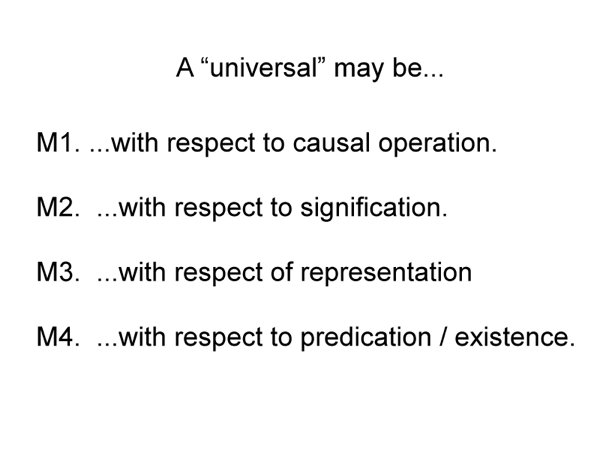
0272 To the first question, Izquierdo offers four meanings:

0273 Let me supply an example from Eric Santner’s (2016) book, The Weight of All Flesh

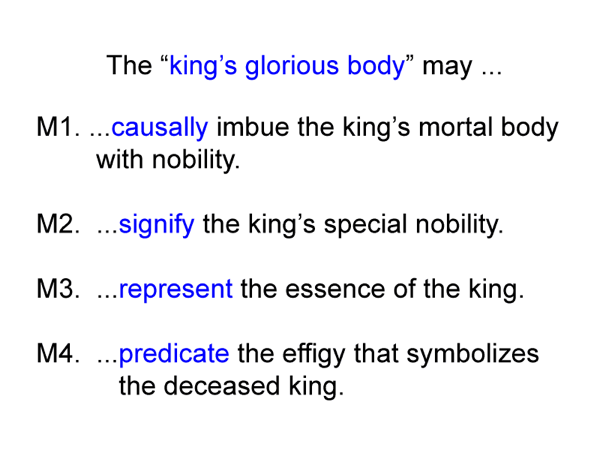
0274 During late medieval and early modern times, political theologians proposed that the king had two bodies.  One was mortal.  The other was glorious.

When a king died, his mortal body was quickly buried.  An effigy (representing the king’s glorious body) was manufactured and placed on the throne until the coronation of a new king.  Then, the effigy was buried in a separate funeral.

0275 The glorious body of the king is a universal with four meanings.

0276 The last meaning is particularly twisted.  The universal, in its proper sense, cannot be a particular.  Yet, here is a particular effigy that becomes a symbol of the king’s glorious body.

According to C. S. Peirce, a symbol is a sign based on tradition, convention, law, consensus and so on.  Here, a political and theological consensus connects a sign-object (the king’s glorious body) to a sign-vehicle (an effigy of the deceased king).

0277 In Peirce’s semiotic terminology, the scholastic term “objective concept” portrays the union of a sign-vehicle and sign-object.  The term “objective precision” reflects the operation of a sign-interpretant.

0278 In the terminology of the nested form, “objective concept” belongs to secondness, the realm of actuality.  “Objective precision” belongs thirdness and firstness, the realms of normal context and possibility, respectively.  An objective concept is a mind-dependent being.  Objective precision is a formal act of the intellect.

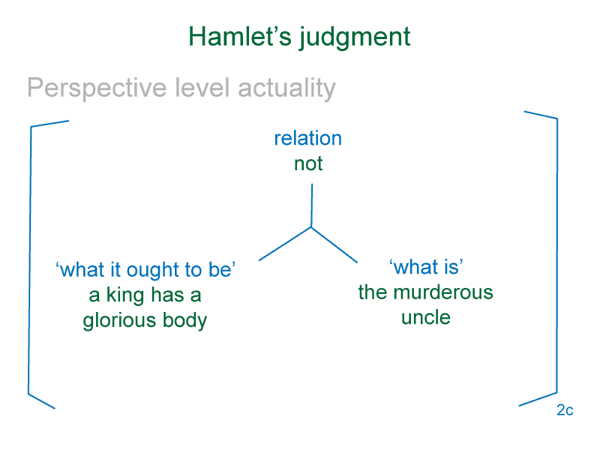
0279 For example, in Shakespeare’s Hamlet, a murderous uncle gains the throne and becomes king (objective concept).  Unfortunately, the ghost of Hamlet’s father (the glorious body of the deceased king) appears, calling Hamlet to reject his uncle’s claims (through objective precision).  Hamlet’s uncle has no nobility.  Therefore, his uncle is not king (and does not have a glorious body, since the glorious body of Hamlet’s father haunts the world).

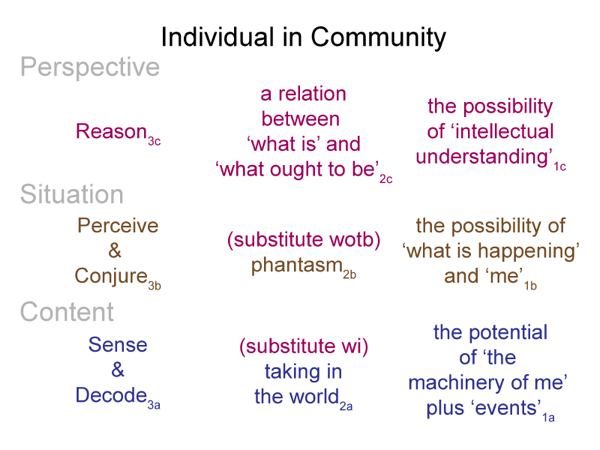
0280 This dramatic call to judgment may be depicted as a relation between what is and what ought to be.  Indeed, I define the actuality of judgment as this triadic relation.

0281 Here is a diagram.

05/1/26

Looking at Daniel Novotny’s Essay (2017) Izquierdo on Universals (Part 6 of 6)

0350 Next, the fourth proposition (P4) comes up for consideration.

0351 What is the disposition of the universal to each of Aristotle’s definitions?

According to the working model, both definitions are in play in the primal triad.  They are not independent.  How can this be?  This model supports further philosophical inquiry.

0352 Propositions P2 and P3 pertain to the interscope of the individual in community.

0353 P3 points to the fact that the normal context for judgment2c is reason3c.

0354 P2 suggests that what is and what ought to be may not be labeled.  Instead, phantasms and impressions substitute for these intersubjective unities.  The resulting judgment is called an intrinsic abstraction.  This is the type of judgmentrendered in the Lebenswelt that we evolved in.

0355 The Christian sacrament of the Eucharist serves as an example.

What is appears as a piece of bread2a.  What ought to be is the phantasm of the body of Christ2b.  Thomas Aquinas discovered the relation, twelve hundred years after the commissioning of the Last Supper.  Transubstantiation2c (as the universal, relation) brings the appearance of bread2a->2c (as the universal, what is) into relation with the body of Christ2b->2c (as the universal, what ought to be).

0356 What is emerges from the potency of the material and physical.  What ought to be emerges from the potency of the formal and logical.  What brings these into relation is a mystical operation emerging from the potency of human understanding.

0357 Of course, I will never hear the word “transubstantiation” on television in this era of big government (il)liberalism.

Instead, I will see a commercial for a Czech beer, starting with the image of an amber bottle, glistening with condensate.  Music starts.  The word “you” appears as a hand grasps the bottle.  “Can”, another hand pops the cap.  “Be”, one hand lifts the bottle.  “The King”, the hand pours the beer.  “Of Bohemia”, the cascading brew fills an image of a throne.

The music swells as the honey-colored throne morphs into a glistening glass of beer.

The voice-over intones, “You can be the King of Bohemia.”

0358 Has the glorious body of the king transubstantiated into a commodity, a regal libation?

0359 I raise my glass to Ceske Budejovice in the Czech Republic, the home of the University of South Bohemia.

0360 Daniel Novotny lists the consequences of Baroque Scholastic Sebastian Izquierdo’s Disputation 17 in The Lighthouse of the Sciences.  He concludes with an impression: Izquierdo is close to modern empiricism.

0361 Izquierdo rejects the extra-mental features of universals and avoids the projection of universals into the realm of the mundane.  He avoids nominalism by insisting on objective concepts.

0362 Novotny suggests that Izquierdo’s rejection of Aristotle’s act-potency distinction draws him into the same errors that plague contemporary metaphysics and philosophy of mathematics.  The middle way between nominalism and Platonism must be grounded in the metaphysical structure of reality.  But, Izquierdo cannot lock onto that relational structure.

0363 Charles S. Peirce gave me a gift.

0364 His three categories point to the ground that Izquierdo intimated.  Izquierdo’s third way may have failed, but with the category-based nested form, I can look across the turbulent seas of the Age of Ideas and say, “I see what you mean.”

0365 The Lighthouse of the Sciences still beacons.

10/30/23

Looking at John Deely’s Book (2010) “Semiotic Animal”  (Part 1 of 22)

0001 The full title of Deely’s book is Semiotic Animal: A Postmodern Definition of “Human Being” Transcending Patriarchy and Feminism: to supersede the ancient and medieval ‘animal rationale’ along with the modern ‘res cogitans’.  The book is published in 2010 by St. Augustine’s Press in South Bend, Indiana.

John Deely (1942-2017 AD) starts as a Thomist interested in Heidegger and becomes a semiotician.  He becomes a really, really good promoter of the study of signs.  He writes a history of philosophy from the point of view of the revelation… or, is it discovery?.. that the sign is a triadic relation. For years, he teaches at University of Saint Thomas, Houston.  He retires, moves to Latrobe, Pennsylvania, home of St. Vincent’s College, then dies.

This examination is to be read in parallel with or after reading (and writing marginalia) in Deely’s book.  My argument may run like a dog on a long leash, compared to Deely’s argument.  But, there is reason for the analogy.  Thirteen years have passed since publication and five years since Deely’s burial, and the Age of Triadic Relations continues to manifest.

Semiotics is the study of signs.  A sign is a triadic relation.

0002 Chapter one considers a question that we ask ourselves.

Humans, what type of animals are they?

Chapter two addresses the answer.

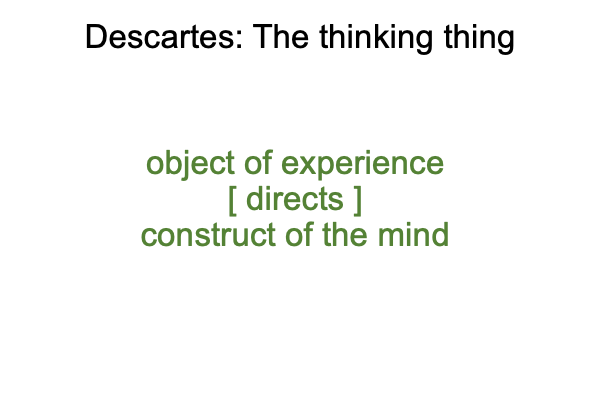
0003 Modern philosophy starts (more or less) when Rene Descartes (1596-1650 AD) presents a sensation, as an idea and an image where the object of experience directs a construct of the mind.  Consequently, he regards humans as thinking things… or the owners of thinking things (minds)… or something like that.

In terms of Peirce’s philosophy, there are two contiguous actualities, characteristic of the category of secondness.  They are an object of experience and a construct of the mind.  The contiguity (which, for nomenclature, is placed in brackets) is “directs”.

Here is a picture of Descartes’ dyadic actuality.  In Latin, the title is “res cogitans“.

Figure 01

0005 As already noted, this hylomorphic structure is coherent with Peirce’s category of secondness.  The actuality corresponds to a sensation. Sensation exhibits a dyadic character.  Sensation is like cause [and] effect or matter [substantiating] form.

There is an implicit claim that this dyad describes the way humans think.

Plus, a superior claim (not realized until Charles Peirce (1839-1914 AD) wrote about it) may be asserted.  Humans think in terms of triadic relations, such a signs, mediations, judgments and category-based nested forms.

Say what?

See A Primer on the Category-Based Nested Form and A Primer on Sensible and Social Construction, by Razie Mah, available at smashwords and other e-book venues.

0006 With the superior claim in mind, it is no surprise that when later philosophers build epistemologies upon Descartes’ foundation, they end up shifting Descartes’ terms out of secondness, the realm of actuality, and into thirdness, the realm of normal contexts, and firstness, the realm of possibility.  

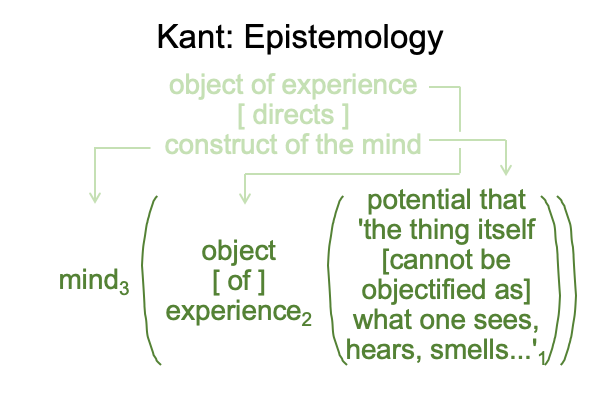
Here is a category-based nested form that sort of captures Kant’s epistemology.

Figure 02

The normal context of the mind3 brings the actuality of an object of experience2 into relation with the potential of a particular condition1. What is that condition? The thing itself [cannot be objectified as] what one sees, hears, smells, tastes or touches.

0007 So, the experience of the five senses2 becomes an object2 as it simultaneously is contextualized by the mind3 and arises from the potential of a particular condition1.  Plus, the particular condition1 is that the object of experience cannot be the thing itself1.

It sort of like saying that my image in a mirror is not me, even though I appear to be the object of experience.

0008 Welcome to modern… philosophy?… er… science?

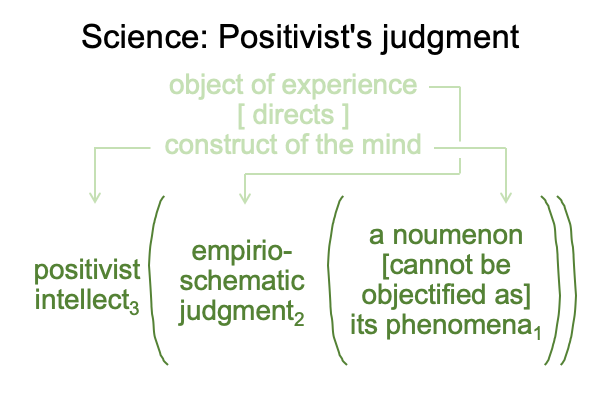
The Positivist’s judgment formalizes the quasi-Kantian category-based nested form by thirdly, replacing the mind3 with a positivist intellect3.  The positivist intellect3 rules out metaphysics.  Secondly, the object of experience2 is replaced by an empirio-schematic judgment2, where disciplinary language (relation) brings observations and measurements of phenomena (what is) into relation with mathematical or mechanical models (what ought to be).  Firstly, the thing itselfand what one senses1 are replaced by Latin terms, the noumenon and its phenomena1.

Here is a diagram of the Positivist’s judgment as a category-based nested form.

Figure 03

0009 The implications of the conversion of Descartes’ dyadic formula for sensation to a modern quasi-Kantian nested form for how humans think are most curious.

It seems that the construct of the mind weaves a normal context3 and potential1, sort of like a spider spinning a web in the hope of catching a flying insect.  The metaphorical flying insect, is an experience2 that immediately becomes an object2as the manifestation of the realness of the normal context3 and potential1.  Plus, the object2 is inside of the observer and the thing itself1 remains (potentially) on the outside.

Similarly, for the Positivist’s judgment, the scientist weaves the normal context of the positivist intellect3 with the potential that phenomena1 may be the observable and measurable facets of a noumenon1, then waits for observations and measurements (what is) to reveal patterns that can be modeled (what ought to be) and discussed with disciplinary precision (relation between what is and what ought to be)2.  One of the oldest adages in science says, “First, observe phenomena.  Second, explain them.”

0010 What a curious implication.

It is almost as if the construct of the mind is looking for an actuality2 that fits its ideals.  And when it does, it transforms whatever enters the realm of actuality, such as an experience2 or a measurement2, into an object2 or an empirio-schematic judgment2.

10/2/23

Looking at John Deely’s Book (2010) “Semiotic Animal”  (Part 22 of 22)

0172 Deely concludes with a sequel concerning the need to develop a semioethics.

The meeting of the two semiotic animals in the previous blog is a case study.

Surely, that brief clash of objective worlds entails ethics, however one defines the word, “ethics”.

Perhaps, the old word for “ethics” is “morality”.

0173 Deely publishes in 2010.

Thirteen years later, his postmodern definition of the human takes on new life.  This examination shows how far semiotics has traveled, swirling around the stasis of a Plutonic publishing world where Cerebus guards the gates.  Please throw a sop to the editors in order to publish, rather than perish.  While academics guard the way to the underworld of professional success, Deely looks down from the heavens above.

And what does he say?

Humans are semiotic animals.

0174 Okay, I have to correct myself.

I don’t know whether Deely is looking down from a heavenly perch.

Surely, many will sheepishly testify to his devilish, as well as his angelic, qualities.

As a shepherd, he is always trying to lead his rag-tag flock of semioticians, explorers and Thomists.  He gets so far as to impress upon every one in his flock the validity of his claim that humans are semiotic animals.

0175 Razie Mah takes that lesson to heart and asks, “If humans are semiotic animals, then how did they evolve?”

The resulting three masterworks are available at smashwords and other e-book venues.

An Archaeology of the Fall appears in 2012, followed by an instructor’s guide.

How to Define the Word “Religion” appears in 2015, followed by ten primers.

The Human Niche appears in 2018, along with four commentaries.

As it turns out, no contemporary scientist takes Deely’s claim seriously. Yet, the implications are enormous.  If humans are semiotic animals, then triadic relations must be key to understanding human evolution.

0176 This examination of Deely’s book takes that lesson one step further.

The specifying and exemplar signs step out from Comments on John Deely’s Book (1994) New Beginnings as expressions of premodern scholastic insight.

The interventional sign steps out from Comments on Sasha Newell’s Article (2018) “The Affectiveness of Symbols” and establishes a postmodern life of its own.

0177 Humans are semiotic animals and how we got here shines like a revelation.

09/23/21

Looking at Mark Spencer’s Essay (2021) “The Many Phenomenological Reductions” (Part 1 of 4)

0001 What is Phenomenology?

Phenomenology belongs to (what John Deely calls) the Age of Ideas, starting with the Western civilization’s turn from scholasticism towards mechanical philosophy.

0002 Mechanical philosophers, such as Rene Descartes (1596-1650 AD) say, “Forget final and formal causation.  Think in terms of material and instrumental causalities.  Attend to phenomena, the observable and measurable features of our world.  Then, build mathematical and mechanical models using well defined terms.”

0003 Later, Immanuel Kant (1724-1804) codifies a reaction against this fixation, arguing that we must not forget the thing itself (the noumenon).  Sure, phenomena are crucial to scientific observations and measurements.  But, the noumenon cannot be objectified as its phenomena.

0004 Then, Edmund Husserl (1856-1939) declares, “I have developed another way to situate phenomena.  By consciously focusing on phenomena, while bracketing out all this measurement business, along with other distractions, I can identify the noumenon, what the thing itself must be.”

0005 Now, there are two ways to situate phenomena.

First, scientists directly situate phenomena through observations and measurements.  They build models.  They are not interested in the thing itself.

Second, phenomenologists virtually situate phenomena through a method of bracketing assumptions, such as the empirio-schematic judgment, to end up with a noumenon, what the thing itself must be.

09/22/21

Looking at Mark Spencer’s Essay (2021) “The Many Phenomenological Reductions” (Part 2 of 4

0006 The scenario depicted in the prior blog appears in Comments on Mark Spencer’s Essay (2021) “The Many Phenomenological Reductions”, available for purchase at smashwords.

Search for Razie Mah, Mark Spencer, and phenomenological reductions.  The electronic article in smashwords, or some other electronic literature venue, should appear.

0007 The engagement between phenomenology and science is delicate.  Phenomenologists attend to the same phenomena as scientists.  But, they do not compete with scientists.

Scientists directly situate phenomena using the empirio-schematic judgment (which is first diagrammed in Comments on Jacques Maritain’s Book (1935) Natural Philosophy), in the normal context of a positivist intellect.  The positivist intellect has a rule.  Metaphysics is not allowed.

Phenomenologists sidestep science, by contemplating phenomena, while reducing their field of consciousness to exclude the machinations of science, among other distractions.  The goal is to identify what the thing itself must be, without any metaphysical baggage… er… I mean… terminology.  Anything that sounds like metaphysics will raise the ire of scientists.

0008 It is like tiptoeing around a sleeping dog.  The metaphorical dog protects science against metaphysics.  It has been known to gnaw on the bones of its victims, especially the ones who uttered the word, “hylomorphism”.  That word sounds totally metaphysical.  “Hyle” is Greek for “matter”.  “Morphe” is Greek for “form”.

To the sleeping dog of science, physics is the master of the house.

The master of the house says, “No metaphysics.”

09/21/21

Looking at Mark Spencer’s Essay (2021) “The Many Phenomenological Reductions” (Part 3 of 4)

0009 Sound is a very interesting thing.

Dogs can hear sounds that humans cannot.

Does that mean that humans cannot be effected by inaudible sounds?

Can humans be impacted by inaudible sounds?

0010 These questions have proper grammatical form, but they do not speak to the heart of the matter.

Phenomenologists speak in a specialized language that scientists do not hear.  The scientist’s ears are tuned to hear about measurements, models and precisely defined terms.  Phenomenology does not speak of phenomena in scientific terminology.

The guard dog of science is on the prowl for another language that scientists do not want to hear, the language of metaphysics.  So, phenomenologists also do not speak of phenomena using metaphysical terms.

0011 In short, phenomenologists strive to be impactful while being inaudible.

0012 Mark Spencer does not reflect on the tentative engagement between phenomenology and science.

He innocently explores an accommodation between Christian realism and phenomenology.

After all, both indirectly situate science.

0013 Well, forget the “after all”. 

Spencer does not mention science at all.

As such, he threatens to wake the sleeping dog of the positivist intellect.

His proposals make phenomenologists jittery.

Talk of metaphysics will upset a delicate arrangement.

09/20/21

Looking at Mark Spencer’s Essay (2021) “The Many Phenomenological Reductions” (Part 4 of 4)

0014 Despite the hazards involved, there are opportunities.  

The Christian realist cannot speak in terms of metaphysics, because those words are not allowed in polite scientific society.

Perhaps, the Christian realist can convey the same meaning, presence and message with phenomenological terms, which are designed to sidestep the dictates of the positivist intellect.  The language of phenomenology is adapted to not wake the sleeping dog of science.

0015 Spencer ends the article in an impasse.

The impasse is theatrical.

Spencer declares, “Phenomenology longs to speak the language of metaphysics.  Metaphysics longs to speak from the platform of phenomenology.  Why can’t we find an accommodation?”

The phenomenologist cannot answer by saying, “An accommodation will destroy us both.”

0016 For Christians and phenomenologists alike, there is something to be learned from Mark Spencer’s 2021 essay, “The Many Phenomenological Reductions and Catholic Metaphysical Anti-Reductionism”, appearing in the summer issue of the American Catholic Philosophical Quarterly, and Razie Mah’s commentary, available at the smashwords website.

Science cannot be ignored.