06/29/26

Looking at Eric Santner’s Book (2016) The Weight of All Flesh (Part 1 of 28)

0001 The following 2017 essay comments on a recent book by a Professor of Literature about the subject matter of the political economy.  Eric Santner tries to figure out its immaterial measure.

Why do I say immaterial measure?

Consider the complete title: The Weight of All Flesh: On the Subject Matter of Political Economy.

Weight is a measure of something material.  However, weight itself is not material.

Similarly, matter ought to be material.  But, subject matter is not.

Also, the economy processes materials.  Politics does not.

Will literalism do under these circumstances?

Once the flesh has weight, then it is no longer simply what it is.

Once matter is taken to be a subject, then it is no longer merely what it is.

Once the economy is taken to be political, then it is no longer only what it is.

0002 To me, the category-based nested form applies.

The actualities of flesh, matter and economics exist by themselves.  But, humans evolved to consider more than what is at hand.  We are designed to put actuality into a nested form.

So, these actualities exist, for us, in the normal contexts of weight, subject and politics.  These are not the only normal contexts.  They are the contexts raised by the author.

The contextualization of actuality raises another question.

What potentiates the weight of fleshsubject matter and political economy?

You may already know the answer.  I do not.  Consequently, I turn to this text to see what I may discover.  This will be a fairly close reading, so have Santner’s book at hand.

‘Words that belong together’ are denoted by single quotes or italics.

0003 Eric Santner wrote The Weight of All Flesh: On the Subject-Matter of Political Economy (Oxford University Press, 2016).  The main body of the book consists in a preface and two lectures.  The two lectures constitute chapters 1 and 2.  These chapters are broken into parts.

Santner’s presentations are works of art, composing the 2014 Tanner Lectures on Human Values at the University of California, Berkeley.

0004 The front piece is an introduction by Kevis Goodman.  The end piece is a suite of comments by Bonnie Honig, Peter E. Gordon and Hent de Vries, followed by a reply by Eric Santner.

The responses are very challenging.  How does one reply to something that sounds like free association?

Unfortunately, the front and end pieces will not be covered in these comments.  However, the end piece may be used as an exercise in the methodology that composes these comments.

0005 Why is this interesting?

My interest is obvious once one looks at How To Define the Word “Religion” plus the first ten associated primers.

The tenth primer ends before the majesty of sovereign power.  Primers 8, 9 and 10 tell of the difficulty of seeing beyond these mountains.  Anyone who argues about politics can stir up an avalanche.

What does Primer 8 tell me?

Infrasovereign religions grasp for sovereign power in order to impose their organizational objectives on those outside their organization.

What about Primer 9?

Socrates had to drink hemlock.  Why did he have to do that?

Primer 10?

Rene Girard proposes that a scapegoat mechanism is apparent in all civilizations.  Plus, the mechanism comes into play when power structures try to preserve themselves.

Overall, politics and religion map a dangerous landscape.  Eric Santner walks where angels fear to tread.

0006 Primers 8, 9 and 10 explore the presence underlying the word “religion”.

Institutions occupy the content level of the society tier.  They contextualize the organization tier.  These institutions harbor organizational objects, objectsorganization, that call the individual into organization.  These objectsorg are virtually situated by sovereign acts, laws and decrees.

0007 Eric Santner reads literature.  He observes art.  He sees that something changed in the West over the past few centuries.

What is this something?

It is completely missed by the current social and political sciences.  However, it appears in Western paintings, poems, novels, plays, and other artistic works.  This is the stuff that Eric Santner studies.

0008 Subject matter.  What is it?

“Matter” is stuff.  “Subject” is something that ends up objectified.

Okay, now what?

Does subject matter signal the objectification of matter?

Or does subject matter signify the objectification of something that matters?

0009 At the end of the Latin Age and the beginning of the Age of Ideas, around the 1600s AD, the subject matter of political theology was the king’s two bodies.  One body was mortal.  The other was sublime.

The object of the king’s glorious body supplemented the subject of the king’s mortal body.  Santner labels the process spectral (glorious body) materiality (mortal body).

0010 To me, the glorious body is the normal context for the actuality of the king’s mortal body.

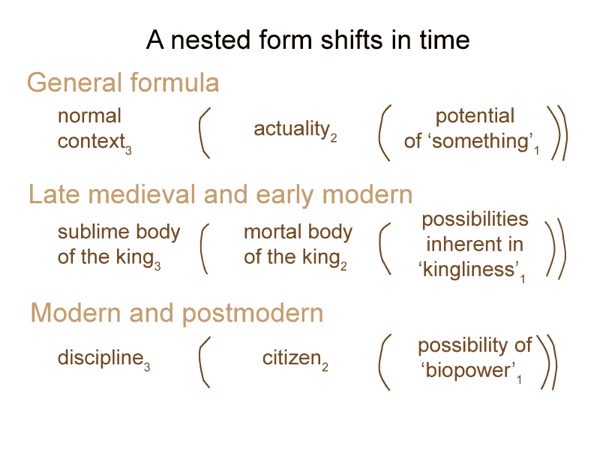
The nested form looks like this:

Sublime body3( mortal body2( potential of kingly being1))

0011 Does this express the character of the subject matter?

The mortal body is matter.  The sublime body is the normal context that objectifies the mortal body.  Thus, the king’s mortal body becomes a subject for political theology.  The something that underlies the mortal body, giving its flesh weight, is the quality of being king.

0012 Moving to the present day, the matter of political theory falls to the people, rather than the king.  The subject gets dispersed from one king to many citizens.  The glorious body translates into what Michel Foucault calls “discipline”.  The qualities that weight the mortal body of the king turn into “biopower”.

To me, modern political theory translates into the following nested form:

Discipline3( citizen2( possibilities inherent in biopower1))

0013 The two nested forms are shown below:

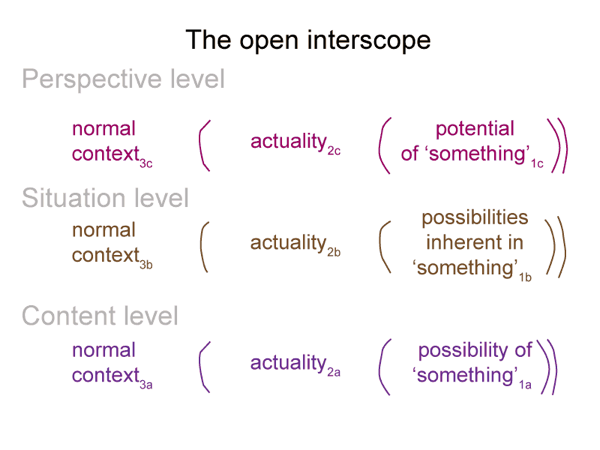
Normal context3 and possibility1 surcharge actuality2.

0014 The mortal body of the king is more than it otherwise would be in any other context.  Its actuality possesses a surplus of immanence because it now has potential.

Similarly, one citizen may heroically rise above others as an expression of the biopower released by discipline.  Other citizens are weighed and measured in the exercise of biopower.

0015 The pressure cooker of the royal person expanded to the business of the citizen.  Medieval and early modern political theology gave way to modern political economy.

0016 Take a look at a painting.  Jacques Louis David painted the extraordinary Death of Marat, during the French Revolution.

Compare this image to a wax effigy of a dead medieval king, or some other memorial, placed on the throne during official mourning.

0017 Jean-Paul Marat, the citizen, dies in his tub.  David paints the death scene.

The king’s mortal body is buried.  An icon of his sublime body is placed on the throne.

Clearly, David paints the equivalent to the sublime body of the citizen, Marat.

0018 One could say that this represents a loss of enchantment.  After all, Marat, the revolutionary, hardly behaved royally.

This lack of royalty aligns with the emptiness above Marat, the corpse.  The upper half of David’s painting is empty.  If Marat had been royalty, the upper register would be full of angels and saints welcoming the glorious king.

What happened to the angels and saints?  

0019 Heck, not even Marat’s fellow citizens are in the upper frame, registering the emotions of shock, grief, and, perhaps, relief.  Critics have called the nondescript space above the dead Marat oppressive, abstract and unmotivated, characteristic of a representational deadlock.

0020 Perhaps, the cunning and ambitious artist was saying, “Do not let this be you.”, while painting, “This fellow was a citizen hero.”

Santner does not tell why Marat got knifed in his enclosed bathtub, filled with medicinal waters.  Marat was a radical agitator.  He named his newspaper, “The People’s Friend”.  He was murdered by a woman who had come to him, claiming news from one of the districts of France.

During her trial, she testified that she killed one man in order to save one hundred thousand.  She was found guilty.  Her head was chopped off with a guillotine.

0021 Jacques-Louis David was charged with organizing Marat’s funeral.  Surely, Marat was a martyr for the Revolution.  Yet, despite the acclamation, no other figure appears in the painting.

0022 Why?

The reason is simple.

No sane person (whether angel, saint or fellow citizen) wanted to be associated with this crazy person, who was typical of the Jacobins, the party that celebrated the Cult of Reason and the Cult of the Supreme Being.

0023 David’s painting is both a warning and a paean.

0024 To Santner, the empty upper register of the painting associates to the impossibility of transcendence in the modern age.  Business is busy-ness.

06/1/26

Looking at Eric Santner’s Book (2016) The Weight of All Flesh (Part 28 of 28)

0547 I now move to Lecture 2.10.

In the preceding section, Santner dwells on the word “doxologies”.

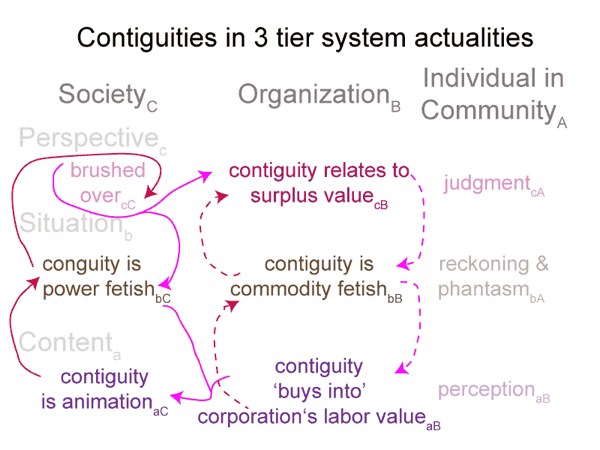
0548 There are two doxologies flowing upwards in the following figure.

This pair of doxologies is glory and money.

One is societal.  The other is organizational.

0548 Santner coins the word, paradoxology, for exploring this double flow.

The subject matter of the political economy is a paradoxology.

0549 There are two movements flowing downwards in the preceding figure.

The pair of condensates are busy-ness and identity / purpose.

One is societal.  The other is organizational.

One is enforced through sovereign laws and decrees.  The other is inculcated through broadcast advertising.

0550 Santner recounts a debate about how to interpret Kafka’s writings.

Walter Benjamin and Gershom Scholem expressed different views of the theological tracks of Kafka’s stories.

0551 Scholem argued that Kafka’s work shines like a revelation.  But, it’s a tricky revealing.  It does not lead the reader to God, but to some originating nothingness.

0552 Benjamin countered that Kafka’s work has a message: The gate to justice is study.  But the question is: What to study?  The Torah has been brushed over by modern inquiry.  Students have lost the Holy Writ.

0553 Scholem replied: No, those who study have not lost the Scriptures.  They have lost the ability to decipher them.

0554 Does this conversation fit into the previous figure?

A suprasovereign religion was brushed over by the time that Marx projected the transcendent (a political theology) onto the immanent (the machinations of the organization tier).

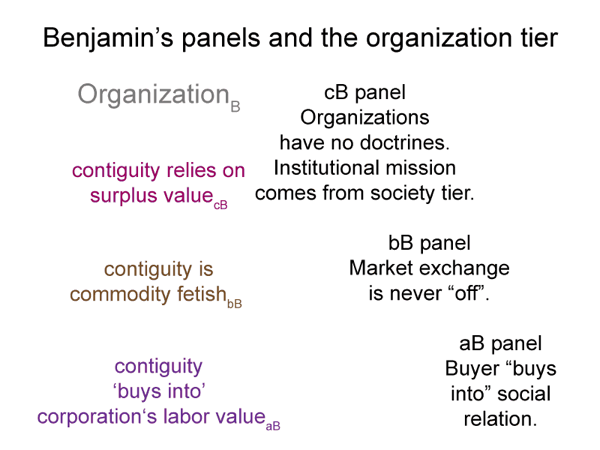
0555 Santner concludes with Walter Benjamin’s tripartite image of capitalism.

In one panel, capitalism is a purely cultic religion.  It has no doctrine.  It has no dogma.  Adam Smith’s theories of the self-regulation of markets are exemplar.  What is the invisible hand?  It is dogma?  Or is a way to describe events that cannot be reduced to cause and effect?

In the next panel, capitalism is always “on”.  It never takes a holiday.  Santner associates this to the doxologies of everyday life.  Work is always waiting.  Duties are never completed.

In the final panel, capitalism creates guilt, not atonement.  In other words, it creates more debt, more burdens and more work.

Does the sovereignty of debt become sovereign debt?

Not necessarily, but it happens often enough.  After all, who pays for the political entrepreneurs?  Who pays for the busy-ness of citizensMarat?

0556 Does each of Benjamin’s panels describe a level of the organization tier as understood from the communist perspective?

How curious.

0557 Certainly, capitalism is a religion worthy of contempt.

Too bad it is a projection of Marxist ideology.

Walter Benjamin’s career as literary critic expanded the cognitive space opened by the Marxist religion

This is the nature of religions.

0558 Marxist ideology projects a plausible theology onto something in the organization tier that everyone encounters.

0559 Marx selected one of the best encounters.

In every purchase, I, the buyer, encounter a corporation that I do not belong to.

Is this alienating, or what?

0560 My money goes up from the product (content) through the price (situation) and becomes surplus value(perspective).

A quality of the product comes down, from the brand name (perspective) through the abstract material guaranteed by the brand name (situation) to the aspects of my identity congruent with this abstract material (content).

0561 Following this pattern, I only purchase bread from The Staff of Life Bakery.

It is my paradoxology.

My devotion increases the glory of the bakery.  The bakery provides me with a mission, “Eat the bread of life.”

My money keeps the bakery in business.  The brand name makes my mouth water.

0562 When Adam Smith attempted to describe this process, he saw an invisible hand, guaranteeing high quality products for low price.  There was no dogma.  There were no doctrines.  There was only rational self-interest.

0563 When Karl Marx passed judgment on this process, he reified the theological dogmas of mercantilism.  Everywhere that Marx looked in the organization tier, he found religious expression.

If he were to start his own religion, then what better way than to project the theology of mercantilism onto the operations of the organization tier and then declare it evil?

Indeed, the organization tier becomes evil when viewed as an unholy ascent of money and a devilish descent of brand names.

0564 Thus, the paradoxology of Marxism becomes clear.

A doxology of communist power rises through the society tier in response to a projected evil doxology, called “capitalism”, arising in the organization tier.

0565 The organizational objectives of Marxism become inevitable once its projections are assumed and never questioned.

0566 To me, this conclusion makes the works of Eric Santner and Giorgio Agamben fascinating to behold.  Here is the subject matter of political economy.

03/26/24

Looking at Michael Tomasello’s Book (2016) “A Natural History of Human Morality” (Part 1 of 22)

0389 The book before me published by Harvard University Press, Cambridge, Massachusetts.    The question?  What makes humans unique?  The approach is scientific.  Humans think differently than great apes, their closest biological kin. One way to understand that difference is to observe and measure the cognitive capacities of human newborns and infants, as well as the cognitive abilities of adult great apes.

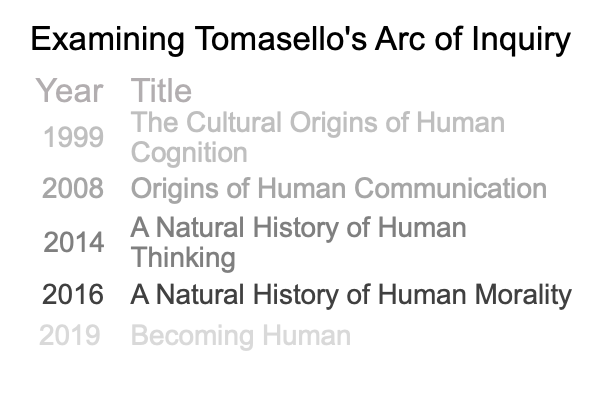
This book belongs to a decades-long arc of inquiry by the author.  During much of this time, Michael Tomasello serves as co-Director of the Max Planck Institute for Evolutionary Anthropology in Leipzig, Germany. I cover two decades in my examinations.  Here is the fourth book in the list.

0390 What has this semiotician found so far?

First, from the very start of his journey, the content-level of Tomasello’s vision corresponds to the situation-level of Razie Mah’s hypothesis.  The ultimate human niche consists of the potential of triadic relations.

Razie Mah’s hypothesis applies the two-level interscope for Darwin’s paradigm to human evolution.

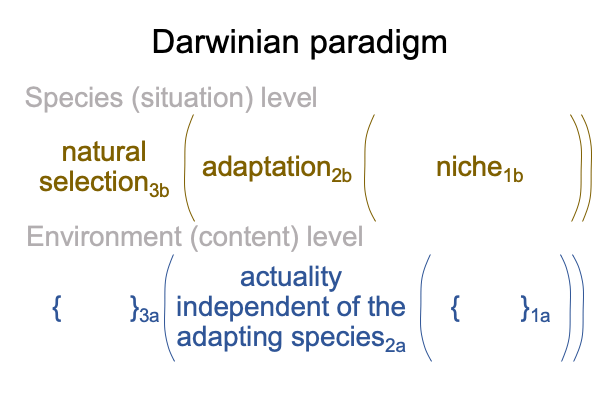
0391 First, the general Darwinian paradigm looks like this.

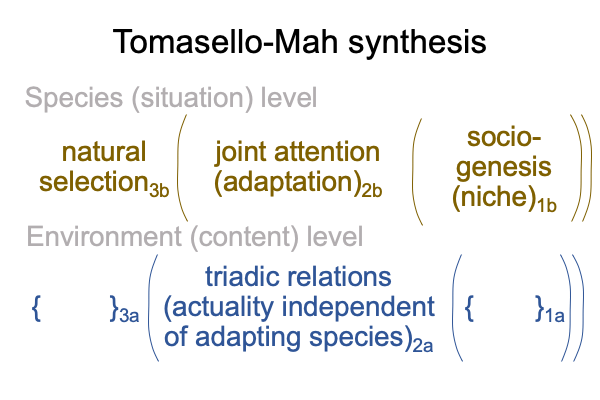
0392 In The Human Niche (available at smashwords and other e-book venues), Razie Mah proposes that the ultimate human niche1b is the potential of triadic relations.

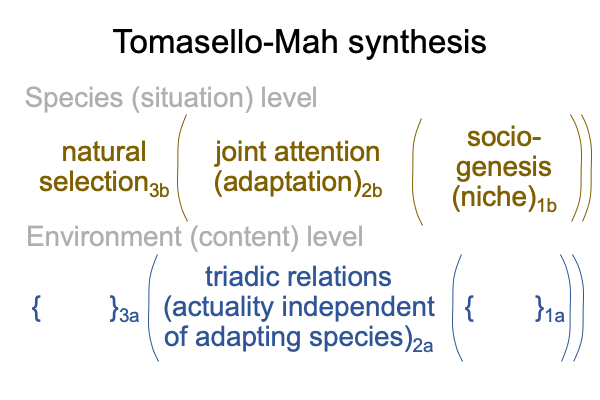
Tomasello’s hypothesis that joint attention2b and shared intentionality2b are behavioral and cognitive adaptations to the niche of sociogenesis1b reconfigures the situation-level of Darwin’s paradigm, resulting in what I call the “Tomasello-Mah synthesis”.

0393 Yes, fortune turns her wheel.  Tomasello does not know Mah’s hypothesis.  Tomasello’s arc of inquiry is underway in 1999.  Mah’s hypothesis first appears online in 2018.  So, Tomasello configures his insight, corresponding to the situation-level of the Darwinian paradigm, as the content-level of his vision.

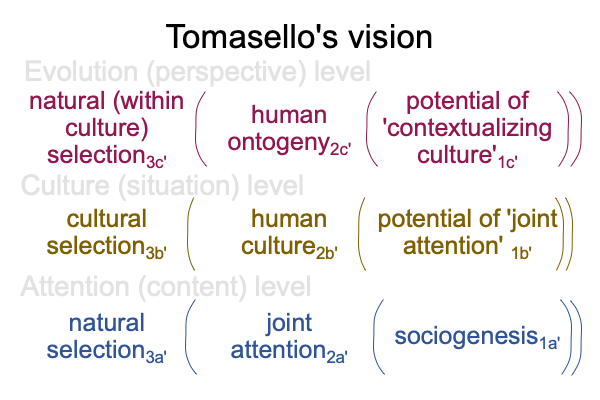
Tomasello’s vision offers a way to bring a phenotype (of human ontogeny2c’) into relation with a foundational adaptation (of joint attention2a’).  But, according to Mah, phenotype and adaptation are two independent fields of evolutionary inquiry.  One does not situate or contextualize the other.  Rather, the two intersect.

Consequently, Tomasello’s vision resolves the internal contradictions of the intersection of genetics and natural history,by assigning the phenotype to the category of thirdness and the adaptation to the category of firstness, while maintaining the actuality of both.

0394 Here is a picture of Tomasello’s vision.

0395 Of course, this examination appears precisely 25 years after Tomasello’s vision is cast in 1999 AD.

His vision is maintained throughout his arc of inquiry.

Consequently, his conclusions carry an awkward emptiness.  The emptiness compares to the basement of a house.  The basement is dark, cool, foundational and ignored, until of course, one must seek refuge in a storm.

0396 The previous examinations of Tomasello’s works demonstrate that the house, the abode of his vision, is furnished with morality.

Tomasello can ignore the basement, haunted by immaterial beings called, “triadic relations”.  Yet, in that place, where a family might store potatoes, onions, smoked meat, along with luggage and Christmas ornaments, dwells something that Tomasello may safely ignore.  I call that ghost, “religion”.

03/1/24

Looking at Michael Tomasello’s Book (2016) “A Natural History of Human Morality” (Part 22 of 22)

0588 The Tomasello-Mah synthesis shows the ghost in the basement of the house of Tomasello’s vision.

Indeed, as this version of Darwin’s paradigm begins to haunt the entire edifice of human evolution, then Tabaczek’s housebecomes more than a house with a basement.  If sociogenesis1b is the potential1b of triadic relations2a, then Tomasello’s arc of inquiry may be re-articulated using triadic relations.

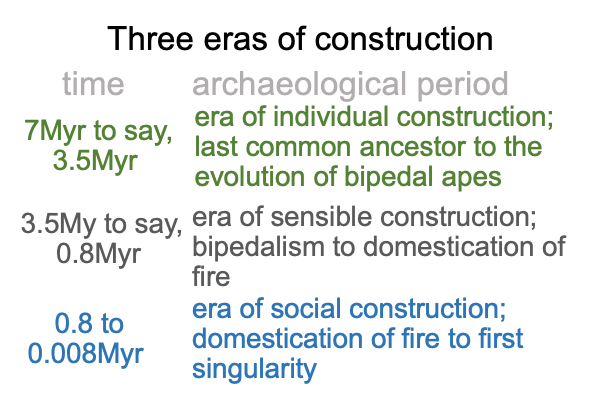
0589 For example, Razie Mah’s Primer on Sensible and Social Construction may be used to re-label the eras of individual, joint and collective intentionality.  Individual construction associates to the category-based nested formSensible construction associates to the two-level interscope, containing content and situation levels.  Social construction associates to the three-level interscope, containing content, situation and perspective levels.

Here is a list of what that might look like.

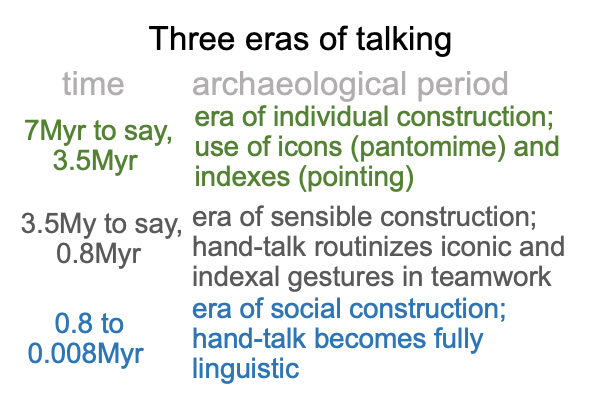
0590 To continue, the re-labeled eras may be regarded in terms of the evolution of talk.

The evolution of talk is not the same as the evolution of language.  Language evolves in the milieu of hand talk.

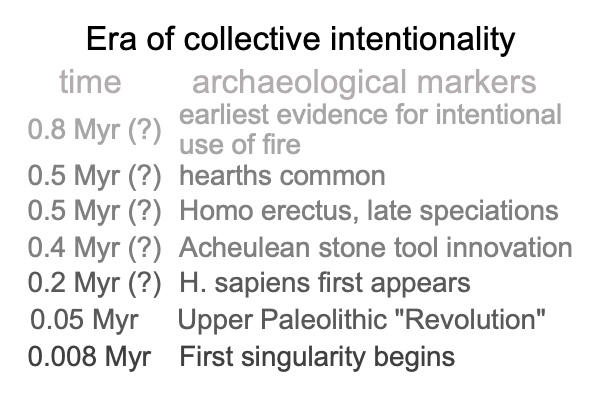
0592 Next, I would like to focus attention on the era of collective intentionality.

Here is a list depicting the timeframe.

0593 Before the era of collective intentionality, hand talk is confined team activities.  Hand talk produces sensible constructions.  Each team develops its own way of hand talking.  

After the domestication of fire, team-tradition hand talk starts to be used generally, eventually producing fully linguistic hand talk.

The situation is very dynamic.  Since cooking with fire increases the number of teams, fully linguistic hand-talk is re-appropriated for specialized use in more and more teams.  Fully linguistic hand-talk influences all social circles.  In some of these circles, grammatically correct, yet apparently nonsensible statements, generate social constructions that open new cognitive spaces.  These novel cognitive spaces become sites for more sensible construction.

0594 The voice comes into play during community meetings (150), seasonal mega-band round-ups (500) and special occasion tribal pow-wows (1500).  The voice is used for synchronization.  Song brings a large gathering of hominins into synchronization.  Once this cultural habit starts, then singing joins other traits in sexual selection.  The voice comes under voluntary control.

0595 Most likely, the early speciations of late Homo erectus produced species that could sing and hand-talk.  But, they could not speak.

Speech is added to hand-talk with Homo sapiens.  Anatomically modern humans practice a dual-mode of talking, hand-speech talk, for the next two hundred-thousand years.

0596 Hand-speech talk would still be practiced by anatomically modern humans today, were it not for the Ubaid of southern Mesopotamia.  The hypothesis of the first singularity proposes that the Ubaid is the first culture on Earth to practice speech-alone talk.

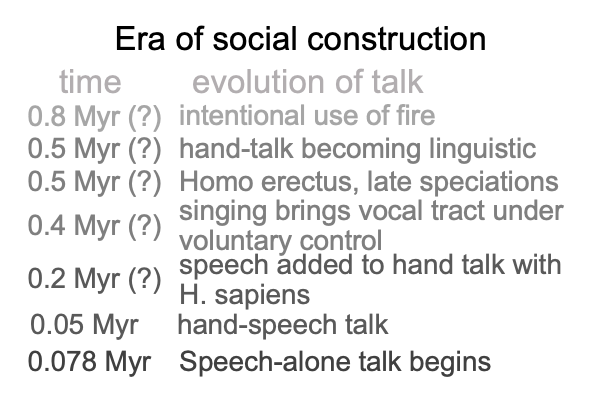
Here is a picture of the era of social construction.

0598 Today, all civilizations practice speech-alone talk.

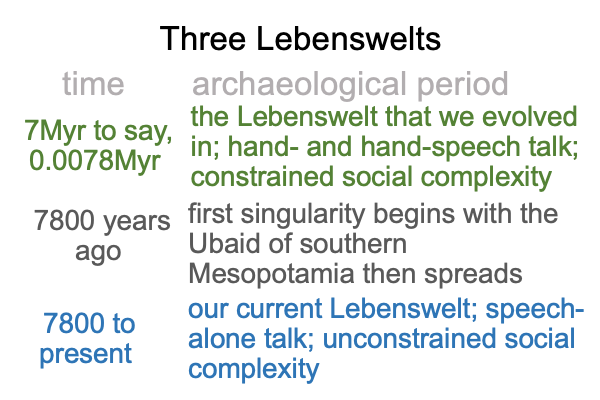
This brings me to the limit of Tomasello’s vision.  I open the door, and step out into the realization that our current Lebenswelt is not the same as the Lebenswelt that we evolved in.  I step into the vision of Razie Mah.

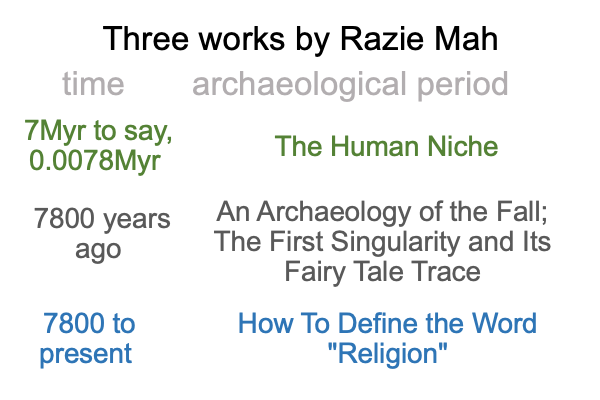
0599 The arc of Tomasello’s inquiry, spanning from 1999 to 2016, opens onto three masterworks by Razie Mah.  These electronic books are available at smashwords and other e-work venues.  This examination relies primarily on The Human Niche, along with books contained in the series, A Course on The Human Niche.  A related series is titled, Buttressing the Human Niche.

Here is a list of Mah’s masterworks.

Still, there is more.

A Commentary on Michael Tomasello’s Arc of Inquiry (1999-2019) is available at smashwords and other e-book venues.  This commentary includes Mah’s blogs for January, February and March, 2024, along with an examination of Becoming Human (2019), the fifth book in a sequence of five books.

0600 My thanks to Michael Tomasello, who writes the books under examination while Co-Director of the Max Planck Institute for Evolutionary Anthropology in Leipzig, Germany, for conducting a scientific inquiry, from which I have examined only several works.

02/29/24

Looking at Michael Tomasello’s Book (2014) “A Natural History of Human Thinking” (Part 1 of 22)

0187 In the preface, the author notes that this book is a prequel to The Cultural Origins of Human Cognition (1999, Harvard University Press).  The question is the same.  What makes humans unique?  The answer is the same.  Humans think differently than great apes, their closest biological kin.

In 1999, researchers in evolutionary anthropology could say, “Only humans think of other humans as intentional agents.  Plus, my cat and my dog are intentional operators, as well, say nothing of the weather.”

Okay, I added the second sentence for dramatic effect.

Unfortunately, research conducted after 1999 introduces a problem.  It turns out that great apes recognize intentionality in others.

Uh oh.

0188 This book is the third marker in Tomasello’s intellectual journey.  I start following his trek with Looking at Michael Tomasello’s Book (1999) “The Cultural Origins of Human Cognition” (appearing in Razie Mah’s January 2024 blog).  The second marker that I examine may be found in Looking at Michael Tomasello’s Book (2008) “Origins of Human Communication” (appearing later in the same blog for the same month).

0189 In the publication before me, A Natural History of Human Thinking (2014, Harvard University Press, Cambridge Massachusetts), Tomasello explicitly abstracts three cognitive processes in order to distinguish humans from apes.  The processes are cognitive representation, inference and self-monitoring.  He then proposes that all three components were transformed in two key steps during hominin evolution.  He labels his claims, “the shared-intentionality hypothesis”.

0190 Does this follow the trajectory set by previous works?

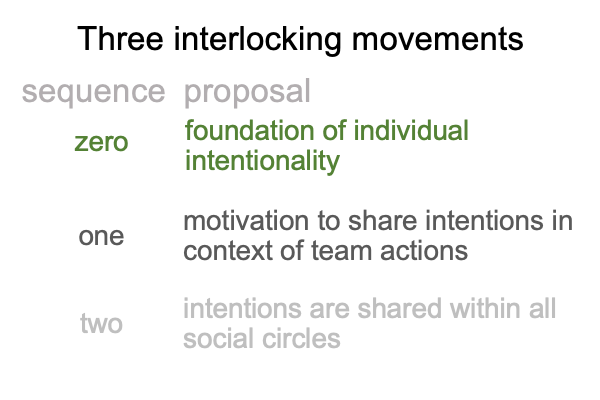
Here is a theme that appears in the second marker, pre-emptively modified with the above propositions in mind.

0191 This modified picture allows me to offer slogans for movements zero and one.

For zero, the slogan is “I work for food.”

For one, the slogan is “We work for food.”

01/31/24

Looking at Michael Tomasello’s Book (1999) “The Cultural Origins of Human Cognition” (Part 1 of 12)

0001 In 1999 AD, Michael Tomasello, then co-director of the Max Planck Institute for Evolutionary Anthropology in Leipzig, Germany, publishes the work before me (Harvard University Press, Cambridge, Massachusetts).

To me, this work marks the start of the author’s twenty year journey, culminating in a theory of human ontogeny, published in 2019.  The word, “ontogeny”, refers to human development and associates to the human phenotype.

0002 What interests me in Tomasello’s journey?

As noted in Comments on Dennis Venema and Scot McKnight’s Book (2017) Adam and the Genome (available at smashwords and other e-book venues), “phenotype” and “adaptation” are not the same.  Instead, these labels apply to distinct actualities that coalesce into a single actuality.  One may call that single actuality, an individual, a species or a genus.  One may also call that single actuality, “a mystery”.

I am interested in the natural history side of the mystery of human evolution.  However, the genetic (or ontogenetic) side cannot be ignored.  Plus, natural history cannot be reduced to genetics, or visa versa

0003 Chapter one of Tomasello’s book is titled, “A Puzzle and a Hypothesis”.

Of course, a puzzle is not a mystery.  A puzzle can be resolved.  A mystery cannot.

The puzzle starts with genetics.  Geneticists have examined the DNA of chimpanzees, bonobos and humans and predict that the last common ancestor lives 6 or 7 Myr (six or seven million years ago).

In contrast, physical anthropologists (natural historians) propose the fossil record noted in the following figure.  With terminological sleight of hand, they refer to human ancestors as “hominins”, even though the old term for any bipedal primate (ape or human) is “hominid”. 

0004 Hmmm. Does the puzzle concern time?

According to genetics, the last common ancestor (LCA) between chimpanzees and humans lives 7 Myr (millions of years ago).  But, little significant shows up in the fossil record until 4 Myr.  Our lineage obviously evolves feet first.  As it turns out, starting around 5 Myr, the extent of tropical vegetation in Africa decreases due to desiccation.  Bipedality is an adaptation to mixed forest and savannah.

0005 The fossil record provides other clues, especially stone tools.

The first stone tools are Oldowan.  Oldowan stones tools are constructed on site.  They are used to scrape meat off of bone and to crack long bones (that are full of fatty marrow).

Acheulean stone tools appear later in the archeological record.  Acheulean stone tools are made beforehand and carried with some intention in mind.  They have the appearance of a giant tooth.  Notably, Acheulean stone tool technology remains unchanged for over a million years.  Innovations in stone-tools follow the domestication of fire.

0006 Surely, these two tables are puzzling.  In the first, the fossil record pertains to changes in hominin phenotypes.  In the second, the fossil record pertains to hominin adaptations, but these adaptations are not phenotypic. They are artifacts.  Are these adaptive artifacts cultural?  Are they behavioral?  I wonder, “Do the words, ‘culture’ and ‘behavior’, capture the matter and the form of these artifacts?”  It is as if an adaptation recognizes matter and generates form.

0007 What is the nature of the adaptation that maintains (and occasionally changes) artifacts, as if these artifacts are phenotypes?

Tomasello suggests that an adaptation is a novel form of social cognition.  Our lineage adapts to a new way of thinking about one another, eventually allowing sociogenesis, new styles of learning and cultural evolution.

0008 Tomasello proposes that there is one adaptation that potentiates subsequent adaptations.

Razie Mah proposes that there is one ultimate niche for our lineage.  The hypothesis is presented in the e-book, The Human Niche (available at smashwords and other e-book venues).

0009 Do Tomasello (in 1999) and Mah (in 2018) propose that our lineage is defined by the same adaptation… er… niche?

What is the difference between an adaptation and a niche?

To these questions, I next attend.

01/18/24

Looking at Michael Tomasello’s Book (1999) “The Cultural Origins of Human Cognition” (Part 12 of 12)

0072 Chapter five is titled, “Linguistic Construction and Event Cognition”.  The perspective-level linguistic communication2c participates in ongoing events2a.

Tomasello claims that joint attention is the key adaptation from which subsequent adaptations proceed.  Surely, the three-level interscope depicted above does not contradict this claim.

After all, the evolution of joint attention should precede the evolution of linguistic communication.

0073 However, there is a disjunction, because great apes show few (if any) tendencies that may be characterized by joint attention.  Even the occasional monkey hunt by chimpanzees is best characterized by several individuals deciding to pursue the same thing at the same time.  The monkey-prey is the focus of attention, but the attention is disjointed, not really coordinated.

So, there must be a period before the evolution of joint attention, where individual intentionality reigns, even when group action takes place.

0074 So, when are these eras happening?

Tomasello wants to place the evolution of joint attention before the time of Homo heidelbergensis, who appears in the fossil record between 800 and 400kyr (thousands of years ago).

To me, this makes sense only so far as this.

Homo heidelbergensis leaves traces of cultural behavior in the archeological record.

To me, such traces indicate that these hominins are in the subsequent build-on era.

So, Tomasello’s timeline may require clarification.

0075 Okay, now that I am nitpicking, I must ask, “Is there a problem with making joint attention2a the foundation of an evolutionary theory?”

Allow me to return to Tomasello’s vision.

0076 According to Comments on Dennis Venema and Scot McKnight’s Book (2017) Adam and the Genome (by Razie Mah, available at smashwords and other e-book venues), adaptation2 and phenotype2 belong to two independent scientific disciplines: natural history and genetics.  Since both belong to situation-level nested forms that rely on different potentials, one cannot situate or contextualize the other.  However, this is precisely what occurs in Tomasello’s vision.

Of course, Tomasello’s vision remains a breakthrough in the framework of modern science.  At least, the phenotype does not correspond to the adaptation.  Instead, the phenotype2c puts culture2b into perspective.  Then, culture2b virtually situates the adaptation of joint attention2a.

Yes, to repeat, the phenotype2c does not directly situate the adaptation2a.  Tomasello’s vision leads upwards from joint attention2a to human culture2b and then to human cognitive development2c. Cognitive development2c puts culture2b into perspective, just as culture2b virtually situates joint attention2a.

Tomasello’s vision is truly remarkable.

0077 And, it is difficult to achieve.

This book is the start of a twenty year journey.

0078 As noted in points 0055 through 0058, the last few chapters cover the cultural (situation) and ontogenetic (perspective) levels of Tomasello’s vision.  As far as I can see, these chapters labor to show how human ontogeny2c (the scientific study of human development) virtually contextualizes human culture2b (a somewhat vaguely defined term that refers to all situations where joint attention2a pertains).  In the process, Tomasello must also explain how human culture2b, especially spoken language and symbolic representation, virtually emerges from and situates joint attention2a.

How ambitious is that?

0079 Here a picture of the virtual nested form in the realm of actuality (the vertical column in secondness in Tomasello’s vision, portrayed as a nested form).

The normal context of the behavior of newborns and infants2c virtually brings the actuality of spoken language and symbolic representation2b into the potential of a foundational adaptation2a.

0080 Yes, this is very ambitious, and the final three chapters of this book strain to meet the challenge.  They should be read with this in mind.  The last three chapters are well composed.  Tomasello is an excellent writer.  He is very organized.  But, his exposition is like lifting a two-hundred pound octopus out of the water.  As soon as one arm is lifted, a different one slides back into the murk.

0081 Plus, there is the lingering issue of natural history.

Here is a picture with Tomasello’s guesses.

Tomasello makes two associations that make no sense at all, when considering joint attention2b as an adaptation to sociogenesis1b in the normal context of natural selection3b.  Sociogenesis1b is the human niche1b.  The human niche1b is the potential1b of triadic relations2a.  Consequently, the adaptation of joint attention2a should be marked in the archaeological record with the appearance of the Homo genus, around 1.8Myr (millions of years ago).

0082 With that in mind, I close this examination of the first step in Tomasello’s journey, scientifically exploring who we are.  The next step is a book that expands and clarifies this first step.  It is published nine years later.

01/17/24

Looking at Michael Tomasello’s Book (2008) “Origins of Human Communication” (Part 1 of 12)

0083 In 2008 AD, Michael Tomasello, then co-director of the Max Planck Institute for Evolutionary Anthropology in Leipzig, Germany, publishes the work before me (MIT Press, Cambridge, Massachusetts).

This book is the second marker in Tomasello’s intellectual journey.  I start following his journey with Looking at Michael Tomasello’s Book (1999) “The Cultural Origins of Human Cognition” (appearing in Razie Mah’s January 2024 blog).  That is the first marker.

0084 The second marker starts as an academic presentation in 2006.  His Jean Nicod Lectures, in Paris, concerns his work on great ape gestural communication, human infant gestural communication and human children’s language development.  These lectures attempt to construct one coherent account of the evolution of hominin communication.

Oh, that terminology.  Where Tomasello inscribes, “human”, I say, “hominin”.

0085 From my examination at the first marker, I already have a guess about Tomasello’s vision.

Here is a picture.

0086 Note that the titles of the levels have changed.

Also note that human ontogeny2c or models of child development currently built by psychologists2c, associates to phenotypes and genetics.  Joint attention2a or models in evolutionary psychology concerning hominin cognition2a,associates to adaptations and natural history.

0087 Tomasello uses the word, “origins”, in his title.  Does this suppose that human communication may be regarded as a phenotypic trait or as an adaptation?  Or maybe, the conjunction is “and”.

In the above figure, I get the idea that the phenotype virtually contextualizes the adaptation.  But, that is not really the case.  The phenotype2b virtually situates a species’ or individual’s DNA2a.

Here is a diagram.

0088 Not surprisingly, this diagram in genetics has the same two-level relational structure as Darwin’s paradigm for natural history.

0089 What does this imply?

A mystery stands at the heart of evolutionary biology.

The adaptation is not the same as the phenotype.

Yet, together, they constitute a single actuality, which may be labeled a genus, a species or an individual.

Two category-based nested forms intersect in the realm of actuality.  It is like two streets that meet.  The intersection is constituted by both streets.  As far as traffic goes, intersections are sites of dangerous contradictions.  Traffic from one street should not collide with traffic from the other street.  I suppose that the intersection of adaptation and phenotypecarries irreconcilable contradictions as well.

0090 Perhaps, Tomasello’s vision may be resolved by considering both joint attention2a and human ontogeny2c as adaptations, even though the latter is technically, phenotypic.

I suggest this because selection is the normal context for all three levels in Tomasello’s vision.  Since natural selection goes with adaptation, the vision is one of natural history.

0091 That implies that the potentials for all three levels are like niches.

Human ontogeny2c is an adaptation that emerges from and situates the potential of human culture2b, where human culture2b is like an actuality independent of the adapting species of individuals undergoing development3c.

Human culture2b is like an adaptation that emerges from and situates the potential of joint attention2a, where joint attention2a is like an actuality independent of the adapting ways of doing things3b.

Joint attention2a is like an adaptation that emerges from and situates sociogenesis1a, where sociogenesis1a is the potential of… what?… I have run out of actualities independent of the adapting species.

0092 Here is where the foundational Tomasello-Mah synthesis enters the picture.

Ah, so here is a problem.

Tomasello’s vision of the origins of human communication conceals the actuality underlying sociogenesis1athe potential1a giving rise to joint attention2a.  The human niche is the potential of triadic relations.

0093 What about the subscripts in the preceding paragraph?

They belong to Tomasello’s vision.

0094 This subscript business can be confusing.

To me, the concealment in Tomasello’s vision is not necessarily a drawback.  Rather, it presents an opportunity to re-articulate Tomasello’s arc of inquiry using the category-based nested form and other triadic relations.

0095 In the prior series of blogs, examining a book published in 1999, I introduced an interscope for the way humans think that derives from work by medieval schoolmen, the so-called “scholastics” of the Latin Age.

Here is a picture of the scholastic version of how humans think, packaged as a three level interscope.

10/30/23

Looking at John Deely’s Book (2010) “Semiotic Animal”  (Part 1 of 22)

0001 The full title of Deely’s book is Semiotic Animal: A Postmodern Definition of “Human Being” Transcending Patriarchy and Feminism: to supersede the ancient and medieval ‘animal rationale’ along with the modern ‘res cogitans’.  The book is published in 2010 by St. Augustine’s Press in South Bend, Indiana.

John Deely (1942-2017 AD) starts as a Thomist interested in Heidegger and becomes a semiotician.  He becomes a really, really good promoter of the study of signs.  He writes a history of philosophy from the point of view of the revelation… or, is it discovery?.. that the sign is a triadic relation. For years, he teaches at University of Saint Thomas, Houston.  He retires, moves to Latrobe, Pennsylvania, home of St. Vincent’s College, then dies.

This examination is to be read in parallel with or after reading (and writing marginalia) in Deely’s book.  My argument may run like a dog on a long leash, compared to Deely’s argument.  But, there is reason for the analogy.  Thirteen years have passed since publication and five years since Deely’s burial, and the Age of Triadic Relations continues to manifest.

Semiotics is the study of signs.  A sign is a triadic relation.

0002 Chapter one considers a question that we ask ourselves.

Humans, what type of animals are they?

Chapter two addresses the answer.

0003 Modern philosophy starts (more or less) when Rene Descartes (1596-1650 AD) presents a sensation, as an idea and an image where the object of experience directs a construct of the mind.  Consequently, he regards humans as thinking things… or the owners of thinking things (minds)… or something like that.

In terms of Peirce’s philosophy, there are two contiguous actualities, characteristic of the category of secondness.  They are an object of experience and a construct of the mind.  The contiguity (which, for nomenclature, is placed in brackets) is “directs”.

Here is a picture of Descartes’ dyadic actuality.  In Latin, the title is “res cogitans“.

Figure 01

0005 As already noted, this hylomorphic structure is coherent with Peirce’s category of secondness.  The actuality corresponds to a sensation. Sensation exhibits a dyadic character.  Sensation is like cause [and] effect or matter [substantiating] form.

There is an implicit claim that this dyad describes the way humans think.

Plus, a superior claim (not realized until Charles Peirce (1839-1914 AD) wrote about it) may be asserted.  Humans think in terms of triadic relations, such a signs, mediations, judgments and category-based nested forms.

Say what?

See A Primer on the Category-Based Nested Form and A Primer on Sensible and Social Construction, by Razie Mah, available at smashwords and other e-book venues.

0006 With the superior claim in mind, it is no surprise that when later philosophers build epistemologies upon Descartes’ foundation, they end up shifting Descartes’ terms out of secondness, the realm of actuality, and into thirdness, the realm of normal contexts, and firstness, the realm of possibility.  

Here is a category-based nested form that sort of captures Kant’s epistemology.

Figure 02

The normal context of the mind3 brings the actuality of an object of experience2 into relation with the potential of a particular condition1. What is that condition? The thing itself [cannot be objectified as] what one sees, hears, smells, tastes or touches.

0007 So, the experience of the five senses2 becomes an object2 as it simultaneously is contextualized by the mind3 and arises from the potential of a particular condition1.  Plus, the particular condition1 is that the object of experience cannot be the thing itself1.

It sort of like saying that my image in a mirror is not me, even though I appear to be the object of experience.

0008 Welcome to modern… philosophy?… er… science?

The Positivist’s judgment formalizes the quasi-Kantian category-based nested form by thirdly, replacing the mind3 with a positivist intellect3.  The positivist intellect3 rules out metaphysics.  Secondly, the object of experience2 is replaced by an empirio-schematic judgment2, where disciplinary language (relation) brings observations and measurements of phenomena (what is) into relation with mathematical or mechanical models (what ought to be).  Firstly, the thing itselfand what one senses1 are replaced by Latin terms, the noumenon and its phenomena1.

Here is a diagram of the Positivist’s judgment as a category-based nested form.

Figure 03

0009 The implications of the conversion of Descartes’ dyadic formula for sensation to a modern quasi-Kantian nested form for how humans think are most curious.

It seems that the construct of the mind weaves a normal context3 and potential1, sort of like a spider spinning a web in the hope of catching a flying insect.  The metaphorical flying insect, is an experience2 that immediately becomes an object2as the manifestation of the realness of the normal context3 and potential1.  Plus, the object2 is inside of the observer and the thing itself1 remains (potentially) on the outside.

Similarly, for the Positivist’s judgment, the scientist weaves the normal context of the positivist intellect3 with the potential that phenomena1 may be the observable and measurable facets of a noumenon1, then waits for observations and measurements (what is) to reveal patterns that can be modeled (what ought to be) and discussed with disciplinary precision (relation between what is and what ought to be)2.  One of the oldest adages in science says, “First, observe phenomena.  Second, explain them.”

0010 What a curious implication.

It is almost as if the construct of the mind is looking for an actuality2 that fits its ideals.  And when it does, it transforms whatever enters the realm of actuality, such as an experience2 or a measurement2, into an object2 or an empirio-schematic judgment2.

10/2/23

Looking at John Deely’s Book (2010) “Semiotic Animal”  (Part 22 of 22)

0172 Deely concludes with a sequel concerning the need to develop a semioethics.

The meeting of the two semiotic animals in the previous blog is a case study.

Surely, that brief clash of objective worlds entails ethics, however one defines the word, “ethics”.

Perhaps, the old word for “ethics” is “morality”.

0173 Deely publishes in 2010.

Thirteen years later, his postmodern definition of the human takes on new life.  This examination shows how far semiotics has traveled, swirling around the stasis of a Plutonic publishing world where Cerebus guards the gates.  Please throw a sop to the editors in order to publish, rather than perish.  While academics guard the way to the underworld of professional success, Deely looks down from the heavens above.

And what does he say?

Humans are semiotic animals.

0174 Okay, I have to correct myself.

I don’t know whether Deely is looking down from a heavenly perch.

Surely, many will sheepishly testify to his devilish, as well as his angelic, qualities.

As a shepherd, he is always trying to lead his rag-tag flock of semioticians, explorers and Thomists.  He gets so far as to impress upon every one in his flock the validity of his claim that humans are semiotic animals.

0175 Razie Mah takes that lesson to heart and asks, “If humans are semiotic animals, then how did they evolve?”

The resulting three masterworks are available at smashwords and other e-book venues.

An Archaeology of the Fall appears in 2012, followed by an instructor’s guide.

How to Define the Word “Religion” appears in 2015, followed by ten primers.

The Human Niche appears in 2018, along with four commentaries.

As it turns out, no contemporary scientist takes Deely’s claim seriously. Yet, the implications are enormous.  If humans are semiotic animals, then triadic relations must be key to understanding human evolution.

0176 This examination of Deely’s book takes that lesson one step further.

The specifying and exemplar signs step out from Comments on John Deely’s Book (1994) New Beginnings as expressions of premodern scholastic insight.

The interventional sign steps out from Comments on Sasha Newell’s Article (2018) “The Affectiveness of Symbols” and establishes a postmodern life of its own.

0177 Humans are semiotic animals and how we got here shines like a revelation.