0267 What are universals? Why are they important?
In the Spring 2017 issue of the American Catholic Philosophical Quarterly (vol. 91(2) pages 227-249), Daniel Novotny examines Disputation 17 of the Baroque scholastic treatise, The Lighthouse of the Sciences (1659). The title of Novotny’s article is Sebastian Izquierdo on Universals: A Way Beyond Realism and Nominalism. These comments intend to demonstrate the postmodern relevance of this work using the category-based nested form.
The student should obtain the article from online.
0268 Oh, back to the starting questions.
Some things are similar to one another. Universals grow out of this impression. Various things can share in certain universals, to the exclusion of other things. In this very brief paper, Daniel Novotny reviews and summarizes the theory of universals proposed by the Spanish Baroque scholastic, Sebastian Izquierdo, SJ (1600-1681 AD).
Izquierdo’s life overlaps with the northern European authors who mark the dawn of the Age of Ideas, including Thomas Hobbes (1588-1679) and Rene Descartes (1596-1650). His life also overlaps with theorists marking the twilight of the Latin Age, including Francisco Suarexz (1548-1617) and John Poinsot (1589-1644). Our current age is born at this time. This is the moment to which we must return in order to come to terms with our era.
0269 Daniel Novotny is not unfamiliar with the Baroque philosophers. I commented on his full-length book, Ens Rationis: From Suarez to Caramuel, published in 2013. Novotny’s exposition is so clear that constructing (inevitably messy) category-based nested forms came easy.
My comments wove a story into his presentation, starting with the dichotomy of fact versus fiction and ending with an intimation of postmodern social construction. This narrative adds value by connecting Baroque scholasticism and our present, postmodern, world.
0270 As for the article under examination, Novotny begins with a caveat. Baroque philosophy and theology is a complex tapestry, filled with commentary and references. One can easily get lost in this forest of questions and answers. Typically, an entire text must be examined in order to configure an author’s opinion, if distinct from all others. Since such effort is very difficult and time consuming, Novotny limits this publication to a careful examination of Disputation 17 of Izquierdo’s major philosophical work, The Lighthouse of the Sciences.
Disputation 17 presents Izquierdo’s theory of universals.
0271 The table of contents for The Lighthouse of the Sciences is organized in a novel way, portending substantial differences from traditional doctrines and methods. In Disputation 17, Izquierdo considers three questions. To me, these questions sound postmodern.
Q1. What are universals?
Q2. Are some universals independent of the intellect?
Q3. If universals are intellect dependent, what is their nature?
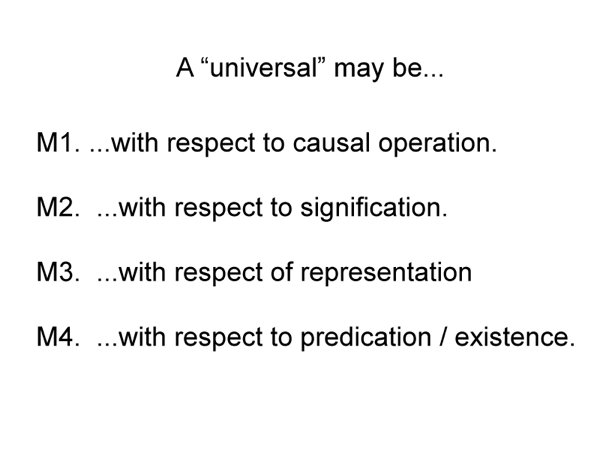
0272 To the first question, Izquierdo offers four meanings:
0273 Let me supply an example from Eric Santner’s (2016) book, The Weight of All Flesh.
0274 During late medieval and early modern times, political theologians proposed that the king had two bodies. One was mortal. The other was glorious.
When a king died, his mortal body was quickly buried. An effigy (representing the king’s glorious body) was manufactured and placed on the throne until the coronation of a new king. Then, the effigy was buried in a separate funeral.
0275 The glorious body of the king is a universal with four meanings.
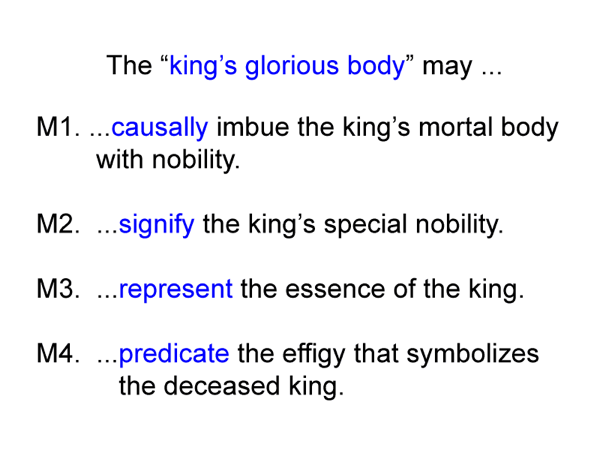
0276 The last meaning is particularly twisted. The universal, in its proper sense, cannot be a particular. Yet, here is a particular effigy that becomes a symbol of the king’s glorious body.
According to C. S. Peirce, a symbol is a sign based on tradition, convention, law, consensus and so on. Here, a political and theological consensus connects a sign-object (the king’s glorious body) to a sign-vehicle (an effigy of the deceased king).
0277 In Peirce’s semiotic terminology, the scholastic term “objective concept” portrays the union of a sign-vehicle and sign-object. The term “objective precision” reflects the operation of a sign-interpretant.
0278 In the terminology of the nested form, “objective concept” belongs to secondness, the realm of actuality. “Objective precision” belongs thirdness and firstness, the realms of normal context and possibility, respectively. An objective concept is a mind-dependent being. Objective precision is a formal act of the intellect.
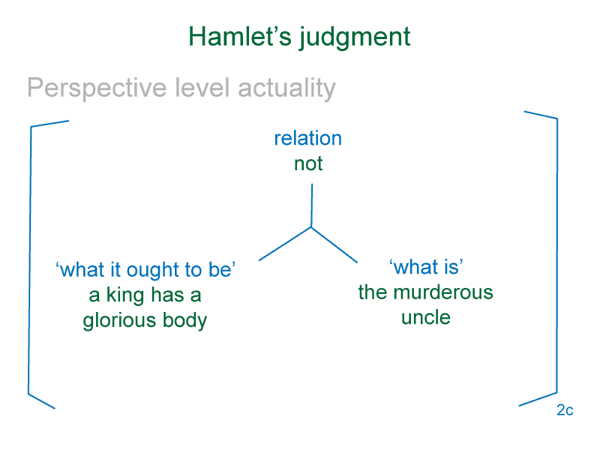
0279 For example, in Shakespeare’s Hamlet, a murderous uncle gains the throne and becomes king (objective concept). Unfortunately, the ghost of Hamlet’s father (the glorious body of the deceased king) appears, calling Hamlet to reject his uncle’s claims (through objective precision). Hamlet’s uncle has no nobility. Therefore, his uncle is not king (and does not have a glorious body, since the glorious body of Hamlet’s father haunts the world).
0280 This dramatic call to judgment may be depicted as a relation between what is and what ought to be. Indeed, I define the actuality of judgment as this triadic relation.
0281 Here is a diagram.