0298 Now, let me return to the example of the dual-body of the king.
0299 Here is the diagram.
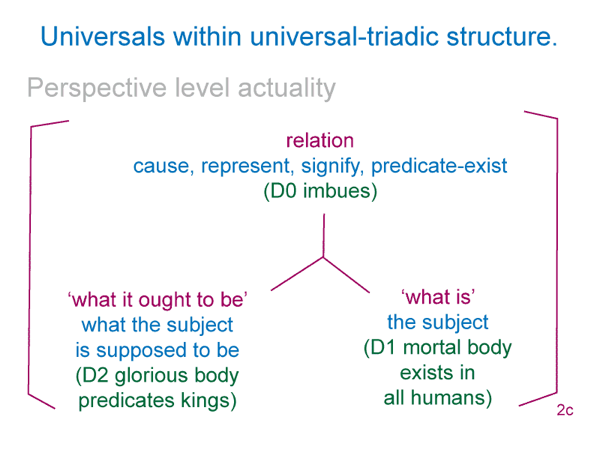
0300 The meaning of a universal (D0, a causal operator, imbues) brings one universal (D1, the mortal body) into relation with another universal (D2, the glorious body of the king).
0301 The political theory of the dual body of the king, identified by Eric Santner as a precursor to the modern theory of capitalism, brings three universals into a primal triad. Each king, just like anyone else, is really or physically bound to the universal of the mortal body. Each king, unlike anyone else, is formally and logically bound to the universal of the royal glorious body. The glorious body of the king is a universal with respect to political nation states.
0302 The king’s glorious body is unique to each realm. As such, the appearance of the king’s ghost (glorious body) must be disturbing for whoever sits on the throne (a mortal body claiming to be imbued with the one unique glorious body).
0303 The relation between ‘what is’ and ‘what ought to be’2c is primal. There is no a priori assignment of each element to a category. The law of non-contradiction (which applies to actuality) dictates that each element dwells in one and only one category. There are only three elements. There are only three categories.
0304 In order for the primal triad to unfold into a nested form, each element must be assigned one unique category. Typically, relation is assigned the quality of thirdness, becoming the normal context of an unfolding nested form. ‘What is’ is filled with the quality of secondness, turning into actuality in the subsequent form. ‘What ought to be’ is endowed with firstness, ending up as the potential of the subsequent unfolding nested form.
0305 However, other permutations are allowed.
0306 The previous figure typically yields the following nested form: The normal context of imbues3 brings the actuality of the mortal body of the king2 into relation with the potential of a royal glorious body1.
0307 In the case of Hamlet, the ghost of the king takes on the mantle of secondness and the king’s deceased body becomes an exclusive concern (rich in thirdness). The resulting nested form looks like this: The normal context of the murder of the king (mortal body)3 brings the actuality of the king’s ghost (glorious body)2 into relation with the potential that the king is imbued with a mission calling for retribution1. The political and theological relation, where the glorious body of the king imbues the mortal body of the king, has been violated.
(Indeed, Shakespeare (1564-1617) and Miguel de cervantes (1547-1616) dates to the time of the Baroque Scholastics (1600-1680)).
0308 Are universals found in reality, independent of the intellect?
0309 Izquierdo lists four positions. He argues against three and agrees with the fourth. Novotny provides the details. The fourth position goes like this:
T4. By nature, a universal is common to individuals only in the intellect. It has no other lesser than numerical unity (that is, it is indivisible).
0310 I wonder: Does the primal triad of judgment and its elements satisfy this position?
0311 Let me start with the primal triad.
0312 The primal triad is by nature common to all individuals in a community. All communities are composed of individuals who reason3c, thus actualize judgment2c in the pursuit of understanding1c.
0313 Members within each civilized community share particular primal triads. Indeed, this is required for members of a community. Those who cannot formulate particular primal triads (as formal acts of the intellect) are excluded from working together within an organization. In our current Lebenswelt, many communities are so specialized that those who have not mastered particular elements and operations are excluded.
0048 In civilization, the fourth position (T4) works in two ways. Objective precision is universal by nature. Particular objective concepts are common to individuals in community. Also, particular objective concepts define individuals in community by establishing conditions for belonging.
0314 The primal triad is indivisible. It cannot be reduced to any one of its components. In this, it has no lesser than numeric unity. The entire primal triad must be delineated in the pursuit of explicit intellectual comprehension.
0050 This delineation is possible only in purely symbolic languages, such as speech-alone talk. This explains my caveat: “in civilization”. Our current Lebenswelt is potentiated by the purely symbolic qualities of speech-alone talk.
0315 Theoretically, each element of a primal triad can be extracted and labeled. Practically, such a process fails to capture the intuitive aspects of judgment.
Remember, each element of the primal triad is a universal, steeped in varying qualities of thirdness (context and exclusivity), secondness (actuality and non-contradiction) and firstness (potential and inclusivity). Only when a judgment becomes a nested form are the categorical assignments fixed.
0316 This brings me to the elements.
Aristotle connects two elements to universals. These two elements are what is (existents) and what ought to be(predicates). Izquierdo has these two elements in mind. At the same time, he searches for how they fit into a bigger picture.
0317 He asks: What is the nature of Aristotle’s universals?
He concludes that universals exist only in the intellect. This means that universals only exist in an intellectual actuality (or structure). The primal triad models the intellectual structure of judgment2c. Only a universal may occupy each slot.
0318 This again poses the question: What is a universal (now, as an element within an intellectual structure, the primal triad)?
0319 In order to discern an answer, I must step back and see the interplay of intellect with other types of cognition in the individual in community.