0233 If it is baroque, then how does one fix it?
0234 Baroque scholasticism is difficult to access.
Why?
It is written in Latin.
Plus, the format of Aristotle’s inquiry can confuse the reader. Novotny’s pithy summaries are marvelous aids for understanding. Also, since Novotny has already surveyed various Baroque scholastics, his intuition serves as a guide. My comments closely track his text.
0235 In his work, Novotny aimed to display the dramatic shift in opinion concerning beings of reason between 1600 and 1680 AD. This shift of opinion now raises two postmodern issues.
0236 One concerns the implications of the first singularity. The adoption of speech-alone talk (and loss of hand talk) opens the door to explicit abstraction. The history of philosophy may tell the tale of the unfolding of explicit abstraction.
0237 Two, there is another history. It is the historical expression of implicit abstraction in our current Lebenswelt.
These are issues to reflect upon.
0238 Through Suarez, scholastic inquiry constructs a model of implicit abstraction. Through Hurtado, Mastri and Belluto, scholastic inquiry explodes the model by placing explicit abstractions into the slot designated for encountered real beings2a. Then, with Caramuel, scholastic inquiry changes the perspective, turning the being of reason into both a real nonbeing and an unreal being. Here is a subject of inquiry that defies the logic of actuality.
0239 But Caramuel does not conclude what I state here: Actuality is not everything. Actuality is not all there is.
0240 I say this only because Charles S. Peirce opens a new age of understanding. There are three categories to existence: firstness, secondness and thirdness. Firstness is the monadic realm of possibility. Secondness is the dyadic realm of actuality. Thirdness is the triadic realm of normal context.
Models of intuitive and explicit abstraction display the trajectory of Novotny’s narrative. They do so from a truly postmodern stance. Consequently, they demonstrate the potential of scholasticism in the Age of Triadic Relations.
0241 What comes next begins where Caramuel left off.
0242 What is this gestalt that contains a contradiction? Where does his alternate definition of the ‘being of reason’ lead?
0243 Caramuel answers the question originally posed by Suarez: What are the causes, natures and divisions of beings of reason? He does this by altering the definition of a ‘being of reason’ into something that Suarez would not recognize:
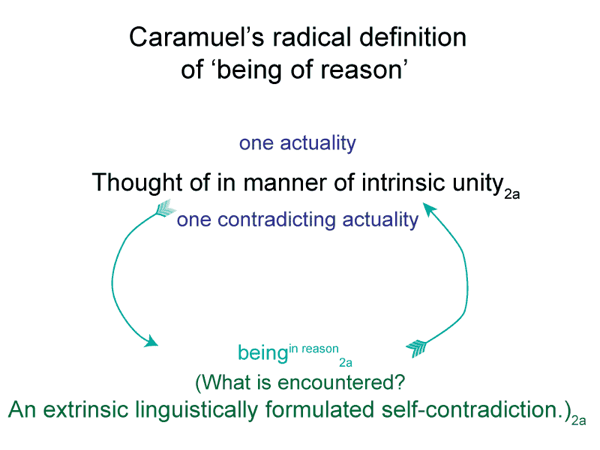
A ‘being of reason’ is an extrinsic, linguistically formulated, self-contradiction that is thought of in the manner of an intrinsic unity.
0244 Here is a picture of Caramuel’s novel concepts, once again.
0245 Let me examine the components.
0246 First, what is encountered?
Caramuel’s redefinition applies to hand talk, hand-speech talk and speech-alone talk. All that is required is a grammatically correct statement that contains a self-contradiction.
What is encountered2a is one element of a dyad in the realm of actuality. Roughly, this element corresponds to the word ‘effect’ in the phrase ‘cause and effect’. The senses come into play. For hand talk and speech-alone talk, the encountered being2a is a statement.
0247 What happens next?
Following Suarez’s model, the efficient intellect then projects a ‘being of reason’ into the slot that would roughly correspond to ‘cause’. The being of reason2a accounts for what is encountered2a. It is an object within the subject of the intellect2b. The efficient intellect2b is able to project ‘an intrinsically unified being of reason2a’ because it emerges from the possibility inherent in unity1b.
0248 This explains how ‘beings of reason’ arise from extrinsic (to the subject, the situated intellect) statements. This also explains how ‘beings of reason’ are projections of the efficient intellect2b.