0175 Walton’s adjustment in the roles of Adam and Eve, from priests to wardens, cements the concept that Adam and Eve are archetypal figures. They represent every man and every woman, rather than the first man and the first woman of humankind. They are custodians, not parents. They are placed in a divine space, oriented to divine order, but they experience the place as a royal garden, in which they are supposed to function as servants to the deity.
0176 All royal gardens have exotic flora and exotic fauna.
The two notable botanical specimens are the Tree of the Knowledge of Good and Evil (in the center of the garden) and the Tree of Life (not in the center).
Walton (the older author) originally considered the former to be a tree of wisdom. Walton (the younger contributor) notes that when Eve imagines that the fruit will make one “wise”, the selected term might also be translated as intelligence, awareness or cleverness.
0177 At this point, I would like to proceed through the semiotic steps of substantiation, entanglement, a confounding taking the shape of a sign-relation, and reversal within the sign-interpretant that resolves the confounding in favor of entanglement.
0178 The first three lines in the following figure depict Walton’s thing in regards to Genesis 2.4-3.
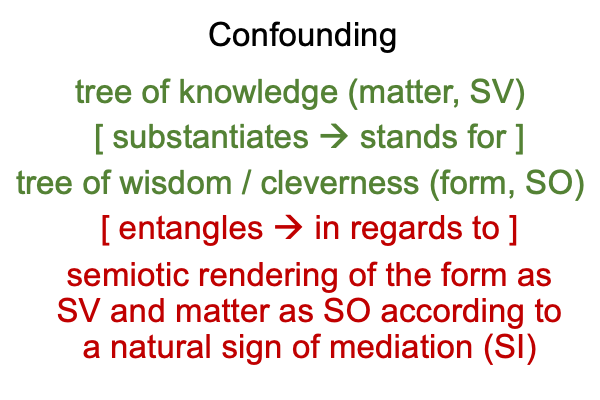
The hylomorphe is {the Tree of the Knowledge of Good and Evil in the text as matter [substantiates] Walton’s tree of wisdom, now “cleverness”, in his ANE informed language of meaning}2.
The form entangles something that acts like a sign-interpretant, thereby transforming the confounding into the shape of a sign-relation.
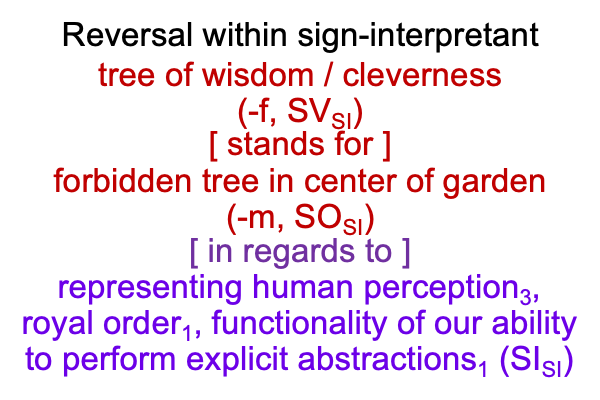
0179 When the sign-interpretant (SI) (as entangled matter) is rendered as a sign-relation, the substantiated form becomes the sign-vehicle (SVSI). The originating matter occupies the sign-object (SOSI). Also, the sign-interpretant within the sign-interpretant (SISI) images, indicates and represents the mediation, human perception3, operating on the perceived design of royal (human, not divine) order1 and our ability to perform explicit abstractions1.
0180 Now, the dangerous confounding resolves in favor of the entanglement.
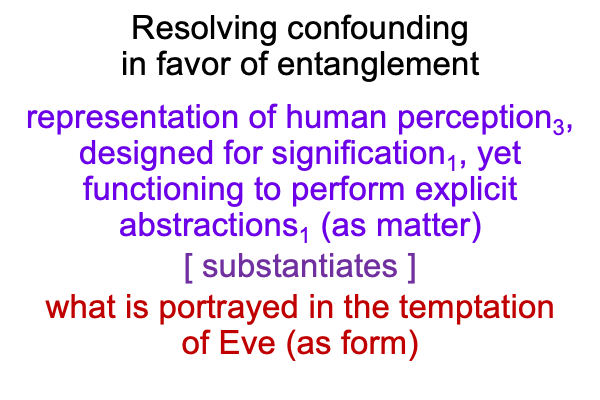
0181 With this resolution, the Waltons arrive at an incredible thing.
Remember that, according to Aristotle, a thing is a hylomorphe (matter [substantiates] form).
Let me go through four points.
0182 One, Adam and Eve perceive divine mediation3 within a human construct3. God constructs a garden. God manufactures humans to tend the divine garden. The divine garden is a sacred space, but the manufactured humans perceive the space in terms of an authority who does not tell them what to do (like the icons of gods in the city temples in ancient Mesopotamia), but tells them what not to do (like the political elites of the city).
0183 Two, humans evolved to respond to divine signification. When a person in an ancient Near East city attends temple, and gazes upon the icon of the temple’s god, their bicameral mind issues an injunction and the person hears that injunction. The temple god tells the supplicant what to do.
See Synaesthesia and the Bicameral Mind in Human Evolution, by Razie Mah, available at smashwords and other e-book venues.
0184 Three, humans respond to signification from other humans. For example, humans talk. Talk engages specifying and exemplar sign-relations. A command not to do something should be classified as a specifying sign-relation. The command specifies what not to do. The explanation associates to the exemplar sign-relation.
See Looking at John Deely’s Book (2010) Semiotic Animal, in Razie Mah’s blog for October 2023.
0185 Four, there seems to be a disconnect.
Human awareness of divine signification yields a social construction, which is not necessarily sensible, but often offers missions that must be accomplished through sensible construction. This is precisely what Julian Jaynes observes in the literature of early civilizations. The gods don’t reason with people. They just tell them what to do. Yahweh tells Noah what to do. Yahweh tells Abraham what to do. Yahweh tells Moses what to do.
In concert with points one and three, in Eden, God tells Adam what he must not do, lest he die. God acts as a royal administer, who tells His servant what not to do. Plus, God offers a reason for the command.
0186 What about points two and four?
Early civilizations retain a certain mindset, that associates to the Lebenswelt that we evolved in. Before the first singularity, humans practice sensible and social signification through hand-speech talk, which promotes implicit abstractions. The icon of a god causes a person to hear its commands. This may be classified as an implicit abstraction.
0187 The Story of the Fall of Adam and Eve, from the very start, pictures, points to and symbolizes our current Lebenswelt. Speech-alone talk is practiced in our current Lebenswelt. In hand-speech talk, one cannot distinguish between what is royal and what is divine because the terms, “royal” and “divine” are spoken labels. They are explicit abstractions.
0188 So, is the disconnect (point four) between implicit and explicit abstraction?
The theodrama of the temptation of Eve portrays the fact that speech-alone talk allows a person to attach labels that alter the meaning, presence and the message of what is being labeled. The serpent has no arms. It cannot practice hand-speech talk. It can only perform speech-alone talk. Eve apparently does not have any training in the arts of speech-alone talk. If she did, she would appreciate the serpent’s sales pitch for what it is. A sales pitch.
Instead, she naively takes the bait.
0189 To me, one of the marvelous features of this book is the author’s grasp that the Garden of Eden, from the onset, seems out of kilter, as if it is founded on civilized human perceptions of divine mediation3, rather than on a precivilized spontaneous oneness with divine mediation3. The former belongs to our current Lebenswelt (German for “living world”). The latter belongs to the Lebenswelt that we evolved in.
In short, our current Lebenswelt is not the same as the Lebenswelt that we evolved in.
The transition from the Lebenswelt that we evolved in to our current Lebenswelt is embodied in the Garden of Eden.
0190 In chapter six, Walton asks (more or less), “If Adam and Eve are archetypes, not necessarily real historical people, then what is their significance?”
The answer is implicit to the Tartu-Moscow School of Semiotics’ treatment of Walton’s thing, Genesis 2.4-4.
Adam and Eve are fairy tale figures that mark the cultural transition from the Lebenswelt that we evolved in to our current Lebenswelt.