0078 So far, so good. The bare-bones schema coheres to Suarez’s nine claims about the nature of ‘beings of reason’. The only drawback is: Suarez actually made eleven claims. There are two more to go.
0079 I did not mention these two because Novotny insightfully does not list them in chapter 3. Why? Novotny argues that they are not consistent with the other nine. So, he lists them in chapter 4 — on the division of beings of reason.
0080 Before I go there, I want to shine the flashlight of the category-based nested form in another direction.
My thesis is that Suarez’s comprehensive treatment of beings of reason coheres to a model of implicit abstraction. I also propose that implicit abstraction corresponds to the Lebenswelt that we evolved in. Implicit abstraction evolves in the milieu of hand talk.
In this section, I want to develop the latter claim.
0081 I intend to adapt this bare bones schema to hand talk. The adaptation provides greater insight into the model and its application to Novotny’s story about ens rationis.
So here goes.
0082 When our hominin ancestors talked, they used linguistic manual-brachial word-gestures. These word-gestures were referential. They were natural signs. They imaged and indicated their referents.
0083 What does this imply?
In hand talk, the words “real” and “being” cannot exist. What is there to image? What is there to point to?
The sensibility that goes with the word “real” changes. From my standpoint, as a person who uses only speech-alone talk, I need to imagine what “real” would denote in the world of hand talk.
So, here is my compromise: “Real” labels that which may be imaged or pointed to instead of that which is regarded in the manner of being. The term “being” goes with existence.
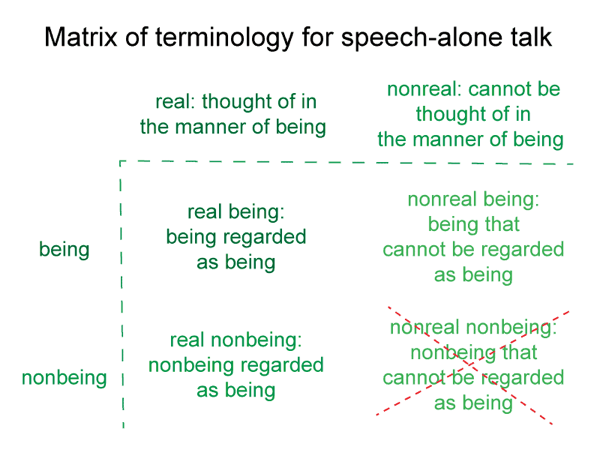
0084 In order to clarify, consider Suarez’s construction of ‘beings of reason’. He uses Latin, a tongue in speech-alone talk. His words belong to our current Lebenswelt. He uses the word “real” in a particular manner. It means to regard in the manner of being (existence).
The following matrix applies to speech-alone talk. The two real elements stand out. The two unreal elements do not stand out. Of the latter, one is not ruled out. The ‘unreal being’ is an existent that must be regarded as if it does not exist. The other is ruled out as impossible. The ‘unreal nonbeing’ is a nothing. It is like a whisper in an empty room.
0085 How should this matrix be adjusted for the Lebenswelt that we evolved in?
There was no word for “real” in the world of hand talk (before Homo sapiens) and hand-speech talk (from the appearance of Homo sapiens to the first singularity). Why? How can anyone picture or point to “real”. The term “real” is an explicit abstraction.
0086 So how do I apply the term to the Lebenswelt that we evolved in?
My suggestion goes like this: “Real” is what can be conveyed through word-gestures. Since word-gestures image and indicate, what they picture and point to can be matched to our current term “real”. The real is whatever can be imaged or indicated. This results in the following matrix of real and being.
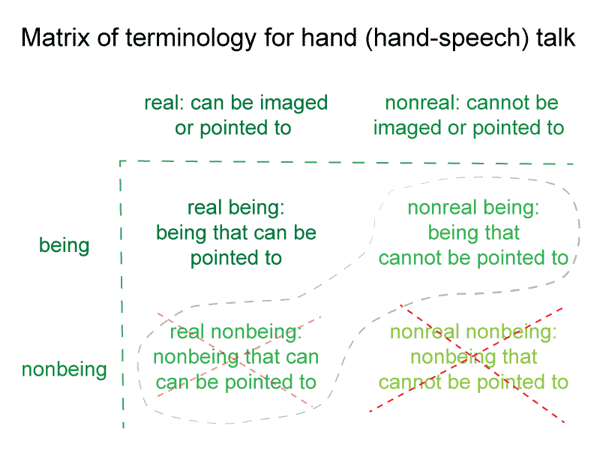
0087 Now, the two elements that stand out belong to being (existence). The two elements that are hidden are nonbeing(nonexistent). Of these, one is less hidden than the other.
To me, real nonbeing and unreal being have similar sensibilities. As soon as I think that an ‘unreal being’ is possible, then I imagine that there must be a way to point to it. The way to point to it may be nonsensical, but what is the alternative? The way to point to a being that cannot be pointed to is by treating it as if it were a nonbeing that can be pointed to.
0088 In other words, in hand-speech talk, unreal being and real nonbeing may be two sides to a single coin.
During the Upper Paleolithic, people were not rich, but they did carry a few items of value with them. Some of these were carvings of animals or people. What were these images pointing to? Obviously, the carvings imaged beings. But, just as obviously, the imaged beings were no longer present. Similarly, what is no longer present could be imaged and pointed to in hand and hand-speech talk. Perhaps, the image was of a real being, that became a unreal being, but is now a real nonbeing.
0089 So maybe, the matrix should look like this:
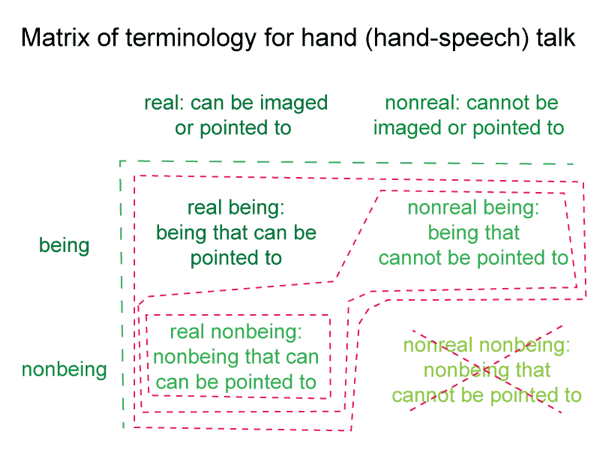
0090 To me, this looks like a nested configuration, rather than two sides of the same coin. The being that can be pointed to goes with content. The being that cannot be pointed to goes with situation. Then, the nonbeing that can be pointed to goes with perspective.
This produces the following variation of the bare-bones schema:
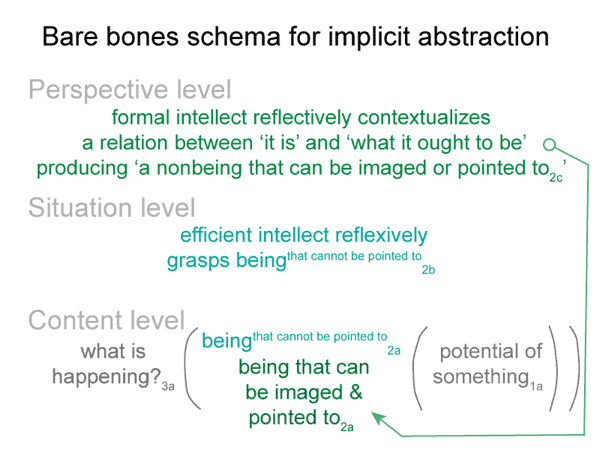
0091 The nonbeing that can be imaged and pointed to2c may enter into the slot designated 2a (real being). In doing so, an implicit abstraction becomes an encountered being2a.
0092 How can this happen?
The nonbeing2c can be pictured or indicated through hand talk. The nonbeing could be a self-contradiction, negation, privation or relation. It can be depicted through a grammatically correct but nonsensical proposition. After all, the statement, “A hole is where the ground is no longer there.” does not make much sense. Thus, the relation between ‘what it is’ and ‘what it ought to be’ may become a gestural utterance that fills the slot designated for a real being2a.
This conclusion parallels the ideas in A Primer on Sensible and Social Construction. The student may want to take a look at this work.