0113 Consider the previous two figures along with the tenth statement on the nature of ‘beings of reason’.
SN10: Negations and privations may be in things (as real negations or privations) or in beings of reason (as negations or privations that are spoken about as if they are real).
0114 Surely, this statement re-enacts the above categorical flip between ‘what it is’ and ‘what it ought to be’. When a negation is regarded as a real privation in a thing, it goes with firstness, the realm of possibility. Why? The real being (secondness) has a potential for reversal (firstness). When the negation is regarded in the manner of being, it goes with secondness, the realm of actuallity. It becomes actual. Meanwhile, the encountered being enters into the category of firstness.
0115 Suarez’s statement on the nature of beingsin_reason explicitly abstracts one feature of the three elements of judgment. The scholastics before Suarez noticed a pattern. If negations, privations, relations and self-contradictions entered into someone’s discourse, then the schoolman ended up discussing nonbeings the manner of being. No one was sure why this was the case.
0116 The observation itself goes into the record as the eleventh and last claim listed by Novotny. Suarez claims:
SN11: Humans think in both the ‘manner of being’ and ‘the manner of nonbeing’.
After all, one could not define the ‘being of reason’ unless one imagined a being in the manner of a nonbeing. Ironically, this is precisely what occurred when Suarez transubstantiated (changed Peircean categories) the encountered real being (what it is) from the category of secondness into firstness.
A being thought of in the manner of a nonbeing may manifest itself it many ways. It may be an existent that one must declare cannot possibly exist. It may be a being existing in pure potential. It may be a being that somehow causes an action to happen. Then, the action exists, and the being that causes it must be regarded in the manner of a nonbeing.
0117 Say what?
Technically, a being belonging to the category of firstness (possibility) within a particular thirdness (normal context)can also be a being that one assumes (as if it is a nonbeing, such as an idea) and then ignores (because one has to deal with secondness, the realm of actuality).
Is that confusing, or what?
It is especially confusing since we evolved to confound the iconic and indexal linguistic act2a with thinking in the manner of being (existence). Hand talk is experienced as real being2a. By extension, so is speech-alone talk. What Suarez calls a ‘being of reason’ is experienced2b as a nonreal being2a, a being that cannot be pictuerd and pointed to (and therefore cannot be regarded as existing by itself).
0118 This experience2b is triggered by the presence of talk2a. The efficient intellect2b asks the question: What accounts for a linguistic act2a (in the slot designated for real encountered beings)?
Is a linguistic act2a the same as an encountered being2a?
Or is it an encounter2a regarded2b in the manner of being2a?
If that is not confusing enough, consider this: What Suarez defines as ‘a being of reason’ (a nonbeing thought of in the manner of a being) corresponds to a judgment2c. Judgment2c is a nonbeing that cannot be imaged or pointed to (hence, hand talked about). But, the action produced by a judgment can be pictured and indicated.
Oh my. An action that can be imaged and indicated may go into the slot for an encountered being2a.
But, the being that cannot be pointed to2a is not the judgment2c that is somehow objectified by the action2a, it2a is um… a beingof reason2a.
0119 The following matrix hybridizes hand talk and Suarez’s speech-alone talk concepts.
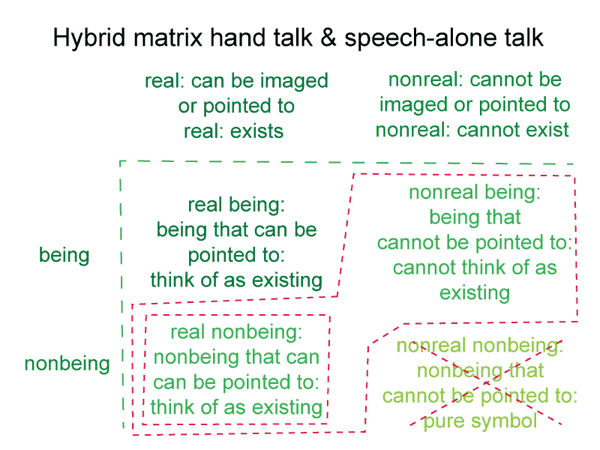
0120 No wonder Daniel Novotny starts to question Suarez’s approach in the chapter of the division of ‘beings of reason’. The terms “being”, “existence”, “nonbeing”, “image” and “indication” are intertwined in the strangest fashion. To me, Suarez has intuitively constructed a model of implicit abstraction in a philosophical tradition devoted to explicit abstraction.
On one hand, implicit abstraction belongs to the Lebenswelt that we evolved in. It also belongs to our current Lebenswelt.
On the other hand, explicit abstraction belongs only to our current Lebenswelt.
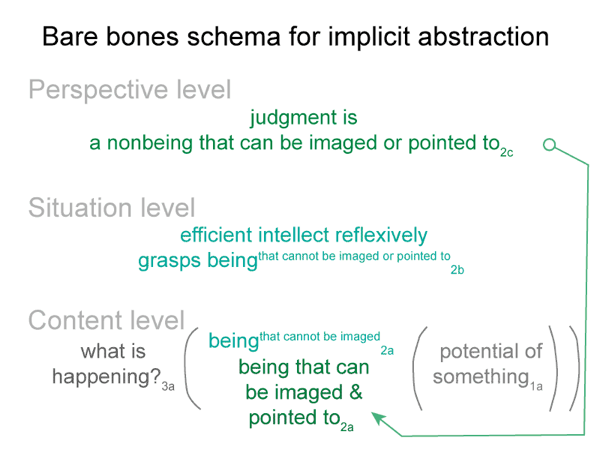
0121 Here is the bare-bones schema for implicit abstraction:
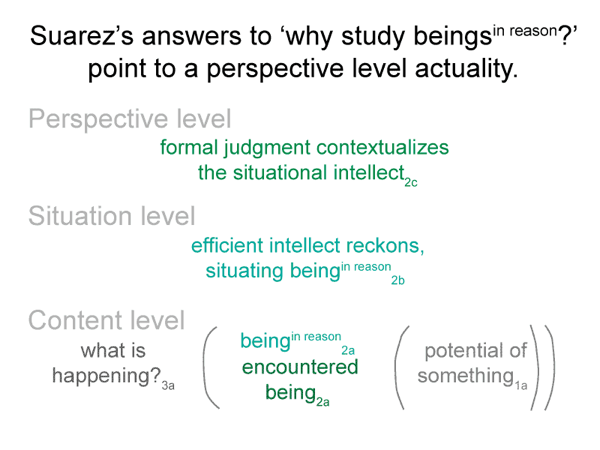
Here is the skeletal model for Suarez’ motivation to study ‘beings of reason’:
0122 Implicit abstraction operates when a judgment is imaged or pointed to in hand or hand-speech talk. Icons and indexes are holistic. They are indivisible. Consequently, their referent is the entire judgment.
0123 The nested form model of Suarez’s motivations diagrams an explicit process. The process starts with an encountered being2a. The efficient intellect reckons a beingin_reason2a. The formal intellect arrives at ‘a judgment that the efficient intellect has generated something that cannot exist as a mind-independent being. Oops, I meant to say: a nonbeing thought of in the manner of being.
Various scholastics (before Suarez) offered this explicit abstraction in order to explain observations. Suarez aims to construct a comprehensive treatment of these ‘beings of reason’. He formulates a thought experiment. The thought experiment imbues beingsin_reason with secondness. But, in doing so, the schoolman enters unknown territory. Suarez is about to place this explicit abstraction into the slot designated for an encountered being2a.