0138 Francisco Suarez, S.J., is born in 1548 AD and died in 1617. He starts teaching at Salamanca College in 1570. He moves on to other universities. Pedro Hurtado de Mendoza, S.J., is a young colleague of Suarez at Salamanca College. He considers beings of reason in two efforts, once in 1615 and again in 1624. The first version of Disputation 19 is five thousand words long. The second version is thirteen thousand words long.
0139 Hurtado starts by confirming Suarez’s divisions:
H1D1: Beings of reason fall into privations, negations and relations.
0140 He then contends:
H1N4: There are beings of reason.
H1N2: A ‘being of reason’ is what has merely objective being in the intellect.
H1N1: Extrinsic denomination is necessary, but not sufficient, for something to be a being of reason.
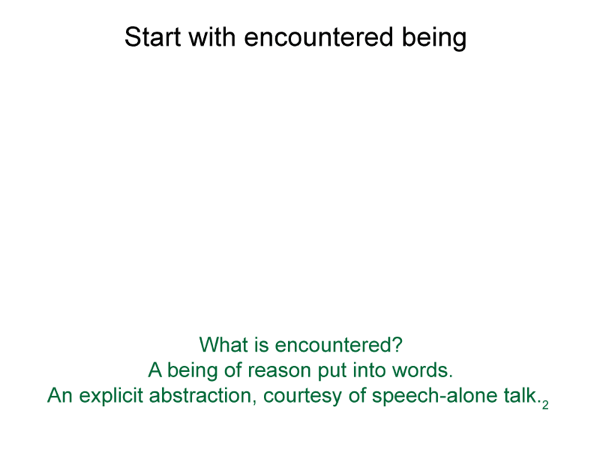
0141 Hurtado steps right into Suarez’s thought experiment. Or should I say, “madness”? He places an explicit abstraction, the ‘being of reason’ defined as ‘a nonbeing thought of in the manner of being’, right into the slot designated for a real being2a. The technical term for this placement is “extrinsic denomination”.
0142 Then, before I can scream, “No! This is a booby trap,” Hurtado’s efficient intellect2b has grasped this apparently real being2a and generated the second element in the dyad of actuality2a:
H1N3: A ‘being of reason’ is a false proposition thought of in the manner of being true.
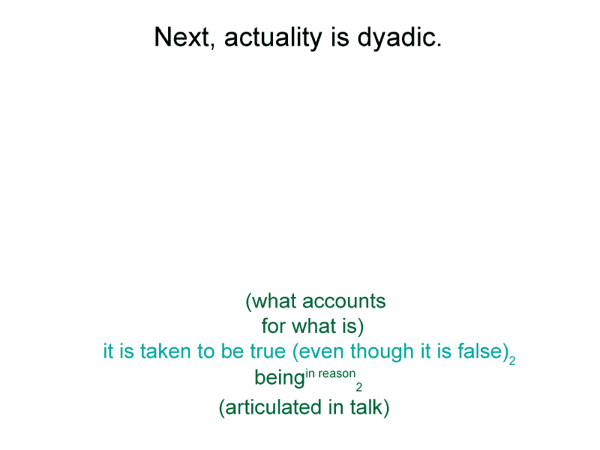
H1N5: ‘Beings of reason’ are completely dependent on actual mental acts.
0143 Here is a model for the actual mental act:
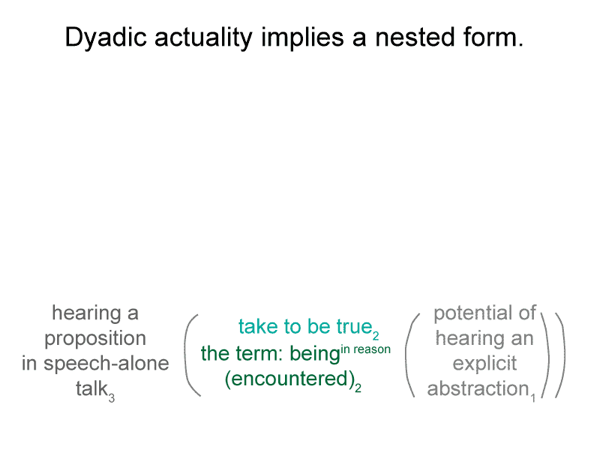
H1C1: ‘Beings of reason’ are constituted by false mental acts.
0144 So, this model must be situated by the possibility of falsehood.
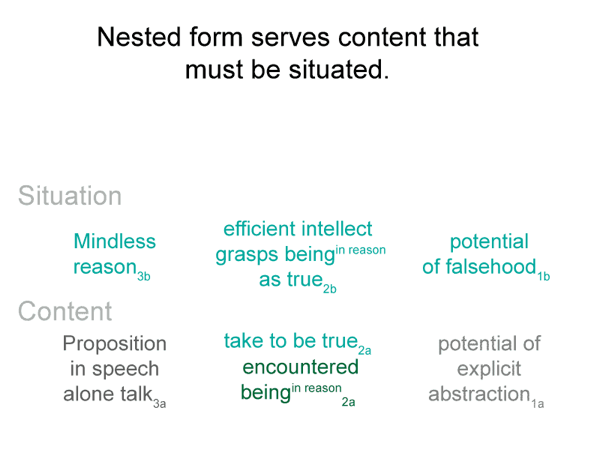
0145 The situation must be put into perspective.
H1N6: Some beings of reason can be actualized in reality.
0146 A good example is the beingin reason2a of my feeling that the Athena will arrive with its cargo intact.
H1C2: Beingsin reason2a are made of false statements. The false statements may be necessary or contingent.
0147 Hmmm. The potential of falsehood1b is taking a life of its own.
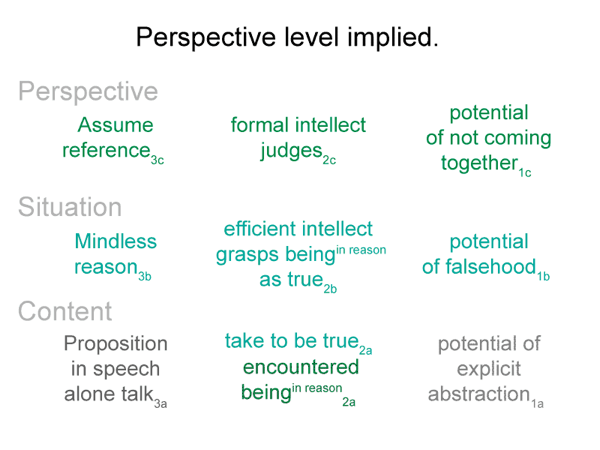
0148 Self-contradictions make certain the possibility of falsehood1b.
H1N8: True judgments about self-contradictory beings must presuppose that they are composed of false statements.
H1N7 and 9: Self-contradictory beings are not ‘beings of reason’. They are pure nothingness. No, that is not it. They are fictitious beings.
0149 This provides nuance to the previous interscope.
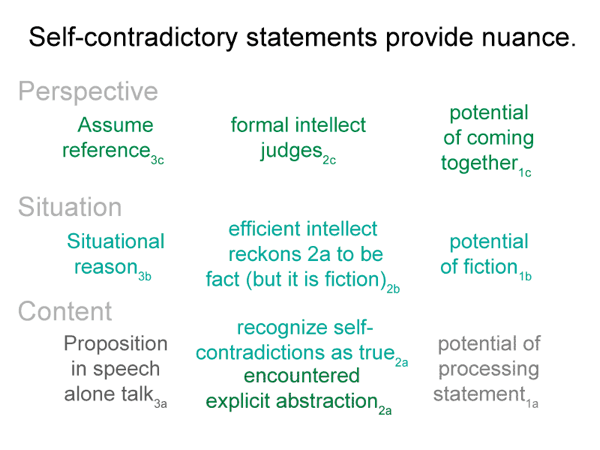
0150 Falsehood1b is a way to deny realness1b. Another way to deny realness1b is labeled “fiction”. This logic implies that truth is a way to affirm realness1b. Another way to affirm realness1b has a label, as well. It is called “fact”.
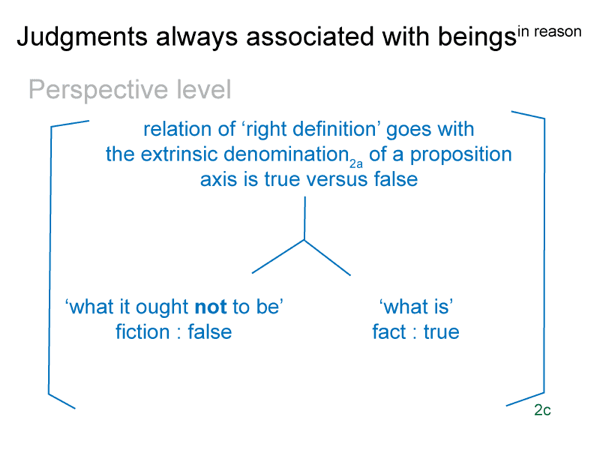
0151 According to Hurtado, facts are not beingsin_reason. They are beings because they affirm the referent that they correspond to. Fictions are a peculiar sort of real being, because they pretend to affirm the referent that they correspond to. Thus, the whole discussion comes to a judgment. This judgment values true over false.
0152 This judgment has some notable features.
Previously, whatever went into the slot for encountered being2a became ‘what it is’. Suarez did not mention this connection. He assumed it. Now, the explicitly abstracted term, “facts”, designates ‘what is’. Thus, Hurtado concludes that facts are not ‘beings of reason’.
0153 The beingin reason2a remains ‘what it ought to be’. Since judgment presents it solely within the metric of true versus false, the ‘being of reason’ becomes false.
0154 The entire relation between ‘what it is’ and ‘what it ought to be’ remains the occasion for an implicit abstraction. However, this abstraction entails a valuation of the quality of a speech-alone statement.
For Hurtado’s first version of Disputation 19, the axis of true versus false brings the ‘what is’ of fact into relation withthe ‘what ought not to be’ of fiction.
0155 To me, that fits the word “definition”.