0124 Here is another example.
0125 Around the time that Suarez was working on his thought experiment, Galileo was tinkering with his less ambitious and more playful scientific experiments. Some of these were driven by technology. The ability to make glass lens and the ability to understand how lenses worked bootstrapped one another. Galileo made a telescope, also called a spyglass, that proved valuable to merchants waiting for ships to arrive.
0126 Why?
The prices of goods changed as soon as a ship arrived. There was an advantage to lock in a low price when the ship had not arrived and its arrival was uncertain. After the ship arrived, ‘the certainty of delivery’ increased prices.
A spyglass and a high tower made for advantage. They eliminated privation (lack of certainty).
0127 Here is the story in a nutshell:
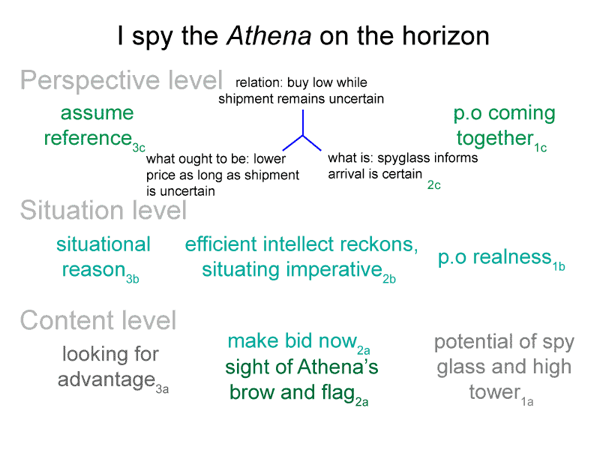
0128 Before the spyglass, no one knew whether the Athena would arrive with its shipment of olive oil from Corinth. This was a privation. A person could pay now for a jug of olive oil later, once the ship came in. Privation went with risk. If I were confident, my privation would not deter me from making my bid (paying a low price). If I were less confident, it would.
0129 In this regard, privation is like negation. It is like blindness. I cannot see the future. I cannot make a confident reckoning2b because the arrival of the ship exists as situational potential2b. I do not know3b whether it is real1b until the arrival itself2a. Until its arrival, I am full of contradictions. Do I make a bid? Or do I wait for expensive certainty?
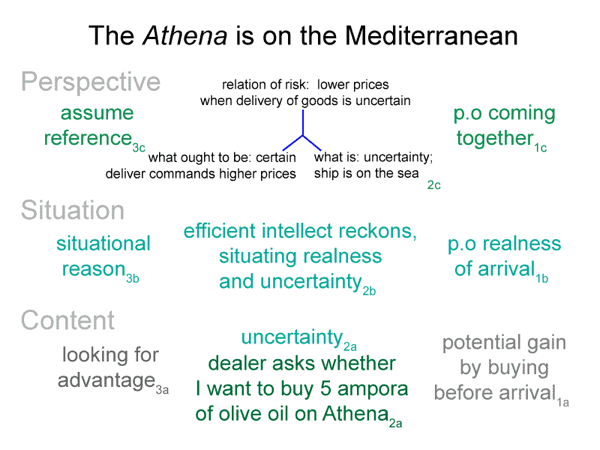
0130 With these two situations in mind, consider the difference between the real and the unreal. Which beingin reason2awould be labeled “real” and which “unreal”? I will answer my own question, “Of course, the delivery would be labeled real because I spied the Athena on the horizon.”
0131 Meanwhile, a different me walks through the downtown exchange. I do not possess a spyglass or a high tower. The owner of the Athena asks me whether I want to buy 5 amphora of olive oil on his ship. He promises it will come in soon. He offers a great price, but I am not sure. I heard rumors… Surely, my privation is a nonbeing that I regard in the manner of being. Why? The risk is palpable.
0132 I could write out the advantages of buying now. I could write out the disadvantages. These would be explicit abstractions that I could use when I go home and tell my wife that I had been to the exchange.
She says, “I told you not to go there. You always lose money. How am I going to run this house with you losing money like that. By the way, we are out of olive oil.”
0133 I sit on a stool as she storms out of the kitchen.
The maid, who was listening, quietly approaches, whispering “Sir, it is none of my business, but I have a friend with a spyglass, and he says the Athena is on the horizon.”
0134 Now, I go back to Suarez.
0135 The terms of “privation”, “negation”, “self-contradiction” and “relation” are explicit abstractions. They are not like implicit abstractions.
The same goes for the term: beingsin reason.
In hand talk and hand-speech talk, beings of reason2a would be beings that one cannot image or point to (therefore, cannot talk about)2a.
In speech-alone talk, ‘beings of reason2a” are nonbeings thought of in the manner of being2a.
My uncertainty in the example is a being of reason2a in both senses.
0136 In hand talk, I could never put my being of reason into the slot designated for the encountered being2a. I could never dissociate my being of reason (what it ought to be) from its relation to an encountered being (it is).
In speech-alone talk, I can dissect my own judgment2c. In fact, this is precisely where Suarez’s thought experiment leads: What happens when I place an explicit abstraction into the slot designated for the encountered being2a?
0137 What happens when my uncertainty enters the slot for a real being2a?
Students should read chapter 6 of Novotny’s book.