0160 Chapter three covers topics in the Creation Story (Genesis 1-2.3). This examination has covered only portions of this chapter. This is enough, I suppose, to establish that the Lost World approach cannot avoid entanglements.
Any time there is a thing, composed of matter and form, there is the possibility that the form will entangle apparently unrelated matter. While this application of substantiation and entanglement is a tad long-winded, it shows the relevance and the reach of one of the significant discoveries of the Tartu-Moscow School of Semiotics.
A confounding can take the shape of a sign-relation.
0161 In chapter four, Walton considers God resting in His temple of creation on the seventh day.
0162 In ancient southern Mesopotamia, when a god “rests” in a temple, its presence invisibly radiates order, in the same way that the sun radiates light. The divine radiation empowers an unspoken agreement shared by all participants in the civilization, despite labor and social specializations. The divine sustenance operates, despite wars among Sumerian cities and intra-urban conflicts.
0163 Note that the agreement is unspoken because, if one goes to temple, one may look upon the icon of the god and hear its voice, in a synaesthesia sort of way. The god’s proclamation does not contain words like “order” or “social stability” or “anything that a modern intellectual might be willing to proclaim”. The god’s visage tells the person what he or she already knows must be done. In short, the presence of the god activates the human’s sensorium of transcendence.
That is Eric Voegelin’s term, by the way.
See his book, The New Science of Politics, published in the 1950s.
0164 Walton does not acknowledge this type of encounter, which greets the modern mind as hypotheses from… well… the frame of mind that one does not want to entangle. Remember that the Creation Story is not about physical creation, it is about metaphysical creation. Take a look at photos of Sumerian statuettes gazing upon the divine icon of their god. The enormous eyes say it all. Look and taste the wisdom of the Lord.
See Razie Mah’s e-book, Synaesthesia and the Bicameral Mind in Human Evolution, available at smashwords and other e-book venues.
0162 Now, let me see whether the last Genesis day fits the pattern of confounding and resolution proposed in this examination.
First, the Lost World confounding looks like this.
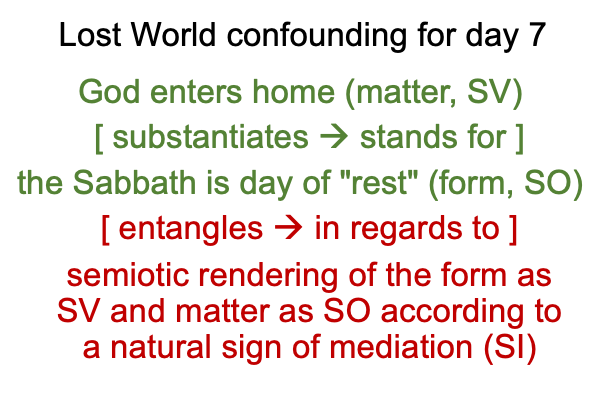
The mediation is in green. The entanglement is in red.
0163 This confounding takes the shape of a sign-relation, where the sign-interpretant (the entangled matter) manifests as a sign-relation. It’s almost as if the entangled matter offers an image, indication or representation of the mediation that contextualizes and potentiates the originating substantiation.
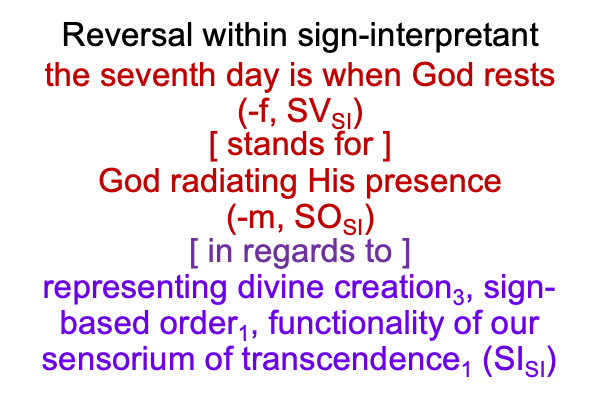
0164 Then, the confounding resolves in favor of entanglement, resulting in the following figure.
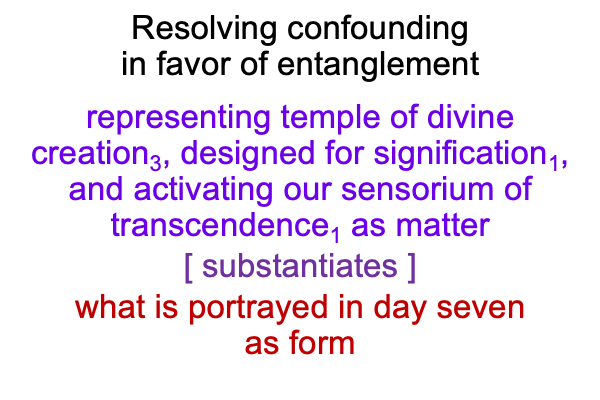
0165 Matter constellates the normal context of divine mediation3, as well as its formal design1 (not physical, but metaphysical) and its final attributes1 (God intends to create a living image capable of sensing His Meaning, Presence and Message).
0166 On day seven, God rests in his temple of the cosmion of the world.
And…. Walton immediately shrinks that temple to the size of a ziggurat, which is large, but not as expansive as what the Christian imagines.
0167 After a bumbling transition, Genesis starts anew with verse 2.4, describing God’s formation of something that seems like an ancient Mesopotamian royal garden, located right next to the temple, where an icon of god radiates authority.
I wonder, what do authorities do?
Oh, they tell people not to do things.
0168 This is sort of confusing. Are Adam and Eve fashioned to work the royal gardens as priests or to work the royal gardens as wardens, appointed by someone in charge of the icon of an ANE god?
In chapter five, Walton notes that Ephrem the Syrian (in the 300s AD) regards the Garden of Eden as a tabernacle and Adam and Eve as priests. He goes on to say a whole lot more. Yes, that is the Christian imagination at work. Sometimes, the entanglement is dangerous. Sometimes, the entanglement works like a miracle. It is for the Body of Christ to decide, one way or another. Danger leads to ruin. Miracles lead to salvation.
0169 So, Walton originally agrees that Adam and Eve are (something like) priests in the sacred space of a divine garden. The strongest evidence for Eden’s sacred status is the four rivers flowing from it. At the same time, the strongest suggestion for the location of Eden is at the mouth of four rivers emptying into the infilling Persian Gulf, around 8800 years ago.
Oh, well. I am going with the sacred space concept.
0170 Remember the structure of mediation and how it fits into a category-based nested form?
The question as to the nature of the divine garden arises when humans are placed in a realm (Eden) that expresses divine order. In the second excursus, authored by the author’s son, J. Harvey Walton, order is located where God lives and manifests when God’s will is carried out.
Now, it seems that the order that radiates from the divine presence would be a place where humans would want to live. However, in our current Lebenswelt, humans experience anthropocentric order, where some specialized authority tells them not to do this or that. They no longer seem to respond to the radiance of the icon of god who is locked up in the city temple.
0171 There are good reasons why the icon of a god is locked in its temple. First, when one gazes upon the god, the visual impact of the idol is heard by the supplicant. Through synaesthesia, the god tells the supplicant what to do. Second, the establishment cannot tolerate synaesthetic messaging willy-nilly. For the safety of everyone concerned, the icon of the god is sequestered in a holy space, which, because it has been set-aside from regular human life, increases the power of the icon to register messages in other sensory modalities.
0172 Surely, this argument seems counter-intuitive.
I wonder whether the garden of Eden (like a holy space within the guarded temple in the city-states of ancient Mesopotamia) could be dangerous.
0173 For this reason, maybe a subtle shift in the imagery of a royal garden is called for. Eden is not a place where God dwells in a human realm. It is a place where humans dwell in a divine realm. But, humans in the cultures of the ANE experience order in the human realm. So, an audience hearing the opening of the Story of the Fall would envision Adam and Eve living in a royal order and a royal realm (rather than in a dangerous divine zone).
The royal realm is divine in a modest sort of way.
So, God telling Adam what not to do is sensible.
Royalty tells their subjects what not to do.
0174 Here is a picture of the mediation as a category-based nested form.
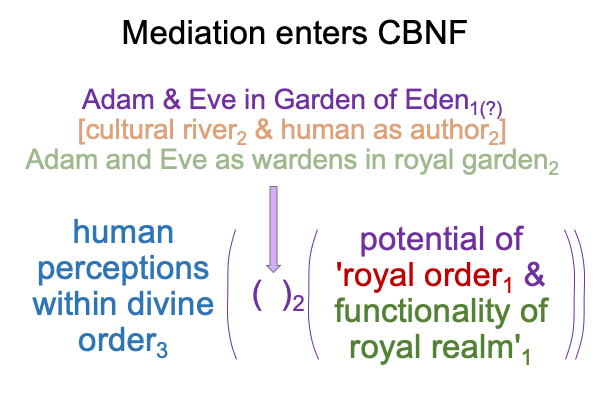
The normal context of human perceptions within a mediating divine order3 brings the dyadic actuality of {Adam and Eve in the Garden of Eden1(?) [cultural river2 as efficient cause & human as author2 as formal design] wardens in royal garden}2 into relation with the potential of ‘divine order perceived as royal order and divine intentions operating as functions in a royal realm’1.