0029 From this association alone, I would expect that each way of talking would represent the world in its own unique way. The way of hand talk represents the world through implicit abstraction. The way of speech-alone talk represents the world through explicit abstraction.
0030 In the following steps, I use Suarez’s definition of ‘beings of reason’ to construct a model for implicit abstraction.
0031 Step 1: Start with an encounter
Beingitself2 belongs to the realm of actuality. Actuality belongs to Peirce’s category of secondness. The category of secondness always contains two elements. The paradigmatic example of secondness is cause and effect. Both elements belong to actuality. The two elements are contiguous. One element accounts for the other.
When I encounter a beingitself, I encounter an effect, not a cause. Animals, for example, respond to effects, rather than causes. The effect is beingitself (what exists). The animal wonders: What do I do in response to this effect? Do I approach, flee, or safely ignore it?
0032 Animals do not comprehend that what exists is one element in the dyad of actuality.
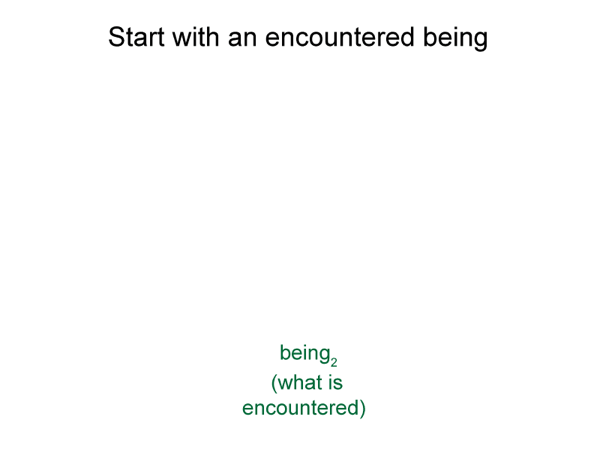
0033 So, I start with beingitself (what is encountered). The figure is mostly empty. One slot has an entry. The slot belongs to actuality.
0034 Step 2: Project what accounts for what is encountered.
Humans, in contrast to animals, somehow understand that there is a cause. The human may wonder: How do I situate this effect in order to see what causes it?
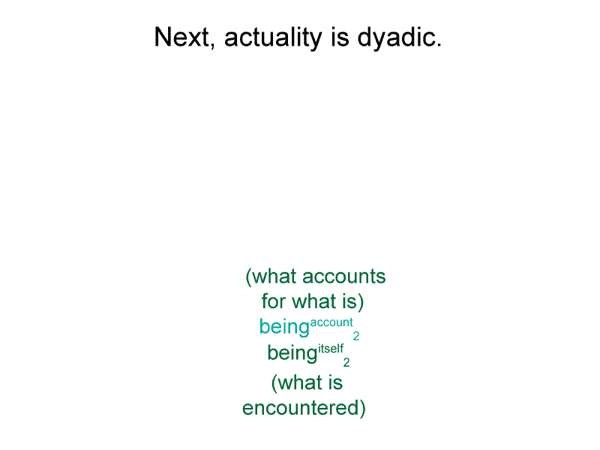
Here, I use the word “cause” in the widest sense. Cause accounts for the encountered being. I encounter beingitself2. Beingencountered2 is accounted for by another being2.
0035 So how does a beingthat-accounts2 enter into the picture?
It enters as the other element in the dyad of actuality. Now, I have two elements in a single entry. This entry corresponds to actuality.
0036 When a dog comes across something quizzical, it may look at its owner.
What is the dog up to?
The dog looks for a clue. The human has something that the dog does not. The encountered being2 is mind-independent. The accounting being2 is mind-dependent. The accounting being2 is a nonbeing. No one can demonstrate its existence. It cannot be imaged or pointed to.
Yet, the human implicitly presumes its presence. The human thinks of this nonbeing in the manner of being. The dog watches for the human’s reaction to this nonbeing. The human’s reaction sets the context for how the dog will respond.
0037 Step 3: A content-level nested form comes into view
Adding the second element to the dyad of actuality entails the construction of a category-based nested form. The nested form is an abstraction because it draws itself out from the encountered being2. This occurs in the human intellect.
The nested form looks like this:
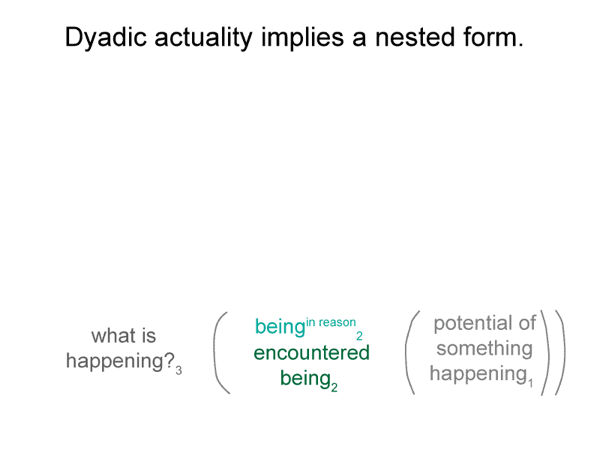
0038 The normal context of what is happening?3 brings the dyadic actuality of {being in reason [accounts for] an encountered being}2 in regards to the potential of ‘something happening’1.