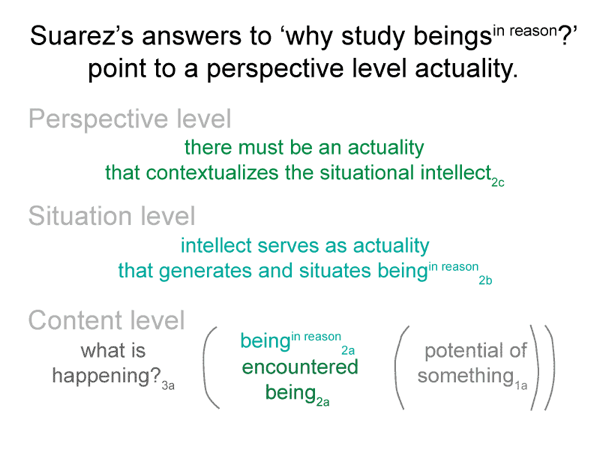
0039 I now return to Novotny’s text (Chapter 3; Section A). Metaphysics is the study of being. It entails the study of nonbeing. The ‘being of reason’ is a type of nonbeing. It is a nonbeing regarded in the manner of being.
So why is metaphysics interested in studying ‘beings of reason’?
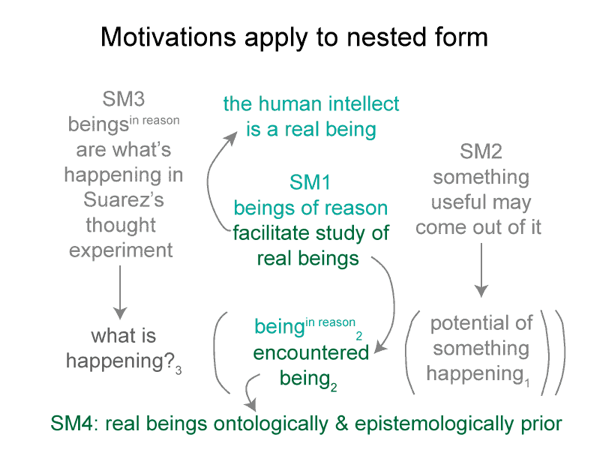
Suarez lists four suggestions:
SM1: ‘Beings of reason’ are studied in order to facilitate the understanding of real beings.
SM2: This study is useful in various ways.
SM3: This study investigates their nature, causes, division and attributes.
SM4: Real beings are ontologically and epistemologically prior to ‘beings of reason’.
0040 These motivations point to various features of the nested form in the previous figure.
0041 At the same time, the suggestions illuminate the nested form.
Am I correct in asserting the following?
The only real being that appears in this picture is the encountered being2a.
0042 Obviously not, the human intellect is also a real being.
So, what do I mean by the word “real”?
If by “real”, I mean to be regarded in the manner of being, then I may consider a beingin_reason to be real, even though it is a nonbeing. So, a beingin_reason is a real nonbeing. It is a nonbeing thought of in the manner of being. In the same way, being regarded in the manner of being is real being.
0043 To me, this suggests that the world “real” requires a mind. An intellect decides whether something is real (to be thought in the manner of being) or unreal (to not be thought in the manner of being). Indeed, an intellect situates the entire content-level nested form.
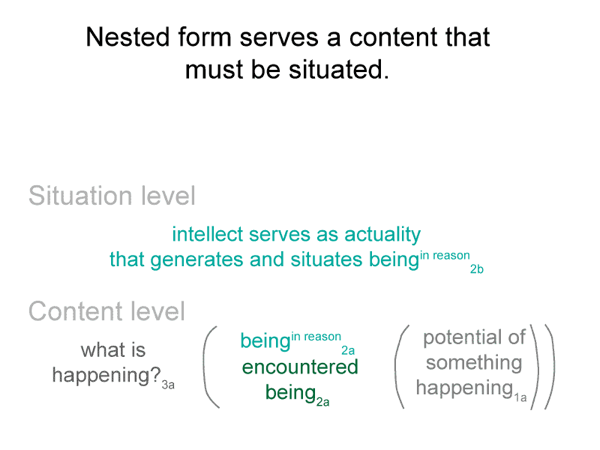
0044 So, the human intellect2b is a real being that situates the beingin_reason2a.
So, let me reconsider Suarez’s four motivations with the other real being in mind. Let me substitute the word “intellect” for “real beings” and rework the phrasing.
SM1: ‘Beings of reason’ are studied in order to facilitate understanding of the intellect (and encountered beings).
SM2: The study of beingsin reason is useful in various ways.
SM3: This study investigates their nature, causes, divisions and attributes.
SM4: The intellect and the encountered being are epistemologically and ontologically prior to ‘beings of reason’.
0045 This rewrite of Suarez’s suggestions enlarges my perspective.
There are two real beings in play: the encountered being2a and the intellect that situates the beingin_reason2a. The study of beingsin_reason is useful to understand both the real beings that we encounter2a and the human intellect2a. That understanding, which includes the nature, causes, divisions and attributes of beingsin_reason, puts both the situation-level intellect2b and the content-level actualities2a into perspective.
What does that imply?
There must be one more actuality. It is located on the perspective level.